Li Ou, English Karen, Tonlorenzi Rossana, Cossu Giulio, Saverio Tedesco Francesco, Wood Kathryn J
Transplantation Research Immunology Group, Nuffield Department of Surgical Sciences, University of Oxford, Oxford, UK.
Cellular Immunology Group, Institute of Immunology, National University of Ireland Maynooth, Co. Kildare, Ireland.
F1000Res. 2013 Jan 25;2:24. doi: 10.12688/f1000research.2-24.v1. eCollection 2013.
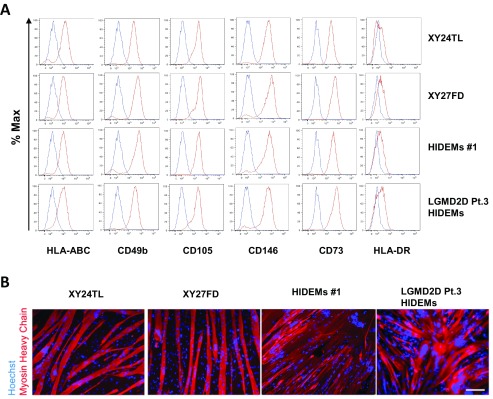
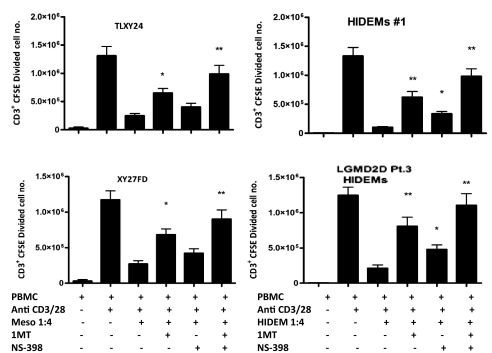
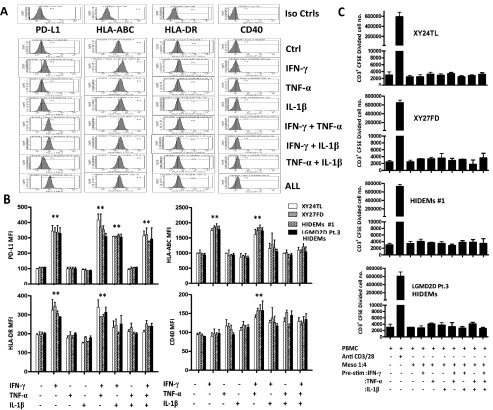
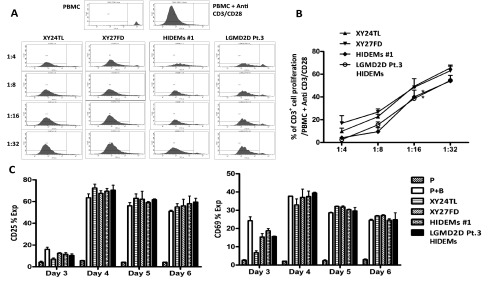
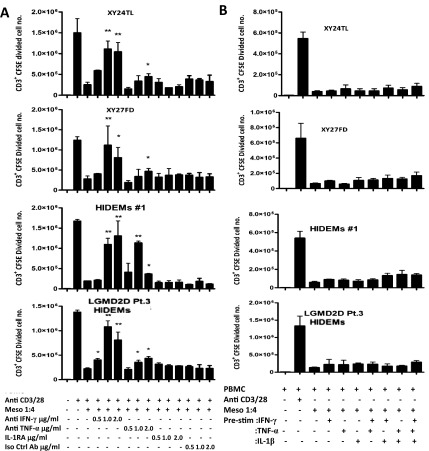
Human mesoangioblasts are currently in a phase I/II clinical trial for the treatment of patients with Duchenne muscular dystrophy. However, limitations associated with the finite life span of these cells combined with the significant numbers of mesoangioblasts required to treat all of the skeletal muscles in these patients restricts their therapeutic potential. Induced pluripotent stem cell (iPSC)-derived mesoangioblasts may provide the solution to this problem. Although, the idea of using iPSC-derived cell therapies has been proposed for quite some time, our understanding of how the immune system interacts with these cells is inadequate. Herein, we show that iPSC-derived mesoangioblasts (HIDEMs) from healthy donors and, importantly, limb-girdle muscular dystrophy 2D patients exert immunosuppressive effects on T cell proliferation. Interferon gamma (IFN-γ) and tumour necrosis factor alpha (TNF-α) play crucial roles in the initial activation of HIDEMs and importantly indoleamine 2,3 dioxygenase (IDO) and prostaglandin E2 (PGE-2) were identified as key mechanisms involved in HIDEM suppression of T cell proliferation. Together with recent studies confirming the myogenic function and regenerative potential of these cells, we suggest that HIDEMs could provide an unlimited alternative source for mesoangioblast-based therapies.
人源间充质血管祖细胞目前正处于治疗杜氏肌营养不良症患者的I/II期临床试验阶段。然而,这些细胞有限的寿命所带来的局限性,再加上治疗这些患者所有骨骼肌所需的大量间充质血管祖细胞,限制了它们的治疗潜力。诱导多能干细胞(iPSC)衍生的间充质血管祖细胞可能为解决这一问题提供办法。尽管使用iPSC衍生细胞疗法的想法已经提出了相当长的时间,但我们对免疫系统如何与这些细胞相互作用的了解还不够充分。在此,我们表明,来自健康供体以及重要的是来自2D型肢带型肌营养不良症患者的iPSC衍生间充质血管祖细胞(HIDEMs)对T细胞增殖具有免疫抑制作用。干扰素γ(IFN-γ)和肿瘤坏死因子α(TNF-α)在HIDEMs的初始激活中起关键作用,重要的是,吲哚胺2,3-双加氧酶(IDO)和前列腺素E2(PGE-2)被确定为HIDEMs抑制T细胞增殖所涉及的关键机制。连同最近证实这些细胞的成肌功能和再生潜力的研究,我们认为HIDEMs可为基于间充质血管祖细胞的疗法提供无限的替代来源。