Siderowf Andrew, Pontecorvo Michael J, Shill Holly A, Mintun Mark A, Arora Anupa, Joshi Abhinay D, Lu Ming, Adler Charles H, Galasko Douglas, Liebsack Carolyn, Skovronsky Daniel M, Sabbagh Marwan N
Banner Sun Health Research Institute, Sun City, AZ 10515W Santa Fe Dr, USA.
BMC Neurol. 2014 Apr 9;14:79. doi: 10.1186/1471-2377-14-79.
Biomarkers based on the underlying pathology of Alzheimer's disease (AD) and Dementia with Lewy Bodies (DLB) have the potential to improve diagnosis and understanding of the substrate for cognitive impairment in these disorders. The objective of this study was to compare the patterns of amyloid and dopamine PET imaging in patients with AD, DLB and Parkinson's disease (PD) using the amyloid imaging agent florbetapir F 18 and 18F-AV-133 (florbenazine), a marker for vesicular monamine type 2 transporters (VMAT2).
Patients with DLB and AD, Parkinson's disease (PD) and healthy controls (HC) were recruited for this study. On separate days, subjects received intravenous injections of florbetapir, and florbenazine. Amyloid burden and VMAT2 density were assessed quantitatively and by binary clinical interpretation. Imaging results for both tracers were compared across the four individual diagnostic groups and for combined groups based on underlying pathology (AD/DLB vs. PD/HC for amyloid burden and PD/DLB vs. AD/HC for VMAT binding) and correlated with measures of cognition and parkinsonism.
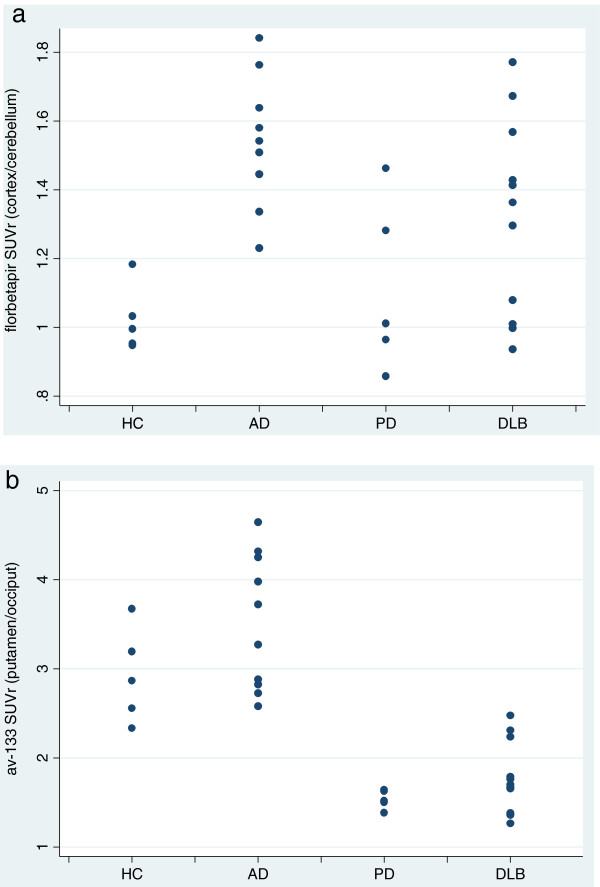
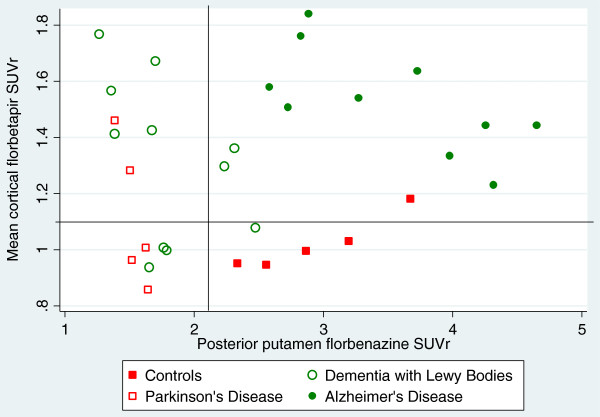
11 DLB, 10 AD, 5 PD, and 5 controls participated in the study. Amyloid binding was significantly higher in the combined AD/DLB patient group (n = 21) compared to the PD/HC groups (n = 10, mean SUVr: 1.42 vs. 1.07; p = 0.0006). VMAT2 density was significantly lower in the PD/DLB group (n = 16) compared to the AD/ HC group (n = 15; 1.83 vs. 2.97; p < 0.0001). Within the DLB group, there was a significant correlation between cognitive performance and striatal florbenazine binding (r = 0.73; p = 0.011).
The results of this study show significant differences in both florbetapir and florbenazine imaging that are consistent with expected pathology. In addition, VMAT density correlated significantly with cognitive impairment in DLB patients (ClinicalTrials.gov identifier: NCT00857506, registered March 5, 2009).
基于阿尔茨海默病(AD)和路易体痴呆(DLB)潜在病理机制的生物标志物,有可能改善对这些疾病中认知障碍的诊断和对其病理基础的理解。本研究的目的是使用淀粉样蛋白成像剂氟代吡咯 F 18 和 18F - AV - 133(氟苯嗪,一种囊泡单胺转运体 2(VMAT2)的标志物),比较 AD、DLB 和帕金森病(PD)患者的淀粉样蛋白和多巴胺 PET 成像模式。
招募 DLB 和 AD 患者、帕金森病(PD)患者及健康对照(HC)参与本研究。在不同日期,受试者接受氟代吡咯和氟苯嗪的静脉注射。通过定量分析和二元临床解读评估淀粉样蛋白负荷和 VMAT2 密度。比较两种示踪剂在四个个体诊断组以及基于潜在病理机制的合并组(淀粉样蛋白负荷方面为 AD/DLB 与 PD/HC 比较,VMAT 结合方面为 PD/DLB 与 AD/HC 比较)的成像结果,并与认知和帕金森症状的测量指标相关联。
11 名 DLB 患者、10 名 AD 患者、5 名 PD 患者和 5 名对照参与了研究。与 PD/HC 组(n = 10)相比,AD/DLB 合并患者组(n = 21)的淀粉样蛋白结合显著更高(平均 SUVr:1.42 对 1.07;p = 0.0006)。与 AD/HC 组(n = 15)相比,PD/DLB 组(n = 16)的 VMAT2 密度显著更低(1.83 对 2.97;p < 0.0001)。在 DLB 组内认知表现与纹状体氟苯嗪结合之间存在显著相关性(r = 0.73;p = 0.011)。
本研究结果显示氟代吡咯和氟苯嗪成像均存在显著差异,这与预期病理相符。此外,VMAT 密度与 DLB 患者的认知障碍显著相关(ClinicalTrials.gov 标识符:NCT00857506,2009 年 3 月 5 日注册)。