Bashir Mustafa R, Breault Steven R, Braun Ryan, Do Richard K, Nelson Rendon C, Reeder Scott B
Department of Radiology, Duke University Medical Center, DUMC 3808, Durham, NC 27710.
Department of Radiology, Duke University Medical Center, DUMC 3808, Durham, NC 27710.
Acad Radiol. 2014 Jun;21(6):726-32. doi: 10.1016/j.acra.2014.02.005. Epub 2014 Apr 6.
To evaluate clinical and imaging features associated with adequacy of the hepatocyte phase (HP) in gadoxetate disodium-enhanced liver magnetic resonance imaging (MRI) in patients without chronic liver disease (CLD).
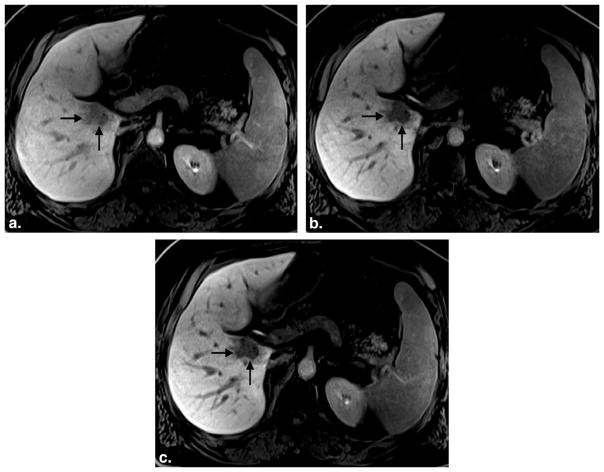
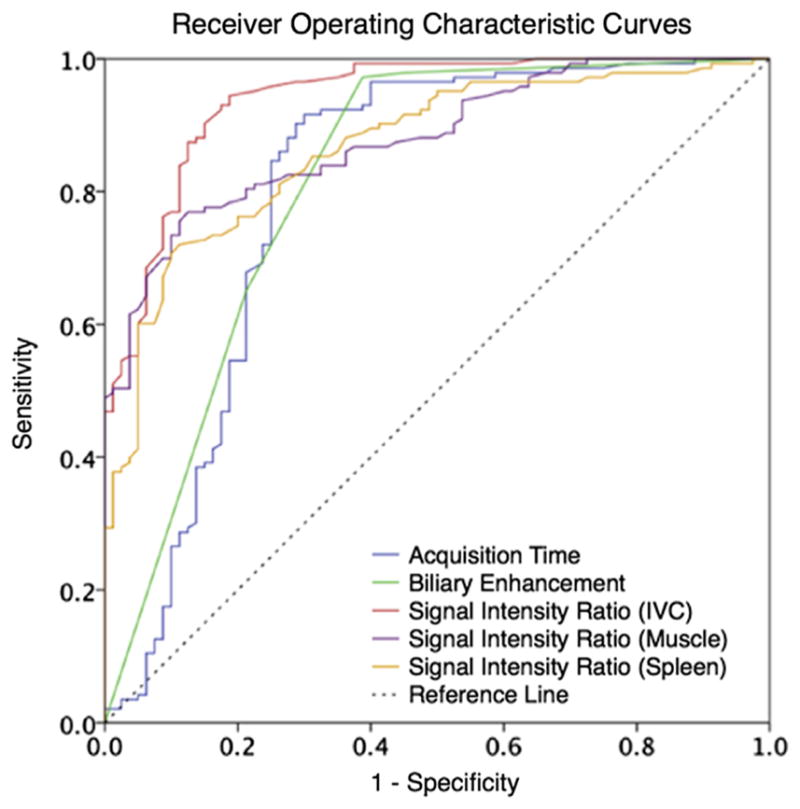
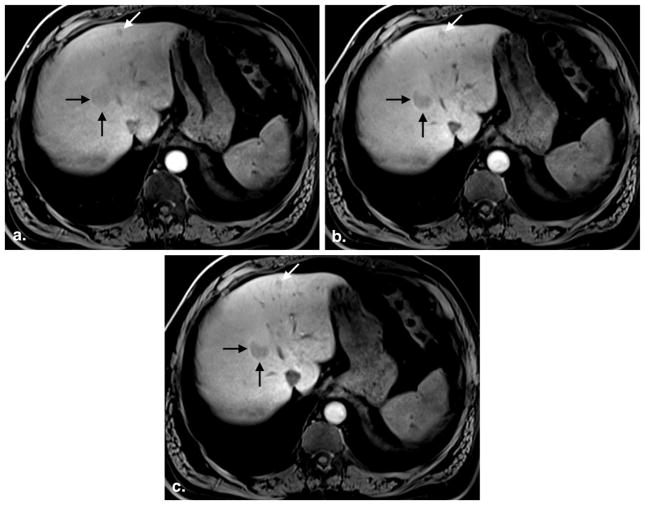
This was a retrospective institutional review board-approved study of 97 patients who underwent liver MRI examinations with gadoxetate disodium and had no history of CLD. Available late dynamic and HP sequences (3-20 minutes postinjection) were independently analyzed by four radiologists for perceived image adequacy and level of biliary enhancement. Signal intensity ratios (SIRs) of liver/inferior vena cava (IVC), liver/spleen, and liver/muscle were measured. The Spearman ρ and receiver operating characteristic analyses were performed correlating various factors with HP adequacy. A rule for predicting HP adequacy was also derived and tested to determine whether overall examination time could be shortened.
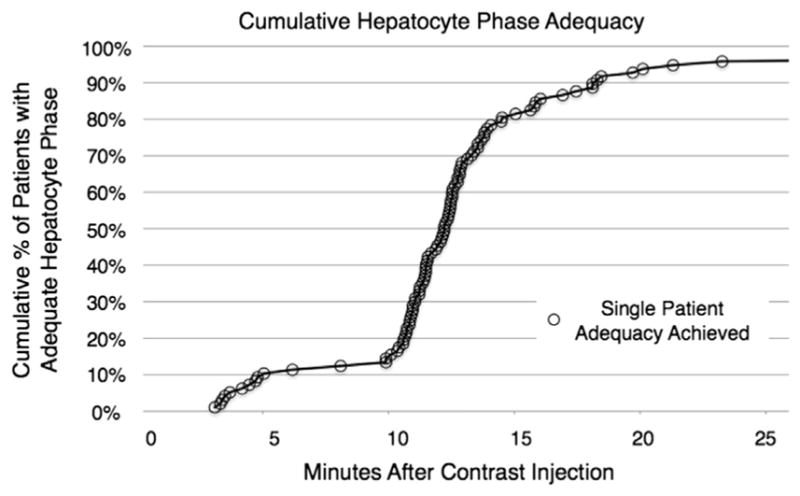
A visually adequate HP was observed in 12% of subjects by 10 minutes, 80% by 15 minutes, and 93% by 20 minutes. An SIRliver/IVC > 1.8 was the imaging feature that had the strongest correlation with an adequate HP (ρ = 0.813, P < .001), and was more predictive of adequacy of the HP than the time postinjection (ρ = 0.5, P < .001). The time at which an adequate HP was first observed did not correlate with any tested demographic or laboratory values. Stopping imaging when an SIRliver/IVC > 1.8 would have successfully reduced mean postcontrast time to 15:39 ± 4:02 from 20:00 (P < .001), although maintaining HP adequacy.
Most patients without CLD undergoing gadoxetate-enhanced liver MRI achieve adequate HP at 20 minutes. However, a shorter postcontrast stopping time can be used in most patients.
评估无慢性肝病(CLD)患者使用钆塞酸二钠增强肝脏磁共振成像(MRI)时,与肝细胞期(HP)充分性相关的临床和影像特征。
这是一项经机构审查委员会批准的回顾性研究,纳入了97例接受钆塞酸二钠肝脏MRI检查且无CLD病史的患者。4名放射科医生独立分析可用的延迟动态序列和HP序列(注射后3 - 20分钟),评估图像质量和胆管强化程度。测量肝脏/下腔静脉(IVC)、肝脏/脾脏和肝脏/肌肉的信号强度比(SIR)。进行Spearman ρ分析和受试者操作特征分析,将各种因素与HP充分性进行关联。还推导并测试了预测HP充分性的规则,以确定是否可以缩短整体检查时间。
10分钟时,12%的受试者HP视觉质量良好;15分钟时,80%的受试者HP视觉质量良好;20分钟时,93%的受试者HP视觉质量良好。SIRliver/IVC > 1.8是与HP充分性相关性最强的影像特征(ρ = 0.813,P <.001),比注射后时间更能预测HP的充分性(ρ = 0.5,P <.001)。首次观察到HP充分的时间与任何测试的人口统计学或实验室值均无相关性。当SIRliver/IVC > 1.8时停止成像,虽然能保持HP充分性,但可成功将平均造影后时间从20:00缩短至15:39 ± 4:02(P <.001)。
大多数无CLD的患者在接受钆塞酸增强肝脏MRI检查时,20分钟时可获得充分的HP。然而,大多数患者可以使用更短的造影后停止时间。