Kooij Pepijn W, Liberti Joanito, Giampoudakis Konstantinos, Schiøtt Morten, Boomsma Jacobus J
Centre for Social Evolution, Department of Biology, University of Copenhagen, Copenhagen, Denmark.
PLoS One. 2014 Apr 9;9(4):e94284. doi: 10.1371/journal.pone.0094284. eCollection 2014.
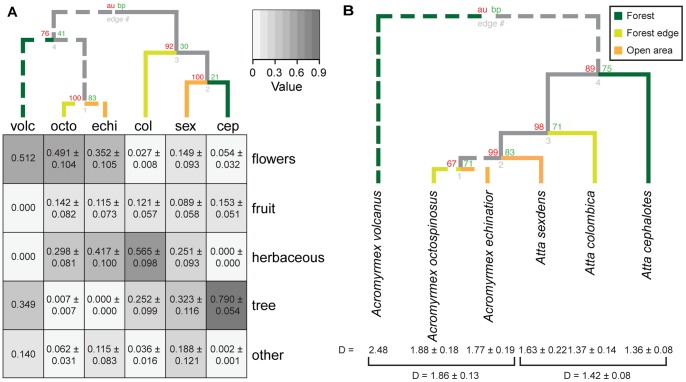
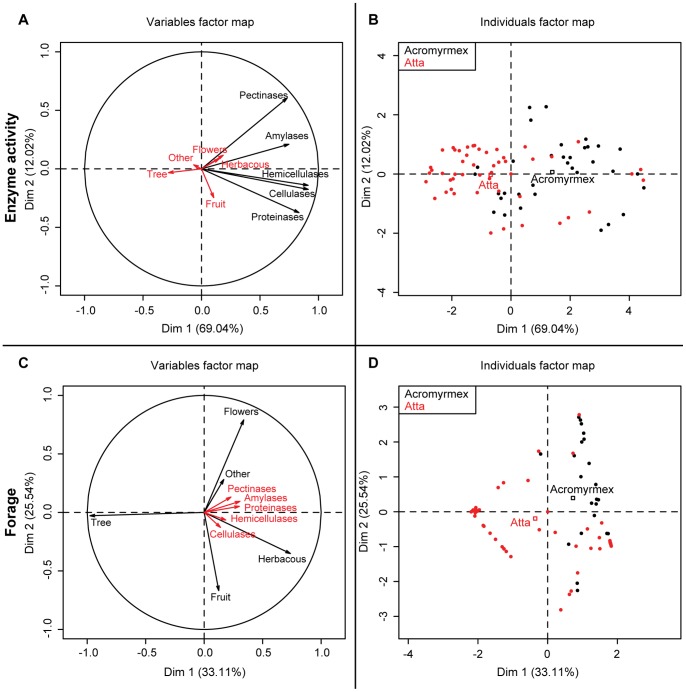
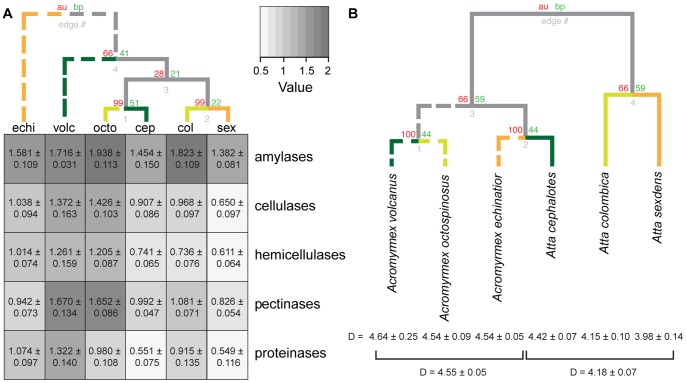
The genera Atta and Acromyrmex are often grouped as leaf-cutting ants for pest management assessments and ecological surveys, although their mature colony sizes and foraging niches may differ substantially. Few studies have addressed such interspecific differences at the same site, which prompted us to conduct a comparative study across six sympatric leaf-cutting ant species in Central Panama. We show that foraging rates during the transition between dry and wet season differ about 60 fold between genera, but are relatively constant across species within genera. These differences appear to match overall differences in colony size, especially when Atta workers that return to their nests without leaves are assumed to carry liquid food. We confirm that Panamanian Atta specialize primarily on tree-leaves whereas Acromyrmex focus on collecting flowers and herbal leaves and that species within genera are similar in these overall foraging strategies. Species within genera tended to be spaced out over the three habitat categories that we distinguished (forest, forest edge, open grassland), but each of these habitats normally had only a single predominant Atta and Acromyrmex species. We measured activities of twelve fungus garden decomposition enzymes, belonging to the amylases, cellulases, hemicellulases, pectinases and proteinases, and show that average enzyme activity per unit of fungal mass in Atta gardens is lower than in Acromyrmex gardens. Expression profiles of fungal enzymes in Atta also appeared to be more specialized than in Acromyrmex, possibly reflecting variation in forage material. Our results suggest that species- and genus-level identities of leaf-cutting ants and habitat-specific foraging profiles may give predictable differences in the expression of fungal genes coding for decomposition enzymes.
在害虫管理评估和生态调查中,切叶蚁属(Atta)和顶切叶蚁属(Acromyrmex)通常被归为切叶蚁,尽管它们成熟蚁群的规模和觅食生态位可能有很大差异。很少有研究在同一地点探讨这种种间差异,这促使我们在巴拿马中部对六种同域分布的切叶蚁进行比较研究。我们发现,旱季和雨季过渡期间,不同属的觅食率相差约60倍,但同一属内的不同物种觅食率相对恒定。这些差异似乎与蚁群规模的总体差异相匹配,特别是当假设返回巢穴时未携带树叶的切叶蚁属工蚁携带液体食物时。我们证实,巴拿马的切叶蚁属主要以树叶为食,而顶切叶蚁属则专注于采集花朵和草本植物叶子,并且同一属内的物种在这些总体觅食策略上相似。同一属内的物种往往分布在我们区分的三种栖息地类型(森林、森林边缘、开阔草地)中,但每个栖息地通常只有一种占主导地位的切叶蚁属和顶切叶蚁属物种。我们测量了属于淀粉酶、纤维素酶、半纤维素酶、果胶酶和蛋白酶的12种真菌菌圃分解酶的活性,结果表明,切叶蚁属菌圃中每单位真菌质量的平均酶活性低于顶切叶蚁属菌圃。切叶蚁属中真菌酶的表达谱似乎也比顶切叶蚁属更具特异性,这可能反映了觅食材料的差异。我们的结果表明,切叶蚁的物种和属水平特征以及特定栖息地的觅食模式可能会导致编码分解酶的真菌基因表达出现可预测的差异。