• 文献检索
  • 文档翻译
  • 深度研究
  • 学术资讯
  • Suppr Zotero 插件Zotero 插件
  • 邀请有礼
  • 套餐&价格
  • 历史记录
应用&插件
Suppr Zotero 插件Zotero 插件浏览器插件Mac 客户端Windows 客户端微信小程序
定价
高级版会员购买积分包购买API积分包
服务
文献检索文档翻译深度研究API 文档MCP 服务
关于我们
关于 Suppr公司介绍联系我们用户协议隐私条款
关注我们

Suppr 超能文献

核心技术专利:CN118964589B侵权必究
粤ICP备2023148730 号-1Suppr @ 2026

文献检索

告别复杂PubMed语法,用中文像聊天一样搜索,搜遍4000万医学文献。AI智能推荐,让科研检索更轻松。

立即免费搜索

文件翻译

保留排版,准确专业,支持PDF/Word/PPT等文件格式,支持 12+语言互译。

免费翻译文档

深度研究

AI帮你快速写综述,25分钟生成高质量综述,智能提取关键信息,辅助科研写作。

立即免费体验

志贺氏菌 3 型效应蛋白 IpgB1 的多功能区域对于细菌的分泌和真核细胞中的膜靶向都很重要。

A multifunctional region of the Shigella type 3 effector IpgB1 is important for secretion from bacteria and membrane targeting in eukaryotic cells.

机构信息

Department of Medicine (Microbiology and Immunobiology), Division of Infectious Diseases, Massachusetts General Hospital and Harvard Medical School, Cambridge, Massachusetts, United States of America.

出版信息

PLoS One. 2014 Apr 9;9(4):e93461. doi: 10.1371/journal.pone.0093461. eCollection 2014.

DOI:10.1371/journal.pone.0093461
PMID:24718571
原文链接:https://pmc.ncbi.nlm.nih.gov/articles/PMC3981709/
Abstract

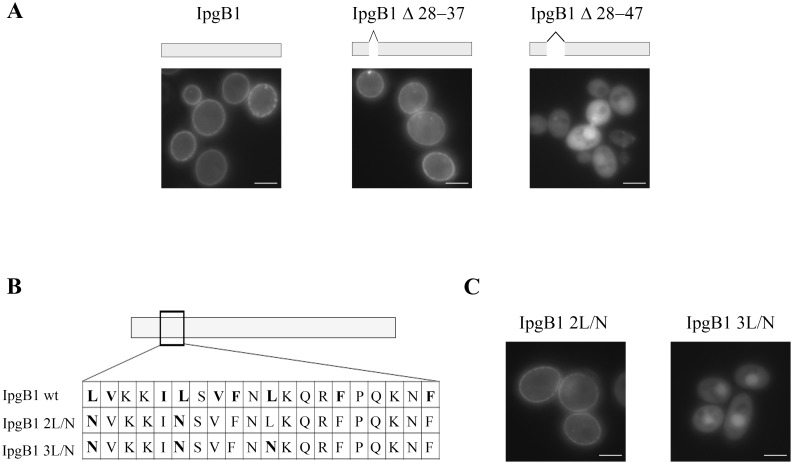
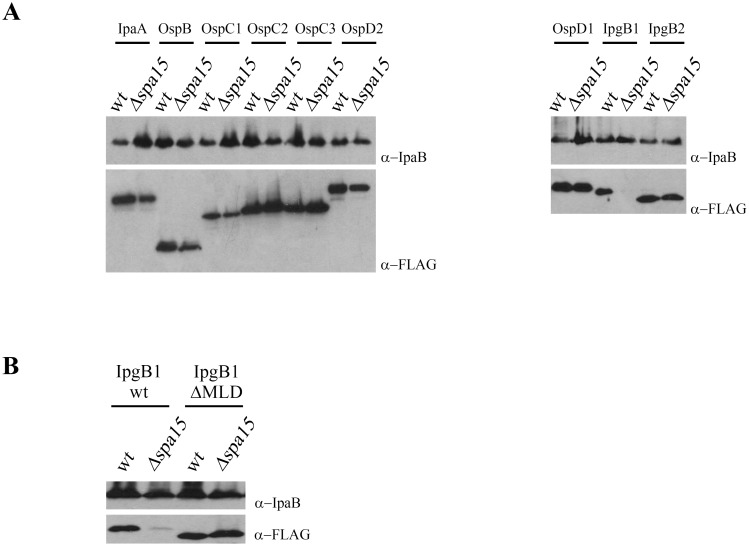
Type 3 secretion systems are complex nanomachines used by many Gram-negative bacteria to deliver tens of proteins (effectors) directly into host cells. Once delivered into host cells, effectors often target to specific cellular loci where they usurp host cell processes to their advantage. Here, using the yeast model system, we identify the membrane localization domain (MLD) of IpgB1, a stretch of 20 amino acids enriched for hydrophobic residues essential for the targeting of this effector to the plasma membrane. Embedded within these residues are ten that define the IpgB1 chaperone-binding domain for Spa15. As observed with dedicated class IA chaperones that mask hydrophobic MLDs, Spa15, a class IB chaperone, promotes IpgB1 stability by binding this hydrophobic region. However, despite being stable, an IpgB1 allele that lacks the MLD is not recognized as a secreted substrate. Similarly, deletion of the chaperone binding domains of IpgB1 and three additional Spa15-dependent effectors result in alleles that are no longer recognized as secreted substrates despite the presence of intact N-terminal secretion signal sequences. This is in contrast with MLD-containing effectors that bind class IA dedicated chaperones, as deletion of the MLD of these effectors alleviates the chaperone requirement for secretion. These observations indicate that at least for substrates of class IB chaperones, the chaperone-effector complex plays a major role in defining type 3 secreted proteins and highlight how a single region of an effector can play important roles both within prokaryotic and eukaryotic cells.

摘要

III 型分泌系统是一种复杂的纳米机器,许多革兰氏阴性菌利用它将数十种蛋白质(效应蛋白)直接输送到宿主细胞中。一旦进入宿主细胞,效应蛋白通常会靶向特定的细胞位置,在那里它们篡夺宿主细胞的过程以获取优势。在这里,我们使用酵母模型系统,确定了 IpgB1 的膜定位结构域(MLD),这是一段富含疏水性残基的 20 个氨基酸序列,对于将这种效应蛋白靶向质膜是必不可少的。在这些残基中,有十个残基定义了 IpgB1 的 Spa15 伴侣结合域。正如专门的 IA 类伴侣蛋白掩盖疏水性 MLD 所观察到的那样,Spa15 作为 IB 类伴侣蛋白,通过结合这个疏水区促进 IpgB1 的稳定性。然而,尽管 IpgB1 等位基因稳定,但缺乏 MLD 的等位基因不会被识别为分泌底物。同样,缺失 IpgB1 和三个额外的 Spa15 依赖性效应物的伴侣结合域会导致等位基因不再被识别为分泌底物,尽管存在完整的 N 端分泌信号序列。这与含有 MLD 的效应物形成对比,这些效应物结合 IA 类专门的伴侣蛋白,因为这些效应物的 MLD 缺失减轻了伴侣蛋白对分泌的需求。这些观察结果表明,至少对于 IB 类伴侣蛋白的底物,伴侣-效应物复合物在定义 III 型分泌蛋白方面起着重要作用,并强调了效应物的一个单一区域如何在原核和真核细胞中发挥重要作用。

https://cdn.ncbi.nlm.nih.gov/pmc/blobs/e072/3981709/d0aca0deb028/pone.0093461.g005.jpg
https://cdn.ncbi.nlm.nih.gov/pmc/blobs/e072/3981709/4dfa66b966cc/pone.0093461.g001.jpg
https://cdn.ncbi.nlm.nih.gov/pmc/blobs/e072/3981709/d43e6247b5a5/pone.0093461.g002.jpg
https://cdn.ncbi.nlm.nih.gov/pmc/blobs/e072/3981709/eb4ceb385e5f/pone.0093461.g003.jpg
https://cdn.ncbi.nlm.nih.gov/pmc/blobs/e072/3981709/fbeeda887d80/pone.0093461.g004.jpg
https://cdn.ncbi.nlm.nih.gov/pmc/blobs/e072/3981709/d0aca0deb028/pone.0093461.g005.jpg
https://cdn.ncbi.nlm.nih.gov/pmc/blobs/e072/3981709/4dfa66b966cc/pone.0093461.g001.jpg
https://cdn.ncbi.nlm.nih.gov/pmc/blobs/e072/3981709/d43e6247b5a5/pone.0093461.g002.jpg
https://cdn.ncbi.nlm.nih.gov/pmc/blobs/e072/3981709/eb4ceb385e5f/pone.0093461.g003.jpg
https://cdn.ncbi.nlm.nih.gov/pmc/blobs/e072/3981709/fbeeda887d80/pone.0093461.g004.jpg
https://cdn.ncbi.nlm.nih.gov/pmc/blobs/e072/3981709/d0aca0deb028/pone.0093461.g005.jpg

相似文献

1
A multifunctional region of the Shigella type 3 effector IpgB1 is important for secretion from bacteria and membrane targeting in eukaryotic cells.志贺氏菌 3 型效应蛋白 IpgB1 的多功能区域对于细菌的分泌和真核细胞中的膜靶向都很重要。
PLoS One. 2014 Apr 9;9(4):e93461. doi: 10.1371/journal.pone.0093461. eCollection 2014.
2
Shigella flexneri Spa15 crystal structure verified in solution by double electron electron resonance.痢疾志贺氏菌 Spa15 在溶液中的双电子电子顺磁共振结构验证。
J Mol Biol. 2011 Jan 14;405(2):427-35. doi: 10.1016/j.jmb.2010.10.053. Epub 2010 Nov 12.
3
IpgB1 and IpgB2, two homologous effectors secreted via the Mxi-Spa type III secretion apparatus, cooperate to mediate polarized cell invasion and inflammatory potential of Shigella flexenri.IpgB1和IpgB2是通过Mxi-Spa III型分泌系统分泌的两种同源效应蛋白,它们协同介导弗氏志贺菌的极化细胞侵袭和炎症潜能。
Microbes Infect. 2008 Mar;10(3):260-8. doi: 10.1016/j.micinf.2007.11.011. Epub 2007 Dec 8.
4
A new means to identify type 3 secreted effectors: functionally interchangeable class IB chaperones recognize a conserved sequence.一种鉴定 III 型分泌效应子的新方法:功能可互换的 I 类分子伴侣识别保守序列。
mBio. 2012 Feb 14;3(1). doi: 10.1128/mBio.00243-11. Print 2012.
5
Spa15 of Shigella flexneri, a third type of chaperone in the type III secretion pathway.福氏志贺菌的Spa15,III型分泌途径中的第三种伴侣蛋白。
Mol Microbiol. 2002 Mar;43(6):1533-42. doi: 10.1046/j.1365-2958.2002.02835.x.
6
Structure of Spa15, a type III secretion chaperone from Shigella flexneri with broad specificity.宋内志贺菌III型分泌分子伴侣Spa15的结构,具有广泛特异性。
EMBO Rep. 2004 May;5(5):477-83. doi: 10.1038/sj.embor.7400144. Epub 2004 Apr 16.
7
High-Throughput Screening of Type III Secretion Determinants Reveals a Major Chaperone-Independent Pathway.高通量筛选 III 型分泌系统决定因子揭示主要的伴侣蛋白非依赖途径。
mBio. 2018 Jun 19;9(3):e01050-18. doi: 10.1128/mBio.01050-18.
8
IpgB1 is a novel Shigella effector protein involved in bacterial invasion of host cells. Its activity to promote membrane ruffling via Rac1 and Cdc42 activation.IpgB1是一种新型的志贺氏菌效应蛋白,参与细菌对宿主细胞的侵袭。它通过激活Rac1和Cdc42来促进膜皱褶形成的活性。
J Biol Chem. 2005 Jun 24;280(25):24022-34. doi: 10.1074/jbc.M502509200. Epub 2005 Apr 22.
9
The type three secretion system effector protein IpgB1 promotes Shigella flexneri cell-to-cell spread through double-membrane vacuole escape.III 型分泌系统效应蛋白 IpgB1 通过逃离双层膜囊泡促进福氏志贺菌细胞间扩散。
PLoS Pathog. 2022 Feb 24;18(2):e1010380. doi: 10.1371/journal.ppat.1010380. eCollection 2022 Feb.
10
A systematic exploration of the interactions between bacterial effector proteins and host cell membranes.系统性探索细菌效应蛋白与宿主细胞膜之间的相互作用。
Nat Commun. 2017 Sep 14;8(1):532. doi: 10.1038/s41467-017-00700-7.

引用本文的文献

1
The Spp. Type III Effector Protein OspB Is a Cysteine Protease.Spp. Ⅲ型效应蛋白 OspB 是一种半胱氨酸蛋白酶。
mBio. 2022 Jun 28;13(3):e0127022. doi: 10.1128/mbio.01270-22. Epub 2022 May 31.
2
Phosphatidic acid-mediated binding and mammalian cell internalization of the Vibrio cholerae cytotoxin MakA.磷脂酸介导的霍乱弧菌细胞毒素 MakA 的结合和哺乳动物细胞内化。
PLoS Pathog. 2021 Mar 18;17(3):e1009414. doi: 10.1371/journal.ppat.1009414. eCollection 2021 Mar.
3
High-Throughput Screening of Type III Secretion Determinants Reveals a Major Chaperone-Independent Pathway.

本文引用的文献

1
Bacterial toxin effector-membrane targeting: outside in, then back again.细菌毒素效应子-膜靶向:从外向内,再从内向外。
Front Cell Infect Microbiol. 2012 May 31;2:75. doi: 10.3389/fcimb.2012.00075. eCollection 2012.
2
A new means to identify type 3 secreted effectors: functionally interchangeable class IB chaperones recognize a conserved sequence.一种鉴定 III 型分泌效应子的新方法:功能可互换的 I 类分子伴侣识别保守序列。
mBio. 2012 Feb 14;3(1). doi: 10.1128/mBio.00243-11. Print 2012.
3
Subcellular targeting of Salmonella virulence proteins by host-mediated S-palmitoylation.
高通量筛选 III 型分泌系统决定因子揭示主要的伴侣蛋白非依赖途径。
mBio. 2018 Jun 19;9(3):e01050-18. doi: 10.1128/mBio.01050-18.
4
Detection of Cytosolic via a C-Terminal Triple-Arginine Motif of GBP1 Inhibits Actin-Based Motility.通过 GBP1 的 C 末端三精氨酸基序检测细胞质,抑制基于肌动蛋白的运动。
mBio. 2017 Dec 12;8(6):e01979-17. doi: 10.1128/mBio.01979-17.
5
A systematic exploration of the interactions between bacterial effector proteins and host cell membranes.系统性探索细菌效应蛋白与宿主细胞膜之间的相互作用。
Nat Commun. 2017 Sep 14;8(1):532. doi: 10.1038/s41467-017-00700-7.
6
Intermediate filaments enable pathogen docking to trigger type 3 effector translocation.中间丝使病原体附着并触发 3 型效应子易位。
Nat Microbiol. 2016 Mar 7;1:16025. doi: 10.1038/nmicrobiol.2016.25.
通过宿主介导的 S-棕榈酰化作用实现沙门氏菌毒力蛋白的亚细胞靶向。
Cell Host Microbe. 2011 Jul 21;10(1):9-20. doi: 10.1016/j.chom.2011.06.003.
4
Coiled-coil domains enhance the membrane association of Salmonella type III effectors.螺旋卷曲结构域增强沙门氏菌 III 型效应蛋白与膜的结合。
Cell Microbiol. 2011 Oct;13(10):1497-517. doi: 10.1111/j.1462-5822.2011.01635.x. Epub 2011 Jul 11.
5
A solvent-exposed patch in chaperone-bound YopE is required for translocation by the type III secretion system.伴侣蛋白结合的 YopE 中的溶剂暴露补丁是 III 型分泌系统易位所必需的。
J Bacteriol. 2010 Jun;192(12):3114-22. doi: 10.1128/JB.00113-10. Epub 2010 Apr 9.
6
Structure of Shigella IpgB2 in complex with human RhoA: implications for the mechanism of bacterial guanine nucleotide exchange factor mimicry.Shigella IpgB2 与人 RhoA 复合物的结构:对细菌鸟嘌呤核苷酸交换因子模拟机制的启示。
J Biol Chem. 2010 May 28;285(22):17197-208. doi: 10.1074/jbc.M110.107953. Epub 2010 Apr 2.
7
The membrane localization domain is required for intracellular localization and autoregulation of YopE in Yersinia pseudotuberculosis.膜定位结构域对于耶尔森氏菌假结核亚种中YopE的细胞内定位和自我调节是必需的。
Infect Immun. 2009 Nov;77(11):4740-9. doi: 10.1128/IAI.00333-09. Epub 2009 Aug 17.
8
The Bordetella type III secretion system effector BteA contains a conserved N-terminal motif that guides bacterial virulence factors to lipid rafts.博德特氏菌 III 型分泌系统效应蛋白 BteA 含有一个保守的 N 端基序,该基序可将细菌毒力因子引导至脂筏。
Cell Microbiol. 2009 Dec;11(12):1735-49. doi: 10.1111/j.1462-5822.2009.01361.x. Epub 2009 Jul 24.
9
Structural insights into host GTPase isoform selection by a family of bacterial GEF mimics.细菌GEF模拟物家族对宿主GTPase亚型选择的结构见解。
Nat Struct Mol Biol. 2009 Aug;16(8):853-60. doi: 10.1038/nsmb.1647. Epub 2009 Jul 20.
10
Protein interaction platforms: visualization of interacting proteins in yeast.蛋白质相互作用平台:酵母中相互作用蛋白质的可视化
Nat Methods. 2009 Jul;6(7):500-2. doi: 10.1038/nmeth.1337. Epub 2009 May 31.