Song Juhyun, Hur Bo Eun, Bokara Kiran Kumar, Yang Wonsuk, Cho Hyun Jin, Park Kyung Ah, Lee Won Taek, Lee Kyoung Min, Lee Jong Eun
Department of Anatomy, Yonsei University College of Medicine, Seoul, Korea.
Department of Anatomy, Yonsei University College of Medicine, Seoul, Korea. ; Brain Korea 21 Plus Project for Medical Science, Brain Research Institute, Yonsei University College of Medicine, Seoul, Korea.
Yonsei Med J. 2014 May;55(3):689-99. doi: 10.3349/ymj.2014.55.3.689. Epub 2014 Apr 1.
Alzheimer's disease (AD) results in memory impairment and neuronal cell death in the brain. Previous studies demonstrated that intracerebroventricular administration of streptozotocin (STZ) induces pathological and behavioral alterations similar to those observed in AD. Agmatine (Agm) has been shown to exert neuroprotective effects in central nervous system disorders. In this study, we investigated whether Agm treatment could attenuate apoptosis and improve cognitive decline in a STZ-induced Alzheimer rat model.
We studied the effect of Agm on AD pathology using a STZ-induced Alzheimer rat model. For each experiment, rats were given anesthesia (chloral hydrate 300 mg/kg, ip), followed by a single injection of STZ (1.5 mg/kg) bilaterally into each lateral ventricle (5 μL/ventricle). Rats were injected with Agm (100 mg/kg) daily up to two weeks from the surgery day.
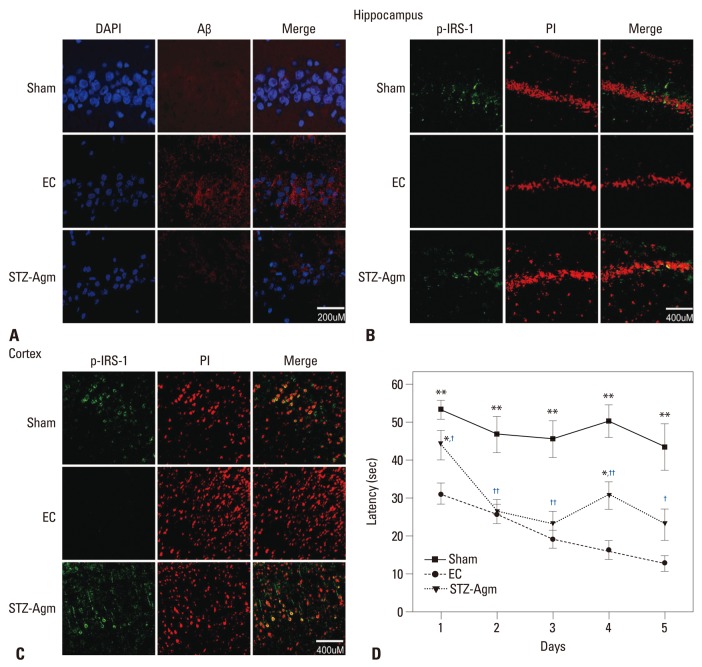
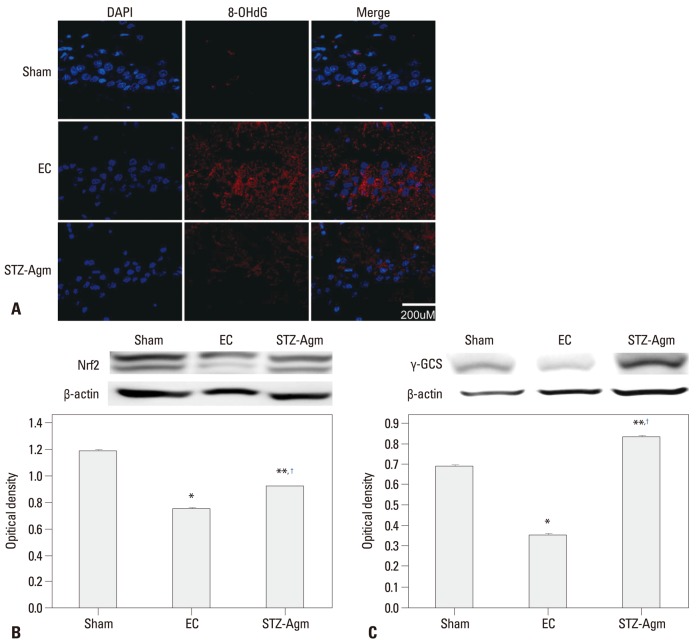
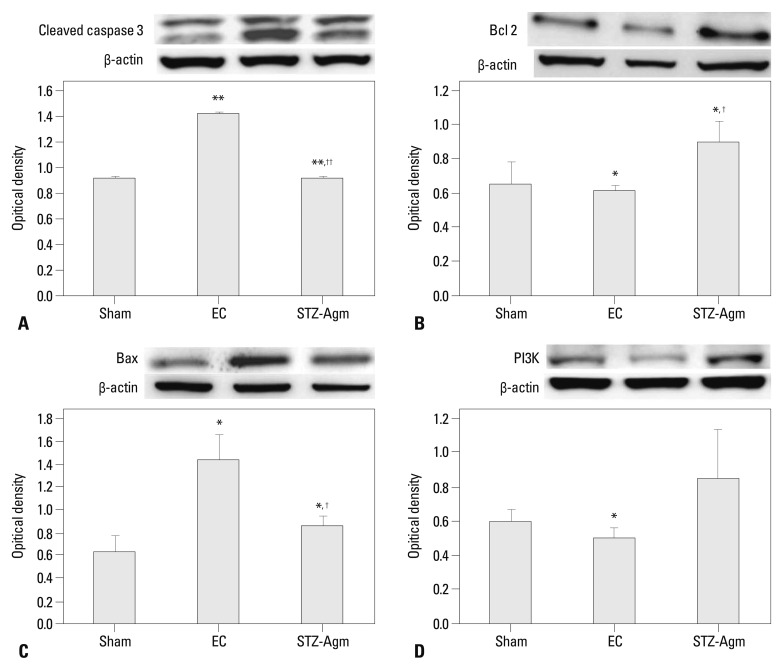
Agm suppressed the accumulation of amyloid beta and enhanced insulin signal transduction in STZ-induced Alzheimer rats [experimetal control (EC) group]. Upon evaluation of cognitive function by Morris water maze testing, significant improvement of learning and memory dysfunction in the STZ-Agm group was observed compared with the EC group. Western blot results revealed significant attenuation of the protein expressions of cleaved caspase-3 and Bax, as well as increases in the protein expressions of Bcl2, PI3K, Nrf2, and γ-glutamyl cysteine synthetase, in the STZ-Agm group.
Our results showed that Agm is involved in the activation of antioxidant signaling pathways and activation of insulin signal transduction. Accordingly, Agm may be a promising therapeutic agent for improving cognitive decline and attenuating apoptosis in AD.
阿尔茨海默病(AD)会导致记忆障碍和大脑中的神经元细胞死亡。先前的研究表明,脑室内注射链脲佐菌素(STZ)会诱发与AD中观察到的类似的病理和行为改变。胍丁胺(Agm)已被证明在中枢神经系统疾病中发挥神经保护作用。在本研究中,我们调查了Agm治疗是否可以减轻STZ诱导的阿尔茨海默病大鼠模型中的细胞凋亡并改善认知功能下降。
我们使用STZ诱导的阿尔茨海默病大鼠模型研究了Agm对AD病理的影响。对于每个实验,大鼠接受麻醉(水合氯醛300mg/kg,腹腔注射),然后双侧向每个侧脑室单次注射STZ(1.5mg/kg)(5μL/脑室)。从手术日起,大鼠每天注射Agm(100mg/kg),持续两周。
在STZ诱导的阿尔茨海默病大鼠[实验对照组(EC)]中,Agm抑制了β淀粉样蛋白的积累并增强了胰岛素信号转导。通过莫里斯水迷宫测试评估认知功能时,与EC组相比,观察到STZ-Agm组的学习和记忆功能障碍有显著改善。蛋白质印迹结果显示,STZ-Agm组中裂解的半胱天冬酶-3和Bax的蛋白质表达显著减弱,以及Bcl2、PI3K、Nrf2和γ-谷氨酰半胱氨酸合成酶的蛋白质表达增加。
我们的结果表明,Agm参与抗氧化信号通路的激活和胰岛素信号转导的激活。因此,Agm可能是一种有前途的治疗药物,用于改善AD中的认知功能下降和减轻细胞凋亡。