Algorri José Francisco, Urruchi Virginia, Bennis Noureddine, Sánchez-Pena José Manuel
Display and Photonic Applications Group, Electronic Technology Department, Carlos III University, Butarque 15, 28911 Leganés, Madrid, Spain.
CEMDATIC, ETSI, Polytechnic University of Madrid, Ciudad Universitaria, 28040 Madrid, Spain.
Sensors (Basel). 2014 Apr 9;14(4):6571-83. doi: 10.3390/s140406571.
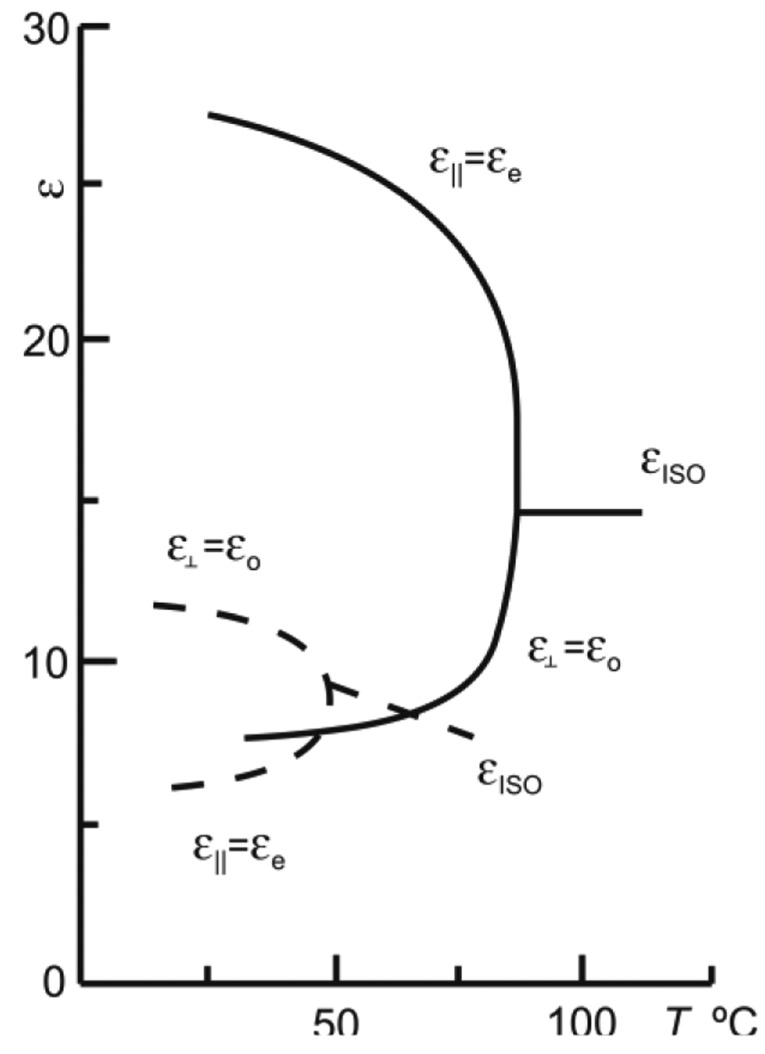
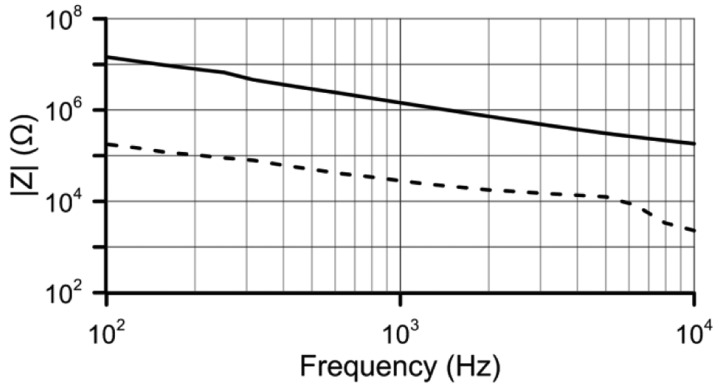
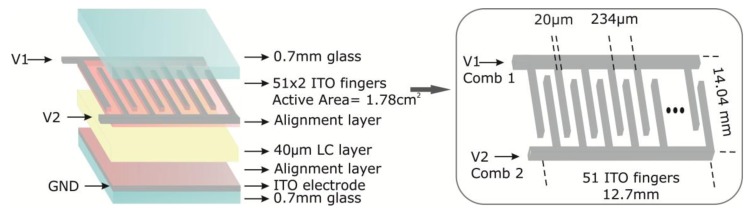
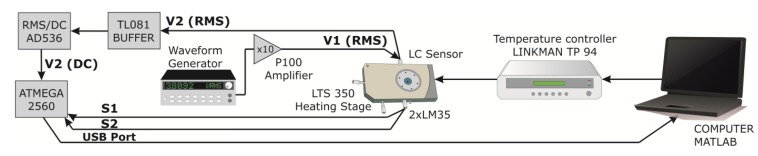
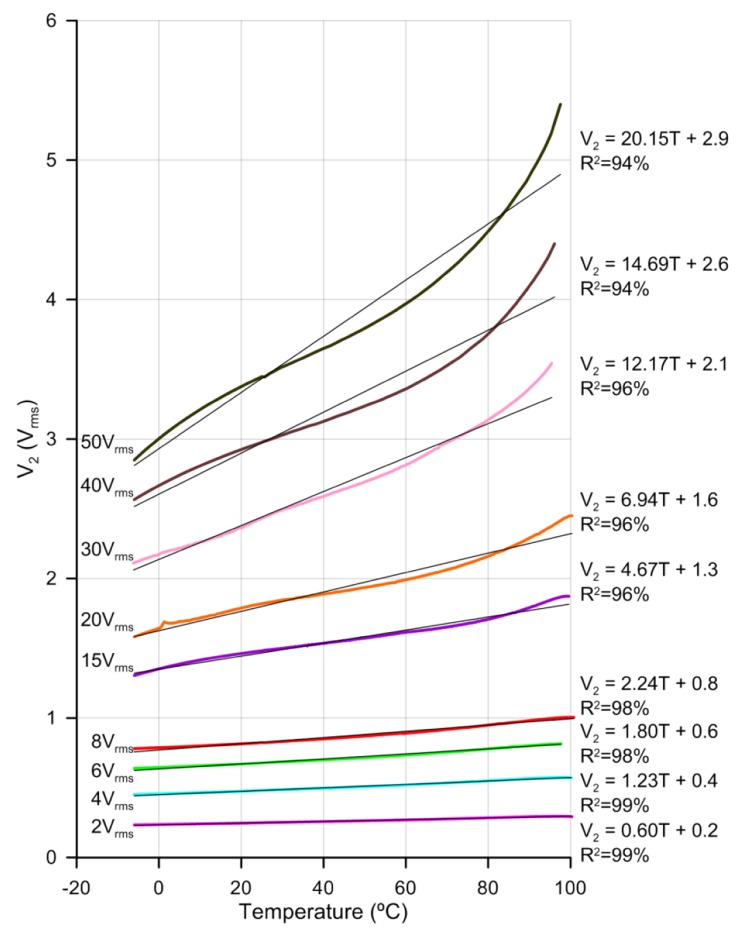
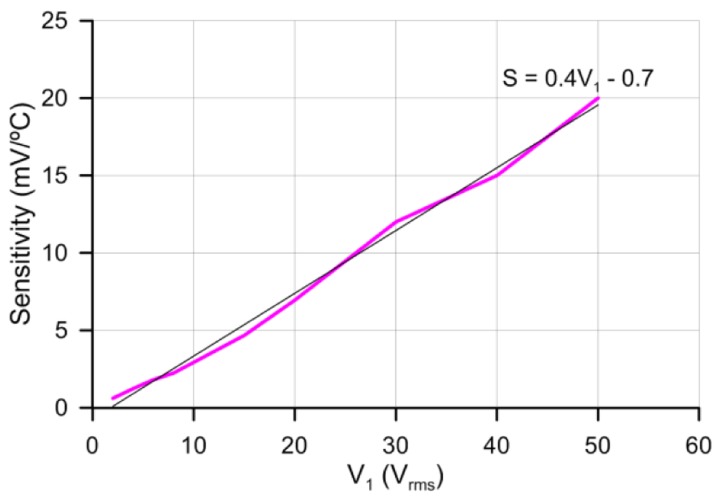
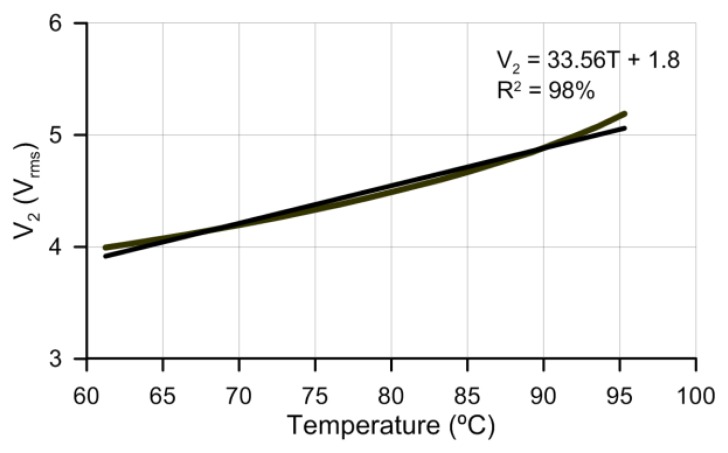
A novel temperature sensor based on nematic liquid crystal permittivity as a sensing magnitude, is presented. This sensor consists of a specific micrometric structure that gives considerable advantages from other previous related liquid crystal (LC) sensors. The analytical study reveals that permittivity change with temperature is introduced in a hyperbolic cosine function, increasing the sensitivity term considerably. The experimental data has been obtained for ranges from -6 °C to 100 °C. Despite this, following the LC datasheet, theoretical ranges from -40 °C to 109 °C could be achieved. These results have revealed maximum sensitivities of 33 mVrms/°C for certain temperature ranges; three times more than of most silicon temperature sensors. As it was predicted by the analytical study, the micrometric size of the proposed structure produces a high output voltage. Moreover the voltage's sensitivity to temperature response can be controlled by the applied voltage. This response allows temperature measurements to be carried out without any amplification or conditioning circuitry, with very low power consumption.
本文提出了一种基于向列相液晶介电常数作为传感量的新型温度传感器。该传感器由一种特殊的微米级结构组成,与之前其他相关液晶(LC)传感器相比具有显著优势。分析研究表明,介电常数随温度的变化呈双曲余弦函数形式,极大地增加了灵敏度项。实验数据是在-6°C至100°C的范围内获得的。尽管如此,根据LC数据手册,理论上可以实现-40°C至109°C的范围。这些结果表明,在特定温度范围内最大灵敏度可达33 mVrms/°C;是大多数硅温度传感器的三倍多。正如分析研究所预测的,所提出结构的微米级尺寸产生了高输出电压。此外,电压对温度响应的灵敏度可以通过施加的电压来控制。这种响应使得无需任何放大或调节电路就能进行温度测量,且功耗非常低。