Killela Patrick J, Pirozzi Christopher J, Healy Patrick, Reitman Zachary J, Lipp Eric, Rasheed B Ahmed, Yang Rui, Diplas Bill H, Wang Zhaohui, Greer Paula K, Zhu Huishan, Wang Catherine Y, Carpenter Austin B, Friedman Henry, Friedman Allan H, Keir Stephen T, He Jie, He Yiping, McLendon Roger E, Herndon James E, Yan Hai, Bigner Darell D
Department of Pathology, Duke University Medical Center, The Preston Robert Tisch Brain Tumor Center at Duke, and Pediatric Brain Tumor Foundation Institute at Duke, Durham, NC, USA.
Oncotarget. 2014 Mar 30;5(6):1515-25. doi: 10.18632/oncotarget.1765.
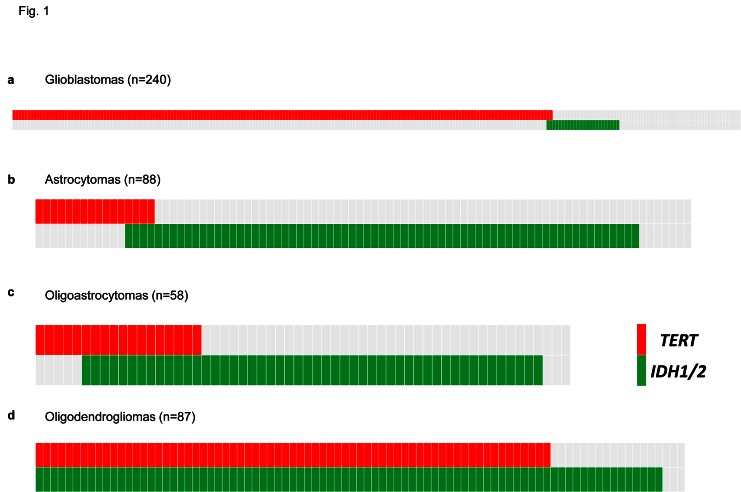
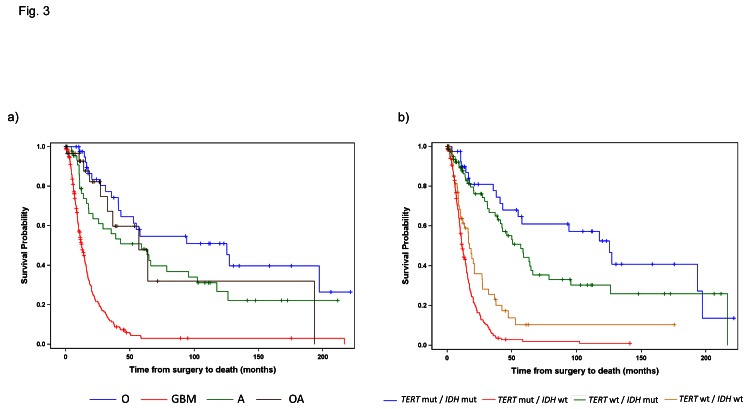
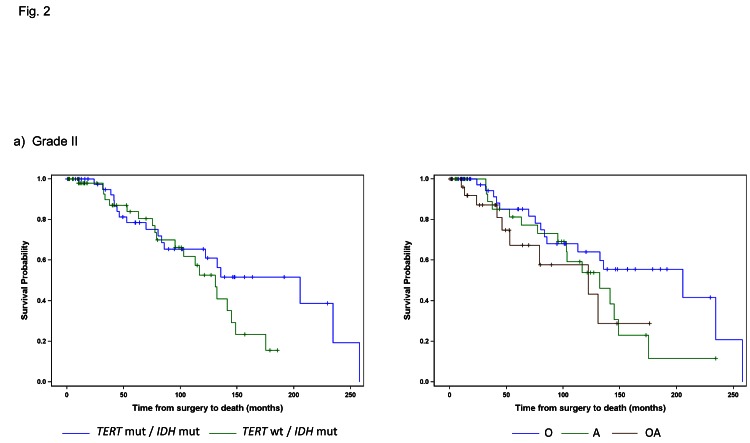
Frequent mutations in isocitrate dehydrogenase 1 and 2 (IDH1 and IDH2) and the promoter of telomerase reverse transcriptase (TERT) represent two significant discoveries in glioma genomics. Understanding the degree to which these two mutations co-occur or occur exclusively of one another in glioma subtypes presents a unique opportunity to guide glioma classification and prognosis. We analyzed the relationship between overall survival (OS) and the presence of IDH1/2 and TERT promoter mutations in a panel of 473 adult gliomas. We hypothesized and show that genetic signatures capable of distinguishing among several types of gliomas could be established providing clinically relevant information that can serve as an adjunct to histopathological diagnosis. We found that mutations in the TERT promoter occurred in 74.2% of glioblastomas (GBM), but occurred in a minority of Grade II-III astrocytomas (18.2%). In contrast, IDH1/2 mutations were observed in 78.4% of Grade II-III astrocytomas, but were uncommon in primary GBM. In oligodendrogliomas, TERT promoter and IDH1/2 mutations co-occurred in 79% of cases. Patients whose Grade III-IV gliomas exhibit TERT promoter mutations alone predominately have primary GBMs associated with poor median OS (11.5 months). Patients whose Grade III-IV gliomas exhibit IDH1/2 mutations alone predominately have astrocytic morphologies and exhibit a median OS of 57 months while patients whose tumors exhibit both TERT promoter and IDH1/2 mutations predominately exhibit oligodendroglial morphologies and exhibit median OS of 125 months. Analyzing gliomas based on their genetic signatures allows for the stratification of these patients into distinct cohorts, with unique prognosis and survival.
异柠檬酸脱氢酶1和2(IDH1和IDH2)以及端粒酶逆转录酶(TERT)启动子的频繁突变是胶质瘤基因组学中的两项重大发现。了解这两种突变在胶质瘤亚型中同时出现或相互独立出现的程度,为指导胶质瘤的分类和预后提供了一个独特的机会。我们分析了473例成人胶质瘤样本中总生存期(OS)与IDH1/2及TERT启动子突变之间的关系。我们假设并证明,能够区分几种类型胶质瘤的基因特征可以被建立,从而提供与临床相关的信息,作为组织病理学诊断的辅助手段。我们发现,TERT启动子突变发生在74.2%的胶质母细胞瘤(GBM)中,但在少数二级至三级星形细胞瘤中出现(18.2%)。相比之下,IDH1/2突变在78.4%的二级至三级星形细胞瘤中被观察到,但在原发性GBM中并不常见。在少突胶质细胞瘤中,TERT启动子和IDH1/2突变在79%的病例中同时出现。三级至四级胶质瘤仅表现出TERT启动子突变的患者主要患有与中位OS较差(11.5个月)相关的原发性GBM。三级至四级胶质瘤仅表现出IDH1/2突变的患者主要具有星形细胞形态,中位OS为57个月,而肿瘤同时表现出TERT启动子和IDH1/2突变的患者主要表现为少突胶质细胞形态,中位OS为125个月。根据基因特征分析胶质瘤可以将这些患者分层为不同的队列,具有独特的预后和生存期。