Corominas Roser, Yang Xinping, Lin Guan Ning, Kang Shuli, Shen Yun, Ghamsari Lila, Broly Martin, Rodriguez Maria, Tam Stanley, Wanamaker Shelly A, Fan Changyu, Yi Song, Tasan Murat, Lemmens Irma, Kuang Xingyan, Zhao Nan, Malhotra Dheeraj, Michaelson Jacob J, Vacic Vladimir, Calderwood Michael A, Roth Frederick P, Tavernier Jan, Horvath Steve, Salehi-Ashtiani Kourosh, Korkin Dmitry, Sebat Jonathan, Hill David E, Hao Tong, Vidal Marc, Iakoucheva Lilia M
Department of Psychiatry, University of California San Diego, La Jolla, 92093, California, USA.
Center for Cancer Systems Biology (CCSB) and Department of Cancer Biology, Dana-Farber Cancer Institute, Boston, 02115, Massachusetts, USA.
Nat Commun. 2014 Apr 11;5:3650. doi: 10.1038/ncomms4650.
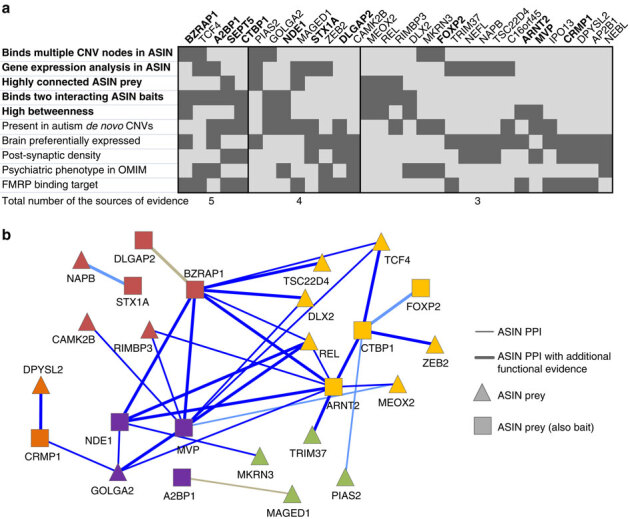
Increased risk for autism spectrum disorders (ASD) is attributed to hundreds of genetic loci. The convergence of ASD variants have been investigated using various approaches, including protein interactions extracted from the published literature. However, these datasets are frequently incomplete, carry biases and are limited to interactions of a single splicing isoform, which may not be expressed in the disease-relevant tissue. Here we introduce a new interactome mapping approach by experimentally identifying interactions between brain-expressed alternatively spliced variants of ASD risk factors. The Autism Spliceform Interaction Network reveals that almost half of the detected interactions and about 30% of the newly identified interacting partners represent contribution from splicing variants, emphasizing the importance of isoform networks. Isoform interactions greatly contribute to establishing direct physical connections between proteins from the de novo autism CNVs. Our findings demonstrate the critical role of spliceform networks for translating genetic knowledge into a better understanding of human diseases.
自闭症谱系障碍(ASD)风险增加归因于数百个基因位点。已使用各种方法研究了ASD变异的汇聚情况,包括从已发表文献中提取的蛋白质相互作用。然而,这些数据集往往不完整,存在偏差,并且仅限于单一剪接异构体的相互作用,而该异构体可能不在与疾病相关的组织中表达。在这里,我们通过实验确定ASD风险因素的大脑表达可变剪接变体之间的相互作用,引入了一种新的相互作用组图谱绘制方法。自闭症剪接异构体相互作用网络表明,几乎一半的检测到的相互作用和约30%的新鉴定的相互作用伙伴代表了剪接变体的贡献,强调了异构体网络的重要性。异构体相互作用极大地有助于在从头自闭症拷贝数变异(CNV)的蛋白质之间建立直接的物理连接。我们的研究结果证明了剪接异构体网络在将遗传知识转化为对人类疾病的更好理解方面的关键作用。