Li Yansong, Sescousse Guillaume, Dreher Jean-Claude
Reward and Decision Making Team, Centre de Neurosciences Cognitives, CNRS, UMR 5229 Lyon, France ; Neuroscience Department, Université Claude Bernard Lyon 1 Lyon, France.
Reward and Decision Making Team, Centre de Neurosciences Cognitives, CNRS, UMR 5229 Lyon, France.
Front Behav Neurosci. 2014 Mar 25;8:83. doi: 10.3389/fnbeh.2014.00083. eCollection 2014.
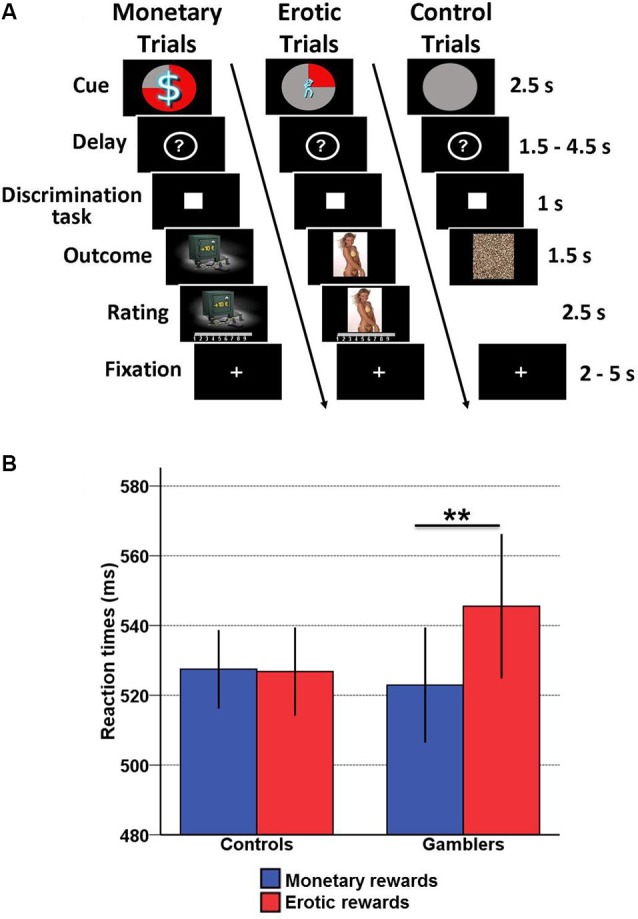
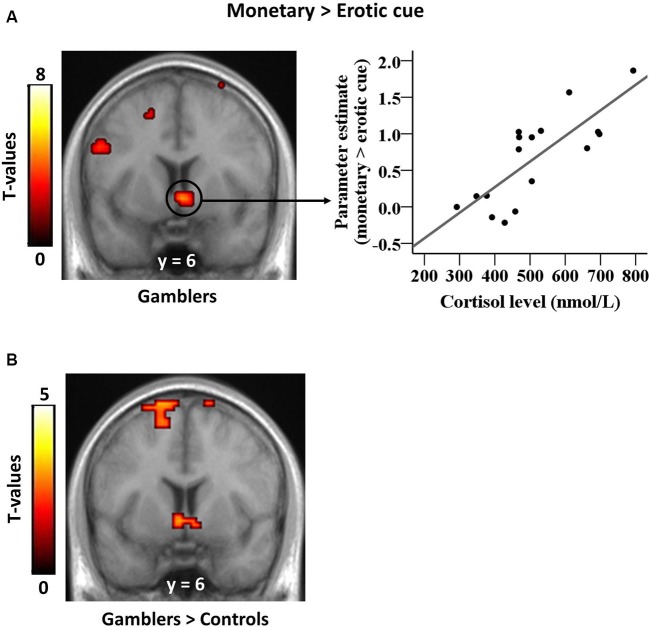
Pathological gambling is a behavioral addiction characterized by a chronic failure to resist the urge to gamble. It shares many similarities with drug addiction. Glucocorticoid hormones including cortisol are thought to play a key role in the vulnerability to addictive behaviors, by acting on the mesolimbic reward pathway. Based on our previous report of an imbalanced sensitivity to monetary versus non-monetary incentives in the ventral striatum of pathological gamblers (PGs), we investigated whether this imbalance was mediated by individual differences in endogenous cortisol levels. We used functional magnetic resonance imaging (fMRI) and examined the relationship between cortisol levels and the neural responses to monetary versus non-monetary cues, while PGs and healthy controls were engaged in an incentive delay task manipulating both monetary and erotic rewards. We found a positive correlation between cortisol levels and ventral striatal responses to monetary versus erotic cues in PGs, but not in healthy controls. This indicates that the ventral striatum is a key region where cortisol modulates incentive motivation for gambling versus non-gambling related stimuli in PGs. Our results extend the proposed role of glucocorticoid hormones in drug addiction to behavioral addiction, and help understand the impact of cortisol on reward incentive processing in PGs.
病理性赌博是一种行为成瘾,其特征是长期无法抗拒赌博的冲动。它与药物成瘾有许多相似之处。包括皮质醇在内的糖皮质激素被认为通过作用于中脑边缘奖赏通路,在成瘾行为易感性中起关键作用。基于我们之前关于病理性赌博者(PGs)腹侧纹状体对金钱与非金钱奖励敏感性失衡的报告,我们研究了这种失衡是否由内源性皮质醇水平的个体差异介导。我们使用功能磁共振成像(fMRI),并在PGs和健康对照者参与同时操纵金钱和色情奖励的奖励延迟任务时,检查了皮质醇水平与对金钱和非金钱线索的神经反应之间的关系。我们发现PGs的皮质醇水平与腹侧纹状体对金钱和色情线索的反应之间存在正相关,而在健康对照者中则不存在。这表明腹侧纹状体是皮质醇调节PGs中与赌博相关刺激和非赌博相关刺激的奖励动机的关键区域。我们的结果将糖皮质激素在药物成瘾中的作用扩展到行为成瘾,并有助于理解皮质醇对PGs奖励激励处理的影响。