Siewert Christin, Luge Toni, Duduk Bojan, Seemüller Erich, Büttner Carmen, Sauer Sascha, Kube Michael
Division Phytomedicine, Department of Crop and Animal Sciences, Humboldt-Universität zu Berlin, Berlin, Germany.
Max Planck Institute for Molecular Genetics, Berlin, Germany.
PLoS One. 2014 Apr 11;9(4):e94391. doi: 10.1371/journal.pone.0094391. eCollection 2014.
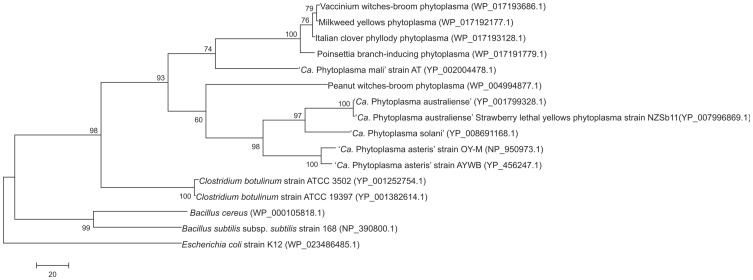
'Candidatus Phytoplasma mali' is a phytopathogenic bacterium of the family Acholeplasmataceae assigned to the class Mollicutes. This causative agent of the apple proliferation colonizes in Malus domestica the sieve tubes of the plant phloem resulting in a range of symptoms such as witches'--broom formation, reduced vigor and affecting size and quality of the crop. The disease is responsible for strong economical losses in Europe. Although the genome sequence of the pathogen is available, there is only limited information on expression of selected genes and metabolic key features that have not been examined on the transcriptomic or proteomic level so far. This situation is similar to many other phytoplasmas. In the work presented here, RNA-Seq and mass spectrometry shotgun techniques were applied on tissue samples from Nicotiana occidentalis infected by 'Ca. P. mali' strain AT providing insights into transcriptome and proteome of the pathogen. Data analysis highlights expression of 208 genes including 14 proteins located in the terminal inverted repeats of the linear chromosome. Beside a high portion of house keeping genes, the recently discussed chaperone GroES/GroEL is expressed. Furthermore, gene expression involved in formation of a type IVB and of the Sec-dependent secretion system was identified as well as the highly expressed putative pathogenicity-related SAP11-like effector protein. Metabolism of phytoplasmas depends on the uptake of spermidine/putescine, amino acids, co-factors, carbohydrates and in particular malate/citrate. The expression of these transporters was confirmed and the analysis of the carbohydrate cycle supports the suggested alternative energy-providing pathway for phytoplasmas releasing acetate and providing ATP. The phylogenetic analyses of malate dehydrogenase and acetate kinase in phytoplasmas show a closer relatedness to the Firmicutes in comparison to Mycoplasma species indicating an early divergence of the Acholeplasmataceae from the Mollicutes.
“苹果植原体(暂定种)”是柔膜菌纲无胆甾原体科的一种植物致病细菌。这种苹果增殖病的病原体定殖于苹果属植物韧皮部的筛管中,导致一系列症状,如扫帚状丛生、活力下降以及影响作物的大小和品质。该病害在欧洲造成了巨大的经济损失。尽管病原体的基因组序列已可得,但关于特定基因的表达和代谢关键特征的信息仍然有限,目前尚未在转录组或蛋白质组水平上进行研究。这种情况与许多其他植原体类似。在本文所展示的研究中,RNA测序和质谱鸟枪法技术应用于被“苹果植原体(暂定种)”菌株AT感染的西方烟草组织样本,从而深入了解该病原体的转录组和蛋白质组。数据分析突出了208个基因的表达,其中包括位于线性染色体末端反向重复序列中的14种蛋白质。除了大部分管家基因外,最近讨论的伴侣蛋白GroES/GroEL也有表达。此外,还鉴定出了参与IVB型和Sec依赖性分泌系统形成的基因表达,以及高表达的假定致病性相关的SAP11样效应蛋白。植原体的代谢依赖于亚精胺/腐胺、氨基酸、辅因子、碳水化合物,特别是苹果酸/柠檬酸的摄取。这些转运蛋白的表达得到了证实,并对碳水化合物循环的分析支持了所提出的植原体替代能量供应途径,该途径释放乙酸盐并提供ATP。植原体中苹果酸脱氢酶和乙酸激酶的系统发育分析表明,与支原体相比,它们与厚壁菌门的亲缘关系更近,这表明无胆甾原体科在柔膜菌纲中较早分化。