Tian Chen, Yan Rengna, Wen Shuzhen, Li Xueling, Li Tianfeng, Cai Zhenming, Li Xinxiu, Du Hong, Chen Huimei
Department of Medical Genetics, Nanjing University School of Medicine, Nanjing, China; Jiangsu Key Laboratory of Molecular Medicine, Nanjing, China.
Jinling Hospital, Nanjing University School of Medicine, Nanjing, China.
PLoS One. 2014 Apr 11;9(4):e94848. doi: 10.1371/journal.pone.0094848. eCollection 2014.
Hereditary multiple exostoses (HME) is an autosomal dominant disease. The classical paradigm of mutation screening seeks to relate alterations in the exostosin glycosyltransferase genes, EXT1 and EXT2, which are responsible for over 70% of HME cases. However, the pathological significance of the majority of these mutations is often unclear.
In a Chinese family with HME, EXT1 and EXT2 genes were screened by direct sequencing. The consequence of a detected mutant was predicted by in silico analysis and confirmed by mRNA analysis. The EXT1 and EXT2 mRNA and protein levels and the HS patterns in the HME patients were compared with those in healthy controls.
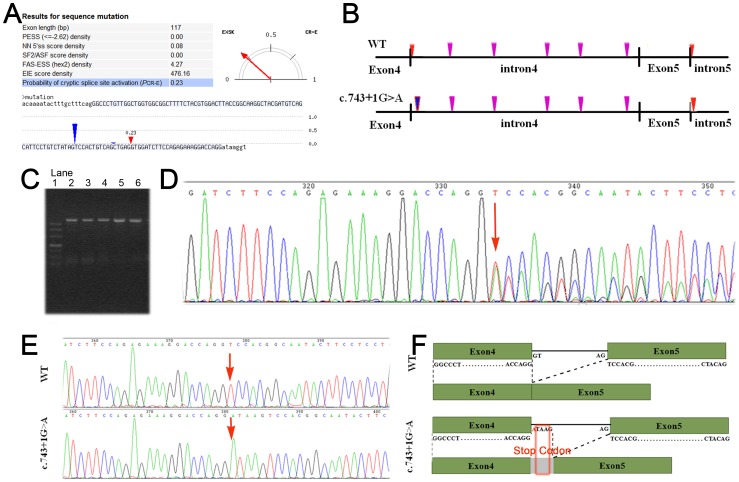
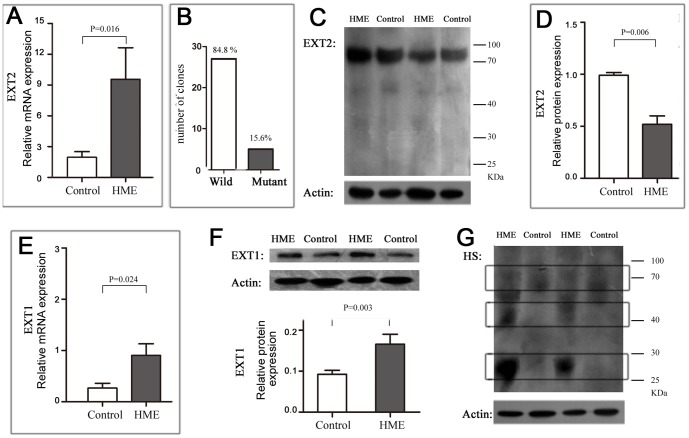
A heterozygous transition (c.743+1G>A) in the EXT2 gene, which co-segregated with the HME phenotype in this family, was identified. The G residue at position +1 in intron 4 of EXT2 was predicted to be a 5' donor splice site. The mRNA analysis revealed an alternative transcript with a cryptic splice site 5 bp downstream of the wild-type site, which harbored a premature stop codon. However, the predicted truncated protein was not detected by western blot analysis. Decay of the mutant mRNA was shown by clone sequencing and quantification analysis. The corresponding downregulation of the EXT2 mRNA will contribute to the abnormal EXT1/EXT2 ratio and HS pattern that were detected in the patients with HME.
The heterozygous mutation c.743+1G>A in the EXT2 gene causes HME as a result of abnormal splicing, mRNA decay, and the resulting haploinsufficiency of EXT2.
遗传性多发性骨软骨瘤(HME)是一种常染色体显性疾病。经典的突变筛查模式旨在探寻外生骨疣糖基转移酶基因EXT1和EXT2的改变,这两个基因导致了超过70%的HME病例。然而,这些突变中大多数的病理意义往往并不明确。
在一个患有HME的中国家庭中,通过直接测序对EXT1和EXT2基因进行筛查。通过计算机分析预测检测到的突变体的后果,并通过mRNA分析进行确认。将HME患者的EXT1和EXT2 mRNA及蛋白水平以及HS模式与健康对照者的进行比较。
在EXT2基因中鉴定出一个杂合性转换(c.743+1G>A),该突变与该家庭中的HME表型共分离。EXT2第4内含子+1位置的G残基被预测为一个5'供体剪接位点。mRNA分析揭示了一个在野生型位点下游5 bp处有一个隐蔽剪接位点的替代转录本,该转录本含有一个提前终止密码子。然而,通过蛋白质印迹分析未检测到预测的截短蛋白。通过克隆测序和定量分析显示了突变体mRNA的降解。EXT2 mRNA的相应下调将导致在HME患者中检测到的EXT1/EXT2比例和HS模式异常。
EXT2基因中的杂合突变c.743+1G>A由于异常剪接、mRNA降解以及由此导致的EXT2单倍体不足而引起HME。