Young Bonnie N, Rendón Adrian, Rosas-Taraco Adrian, Baker Jack, Healy Meghan, Gross Jessica M, Long Jeffrey, Burgos Marcos, Hunley Keith L
University of New Mexico, Department of Anthropology, Albuquerque, New Mexico, United States of America.
Universidad Autónoma de Nuevo León, Hospital José E. González, Tuberculosis Clinic, Monterrey, Nuevo León, Mexico.
PLoS One. 2014 Apr 11;9(4):e94303. doi: 10.1371/journal.pone.0094303. eCollection 2014.
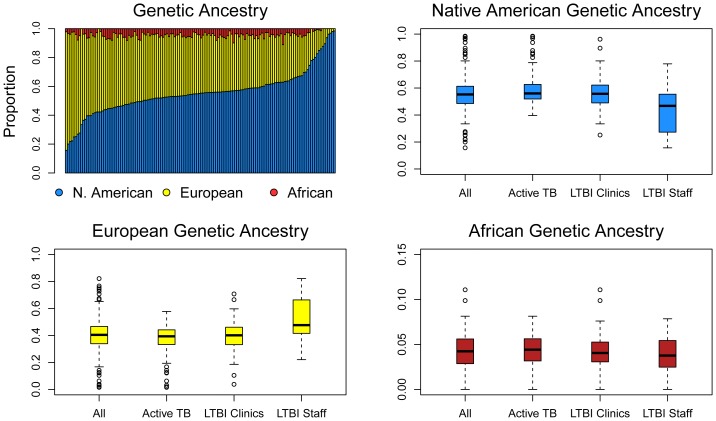
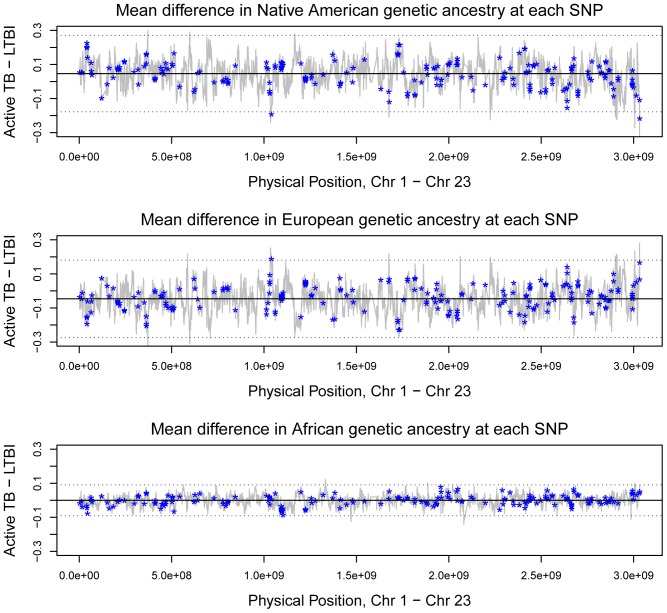
Diverse socioeconomic and clinical factors influence susceptibility to tuberculosis (TB) disease in Mexico. The role of genetic factors, particularly those that differ between the parental groups that admixed in Mexico, is unclear. The objectives of this study are to identify the socioeconomic and clinical predictors of the transition from latent TB infection (LTBI) to pulmonary TB disease in an urban population in northeastern Mexico, and to examine whether genetic ancestry plays an independent role in this transition. We recruited 97 pulmonary TB disease patients and 97 LTBI individuals from a public hospital in Monterrey, Nuevo León. Socioeconomic and clinical variables were collected from interviews and medical records, and genetic ancestry was estimated for a subset of 142 study participants from 291,917 single nucleotide polymorphisms (SNPs). We examined crude associations between the variables and TB disease status. Significant predictors from crude association tests were analyzed using multivariable logistic regression. We also compared genetic ancestry between LTBI individuals and TB disease patients at 1,314 SNPs in 273 genes from the TB biosystem in the NCBI BioSystems database. In crude association tests, 12 socioeconomic and clinical variables were associated with TB disease. Multivariable logistic regression analyses indicated that marital status, diabetes, and smoking were independently associated with TB status. Genetic ancestry was not associated with TB disease in either crude or multivariable analyses. Separate analyses showed that LTBI individuals recruited from hospital staff had significantly higher European genetic ancestry than LTBI individuals recruited from the clinics and waiting rooms. Genetic ancestry differed between individuals with LTBI and TB disease at SNPs located in two genes in the TB biosystem. These results indicate that Monterrey may be structured with respect to genetic ancestry, and that genetic differences in TB susceptibility in parental populations may contribute to variation in disease susceptibility in the region.
多种社会经济和临床因素影响墨西哥人群对结核病(TB)的易感性。遗传因素的作用尚不清楚,尤其是那些在墨西哥混合的亲代群体之间存在差异的遗传因素。本研究的目的是确定墨西哥东北部城市人群中从潜伏性结核感染(LTBI)转变为肺结核疾病的社会经济和临床预测因素,并检验遗传血统在这一转变中是否起独立作用。我们从新莱昂州蒙特雷的一家公立医院招募了97名肺结核疾病患者和97名LTBI个体。通过访谈和医疗记录收集社会经济和临床变量,并从291,917个单核苷酸多态性(SNP)中估计了142名研究参与者的遗传血统。我们研究了这些变量与结核病状态之间的粗略关联。使用多变量逻辑回归分析粗略关联测试中的显著预测因素。我们还在NCBI生物系统数据库中TB生物系统的273个基因的1,314个SNP处比较了LTBI个体和结核病患者之间的遗传血统。在粗略关联测试中,12个社会经济和临床变量与结核病相关。多变量逻辑回归分析表明,婚姻状况、糖尿病和吸烟与结核病状态独立相关。在粗略分析或多变量分析中,遗传血统均与结核病无关。单独分析表明,从医院工作人员中招募的LTBI个体的欧洲遗传血统明显高于从诊所和候诊室招募的LTBI个体。在TB生物系统的两个基因中的SNP处,LTBI个体和结核病患者的遗传血统存在差异。这些结果表明,蒙特雷在遗传血统方面可能存在结构差异,并且亲代群体中结核病易感性的遗传差异可能导致该地区疾病易感性的变化。