Institut Pasteur de Montevideo, Montevideo 11400, Uruguay Faculty of Science, Universidad de la República, Montevideo 11400, Uruguay.
Division of Oncology, Department of Clinical Sciences, Lund University Cancer Center, Lund 223 81, Sweden.
RNA. 2014 Jun;20(6):754-7. doi: 10.1261/rna.044263.114. Epub 2014 Apr 11.
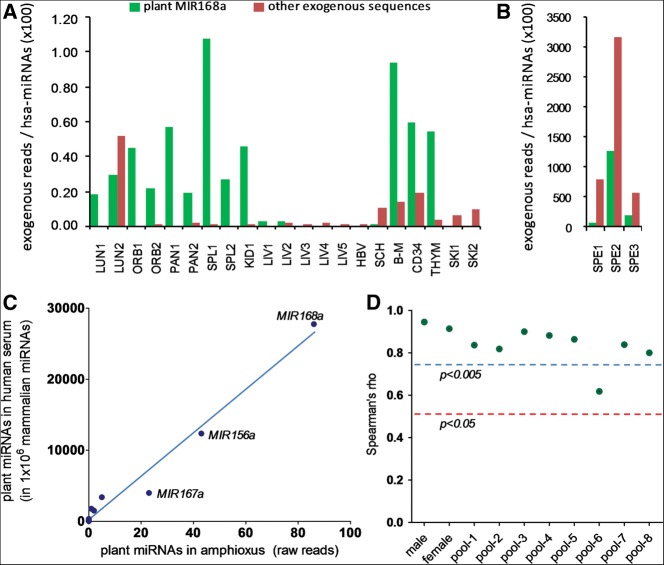
The report that exogenous plant miRNAs are able to cross the mammalian gastrointestinal tract and exert gene-regulation mechanism in mammalian tissues has yielded a lot of controversy, both in the public press and the scientific literature. Despite the initial enthusiasm, reproducibility of these results was recently questioned by several authors. To analyze the causes of this unease, we searched for diet-derived miRNAs in deep-sequencing libraries performed by ourselves and others. We found variable amounts of plant miRNAs in publicly available small RNA-seq data sets of human tissues. In human spermatozoa, exogenous RNAs reached extreme, biologically meaningless levels. On the contrary, plant miRNAs were not detected in our sequencing of human sperm cells, which was performed in the absence of any known sources of plant contamination. We designed an experiment to show that cross-contamination during library preparation is a source of exogenous RNAs. These contamination-derived exogenous sequences even resisted oxidation with sodium periodate. To test the assumption that diet-derived miRNAs were actually contamination-derived, we sought in the literature for previous sequencing reports performed by the same group which reported the initial finding. We analyzed the spectra of plant miRNAs in a small RNA sequencing study performed in amphioxus by this group in 2009 and we found a very strong correlation with the plant miRNAs which they later reported in human sera. Even though contamination with exogenous sequences may be easy to detect, cross-contamination between samples from the same organism can go completely unnoticed, possibly affecting conclusions derived from NGS transcriptomics.
外源性植物 miRNAs 能够穿过哺乳动物的胃肠道,并在哺乳动物组织中发挥基因调控机制的报告在公众媒体和科学文献中引起了很多争议。尽管最初人们对此感到兴奋,但最近有几位作者对这些结果的可重复性提出了质疑。为了分析这种不安的原因,我们在自己和他人进行的深度测序文库中搜索了饮食来源的 miRNAs。我们在公开的人类组织小 RNA-seq 数据集发现了不同数量的植物 miRNAs。在外源 RNA 水平极高的人类精子中,甚至达到了生物学上毫无意义的水平。相反,在我们对人类精子细胞进行的测序中未检测到植物 miRNAs,而我们的测序是在没有任何已知植物污染来源的情况下进行的。我们设计了一个实验来证明文库制备过程中的交叉污染是外源性 RNA 的来源。这些污染衍生的外源性序列甚至抵抗过碘酸钠的氧化。为了验证饮食来源的 miRNAs 实际上是污染衍生的假设,我们在文献中寻找了报告最初发现的同一组之前进行的测序报告。我们分析了该小组在 2009 年对文昌鱼进行的小 RNA 测序研究中植物 miRNAs 的图谱,发现与他们后来在人血清中报告的植物 miRNAs 具有很强的相关性。尽管外源性序列的污染可能很容易被检测到,但来自同一生物体的样本之间的交叉污染可能完全被忽略,这可能会影响从 NGS 转录组学中得出的结论。