Pei Xing, Kang Wenjing, Yue Wei, Bange Adam, Heineman William R, Papautsky Ian
BioMicroSystems Laboratory, Department of Electrical Engineering and Computing Systems, University of Cincinnati, Cincinnati, Ohio 45221, USA.
Department of Chemistry, University of Cincinnati, Cincinnati, Ohio 45221, USA.
J Electrochem Soc. 2014 Feb 1;161(2):B3160-B3166. doi: 10.1149/2.022402jes.
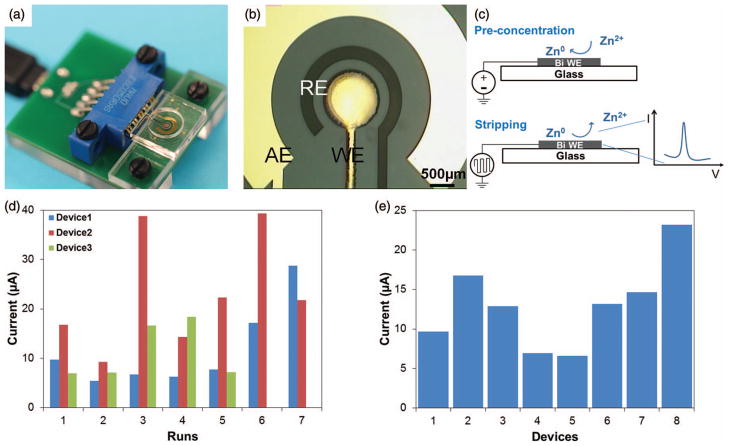
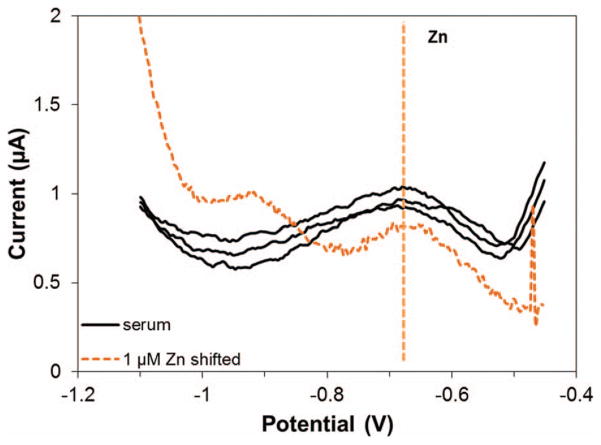
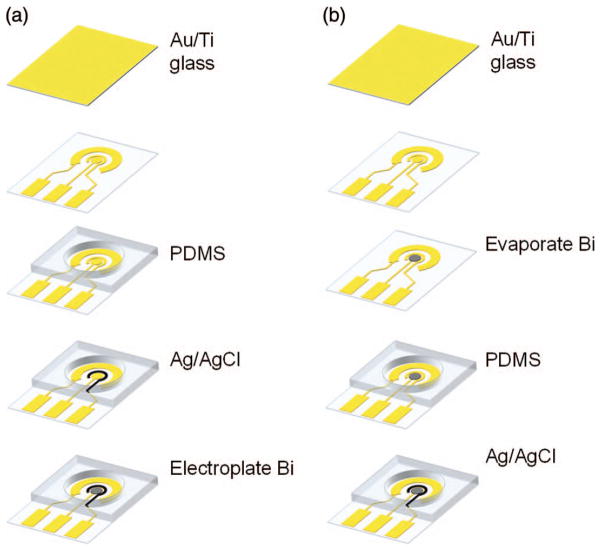
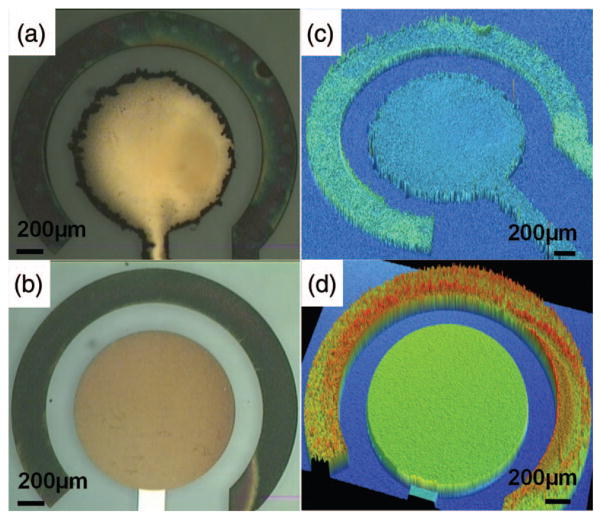
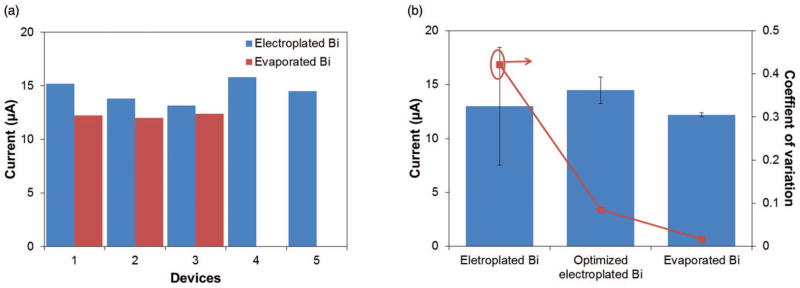
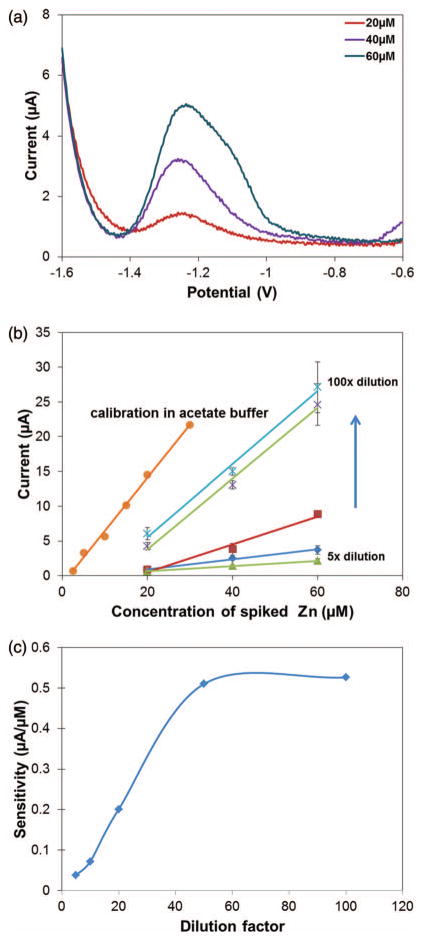
This work reports on the continuing development of a lab-on-a-chip electrochemical sensor for determination of zinc in blood serum using square wave anodic stripping voltammetry. The microscale sensor consists of a three electrode system, including an environmentally friendly bismuth working electrode, an integrated silver/silver chloride reference electrode, and a gold auxiliary electrode. The sensor demonstrates a linear response in 0.1 M acetate buffer at pH 6 for zinc concentrations in the 1-30 μM range. By optimizing bismuth film deposition and better control of the fabrication process, repeatability of the sensor was improved, reducing variability from 42% to <2%. Through optimization of electrolyte and stripping voltammetry parameters, limit of detection was greatly improved to 60 nM. The optimized sensor was also able to measure zinc in the extracted blood serum. Ultimately, with integrated sample preparation, the sensor will permit rapid (min) measurements of zinc from a sub-mL sample (a few drops of blood) for clinical applications.
本研究报告了一种用于血清中锌测定的芯片实验室电化学传感器的持续开发情况,该传感器采用方波阳极溶出伏安法。该微型传感器由三电极系统组成,包括一个环保型铋工作电极、一个集成的银/氯化银参比电极和一个金辅助电极。该传感器在pH值为6的0.1 M醋酸盐缓冲液中,对1-30 μM范围内的锌浓度呈现线性响应。通过优化铋膜沉积并更好地控制制造工艺,传感器的重复性得到了提高,变异系数从42%降至<2%。通过优化电解质和溶出伏安法参数,检测限大幅提高至60 nM。优化后的传感器还能够测量提取血清中的锌。最终,通过集成样品制备,该传感器将能够对亚毫升样品(几滴血液)中的锌进行快速(分钟级)测量,以用于临床应用。