Roemeling-van Rhijn Marieke, Reinders Marlies E, Franquesa Marcella, Engela Anja U, Korevaar Sander S, Roelofs Helene, Genever Paul G, Ijzermans Jan Nm, Betjes Michiel Gh, Baan Carla C, Weimar Willem, Hoogduijn Martin J
Internal Medicine, Erasmus MC, Rotterdam, The Netherlands.
Nephrology, Leiden University Medical Center, Leiden, The Netherlands.
J Stem Cell Res Ther. 2013 Dec 12;3(Suppl 6):004. doi: 10.4172/2157-7633.S6-004.
For clinical applications, Mesenchymal Stromal Cells (MSC) can be isolated from bone marrow and adipose tissue of autologous or allogeneic origin. Allogeneic cell usage has advantages but may harbor the risk of sensitization against foreign HLA. Therefore, we evaluated whether bone marrow and adipose tissue-derived MSC are capable of inducing HLA-specific alloreactivity.
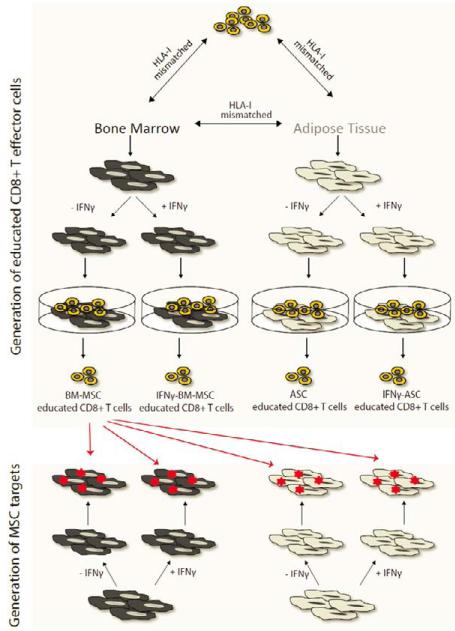
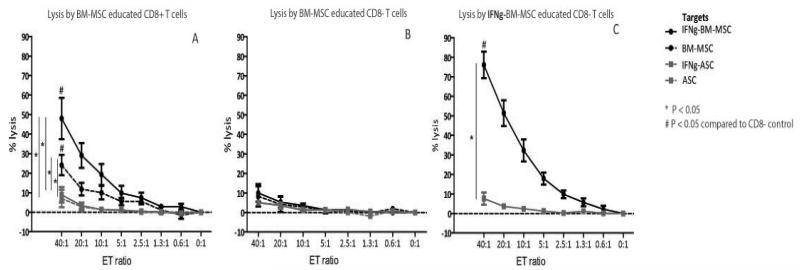
MSC were isolated from healthy human Bone Marrow (BM-MSC) and adipose tissue (ASC) donors. Peripheral Blood Mononuclear Cells (PBMC) were co-cultured with HLA-AB mismatched BM-MSC or ASC precultured with or without IFNy. After isolation via FACS sorting, the educated CD8+ T effector populations were exposed for 4 hours to Europium labeled MSC of the same HLA make up as in the co-cultures or with different HLA. Lysis of MSC was determined by spectrophotometric measurement of Europium release.
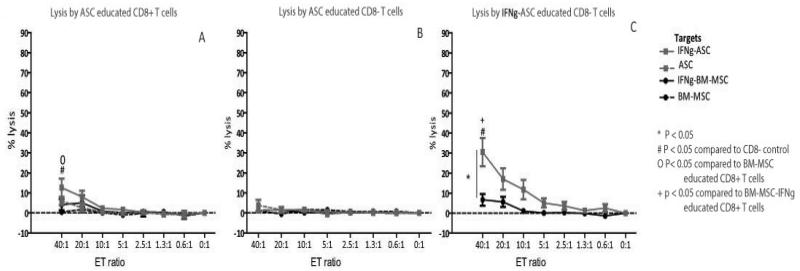
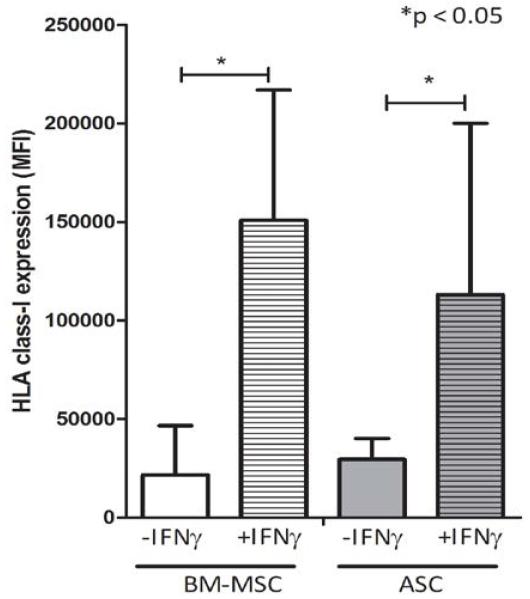
CD8+ T cells educated with BM-MSC were capable of HLA specific lysis of BM-MSC. The maximum lysis was 24% in an effector:target (E:T) ratio of 40:1. Exposure to IFNγ increased HLA-I expression on BM-MSC and increased lysis to 48%. Co-culturing of PBMC with IFNγ-stimulated BM-MSC further increased lysis to 76%. Surprisingly, lysis induced by ASC was significantly lower. CD8+ T cells educated with ASC induced a maximum lysis of 13% and CD8+ T cells educated with IFNγ-stimulated ASC of only 31%.
Allogeneic BM-MSC, and to a lesser extend ASC, are capable of inducing HLA specific reactivity. These results should be taken into consideration when using allogeneic MSC for clinical therapy.
在临床应用中,间充质基质细胞(MSC)可从自体或异体来源的骨髓和脂肪组织中分离得到。使用异体细胞具有优势,但可能存在对异体人类白细胞抗原(HLA)致敏的风险。因此,我们评估了骨髓和脂肪组织来源的MSC是否能够诱导HLA特异性同种异体反应性。
从健康人类骨髓(BM-MSC)和脂肪组织(ASC)供体中分离MSC。外周血单个核细胞(PBMC)与HLA-AB不匹配的BM-MSC或经或未经干扰素γ(IFNγ)预培养的ASC共培养。通过荧光激活细胞分选(FACS)分离后,将受过训练的CD8+T效应细胞群体与共培养中相同HLA组成或不同HLA的铕标记MSC接触4小时。通过分光光度法测量铕释放来确定MSC的裂解情况。
用BM-MSC培养的CD8+T细胞能够对BM-MSC进行HLA特异性裂解。在效应细胞与靶细胞(E:T)比例为40:1时,最大裂解率为24%。暴露于IFNγ可增加BM-MSC上HLA-I的表达,并将裂解率提高到48%。PBMC与IFNγ刺激的BM-MSC共培养可进一步将裂解率提高到76%。令人惊讶的是,ASC诱导的裂解明显较低。用ASC培养的CD8+T细胞诱导的最大裂解率为13%,用IFNγ刺激的ASC培养的CD8+T细胞诱导的裂解率仅为31%。
异体BM-MSC以及程度较轻的ASC能够诱导HLA特异性反应性。在将异体MSC用于临床治疗时应考虑这些结果。