Hein Alexander, Bayer Christian M, Schrauder Michael G, Häberle Lothar, Heusinger Katharina, Strick Reiner, Ruebner Matthias, Lux Michael P, Renner Stefan P, Schulz-Wendtland Rüdiger, Ekici Arif B, Hartmann Arndt, Beckmann Matthias W, Fasching Peter A
Department of Gynecology and Obstetrics, University Breast Center Franconia, University Hospital Erlangen, Friedrich-Alexander University Erlangen-Nuremberg, Comprehensive Cancer Center Erlangen-EMN, Erlangen, Germany.
Institute of Diagnostic Radiology, University Hospital Erlangen, Friedrich-Alexander University Erlangen-Nuremberg, Comprehensive Cancer Center Erlangen-EMN, Erlangen, Germany.
Biomed Res Int. 2014;2014:842452. doi: 10.1155/2014/842452. Epub 2014 Mar 5.
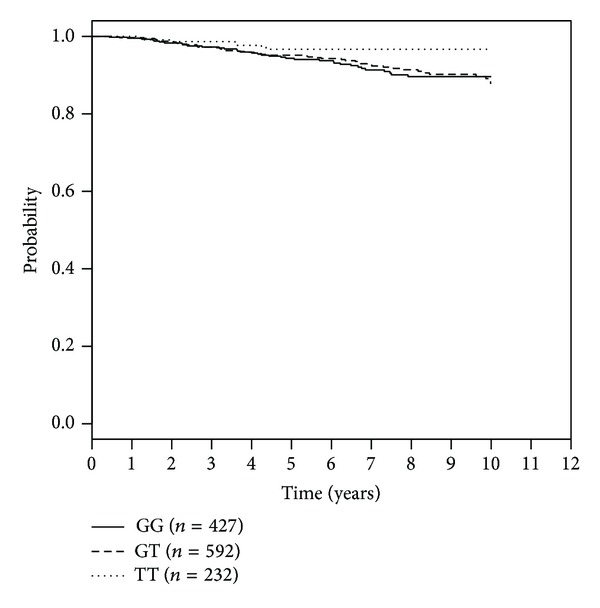
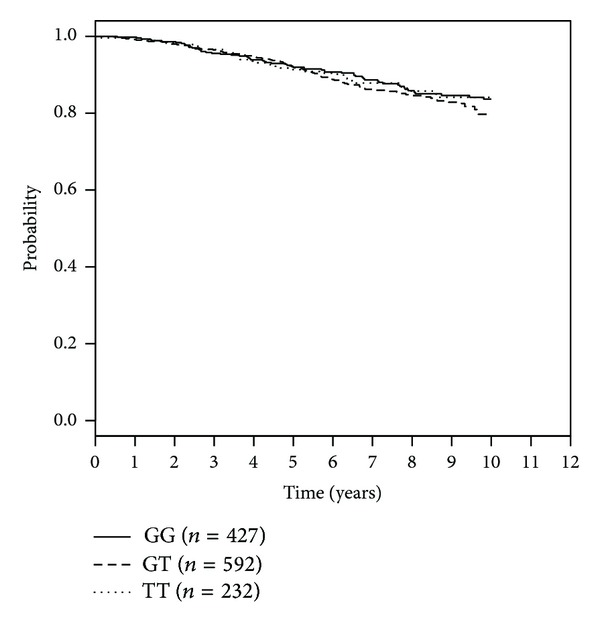
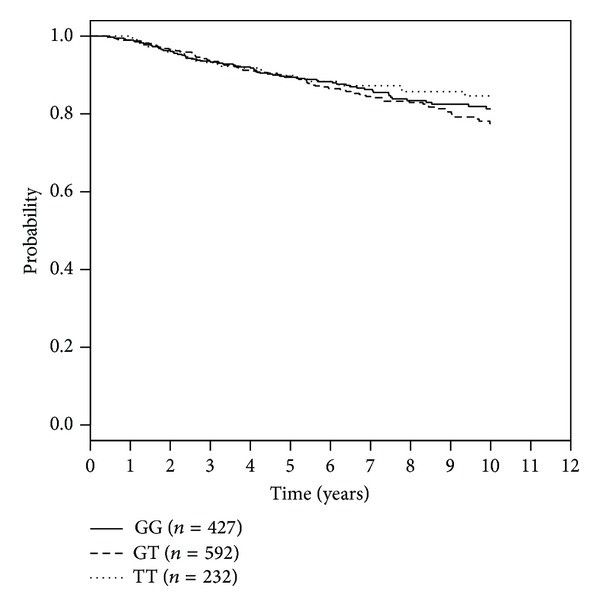
The receptor activator of NF-κB (RANK) pathway is involved in bone health as well as breast cancer (BC) pathogenesis and progression. Whereas the therapeutic implication of this pathway is established for the treatment of osteoporosis and bone metastases, the application in adjuvant BC is currently investigated. As genetic variants in this pathway have been described to influence bone health, aim of this study was the prognostic relevance of genetic variants in RANK and RANKL. Single nucleotide polymorphisms in RANK(L) (rs1054016/rs1805034/rs35211496) were genotyped and analyzed with regard to bone metastasis-free survival (BMFS), disease-free survival, and overall survival for a retrospective cohort of 1251 patients. Cox proportional hazard models were built to examine the prognostic influence in addition to commonly established prognostic factors. The SNP rs1054016 seems to influence BMFS. Patients with two minor alleles had a more favorable prognosis than patients with at least one common allele (HR 0.37 (95% CI: 0.17, 0.84)), whereas other outcome parameters remained unaffected. rs1805034 and rs35211496 had no prognostic relevance. The effect of rs1054016(RANKL) adds to the evidence that the RANK pathway plays a role in BC pathogenesis and progression with respect to BMFS, emphasizing the connection between BC and bone health.
核因子κB受体激活剂(RANK)通路与骨骼健康以及乳腺癌(BC)的发病机制和进展有关。虽然该通路在骨质疏松症和骨转移治疗中的治疗意义已得到确立,但目前正在研究其在辅助性BC治疗中的应用。由于该通路中的基因变异已被描述为会影响骨骼健康,本研究的目的是探讨RANK和RANKL基因变异的预后相关性。对1251例患者的回顾性队列进行RANK(L)(rs1054016/rs1805034/rs35211496)单核苷酸多态性基因分型,并分析其无骨转移生存期(BMFS)、无病生存期和总生存期。除了常用的既定预后因素外,还建立了Cox比例风险模型来检验预后影响。SNP rs1054016似乎会影响BMFS。具有两个次要等位基因的患者比至少有一个常见等位基因的患者预后更好(风险比0.37(95%置信区间:0.17,0.84)),而其他结局参数未受影响。rs1805034和rs35211496没有预后相关性。rs1054016(RANKL)的作用进一步证明了RANK通路在BC发病机制和进展中对BMFS起着作用,强调了BC与骨骼健康之间的联系。