Department of Psychiatry, University of California, San Diego, La Jolla, CA, USA.
Implement Sci. 2014 Apr 14;9(1):45. doi: 10.1186/1748-5908-9-45.
In healthcare and allied healthcare settings, leadership that supports effective implementation of evidenced-based practices (EBPs) is a critical concern. However, there are no empirically validated measures to assess implementation leadership. This paper describes the development, factor structure, and initial reliability and convergent and discriminant validity of a very brief measure of implementation leadership: the Implementation Leadership Scale (ILS).
Participants were 459 mental health clinicians working in 93 different outpatient mental health programs in Southern California, USA. Initial item development was supported as part of a two United States National Institutes of Health (NIH) studies focused on developing implementation leadership training and implementation measure development. Clinician work group/team-level data were randomly assigned to be utilized for an exploratory factor analysis (n = 229; k = 46 teams) or for a confirmatory factor analysis (n = 230; k = 47 teams). The confirmatory factor analysis controlled for the multilevel, nested data structure. Reliability and validity analyses were then conducted with the full sample.
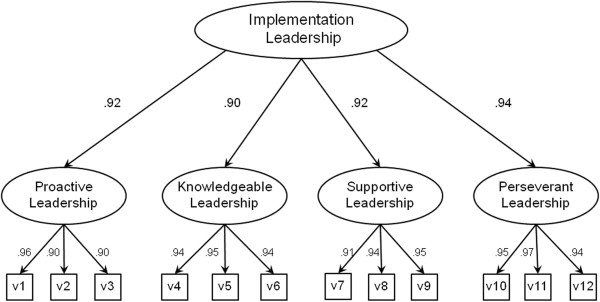
The exploratory factor analysis resulted in a 12-item scale with four subscales representing proactive leadership, knowledgeable leadership, supportive leadership, and perseverant leadership. Confirmatory factor analysis supported an a priori higher order factor structure with subscales contributing to a single higher order implementation leadership factor. The scale demonstrated excellent internal consistency reliability as well as convergent and discriminant validity.
The ILS is a brief and efficient measure of unit level leadership for EBP implementation. The availability of the ILS will allow researchers to assess strategic leadership for implementation in order to advance understanding of leadership as a predictor of organizational context for implementation. The ILS also holds promise as a tool for leader and organizational development to improve EBP implementation.
在医疗保健和相关医疗保健环境中,支持有效实施基于证据的实践(EBPs)的领导力是一个关键问题。然而,目前还没有经过实证验证的措施来评估实施领导力。本文介绍了一种非常简短的实施领导力评估工具的开发、结构、初始可靠性以及收敛和区分效度:实施领导力量表(ILS)。
参与者是来自美国南加州 93 个不同门诊心理健康项目的 459 名心理健康临床医生。初始项目开发是作为两项美国国立卫生研究院(NIH)研究的一部分得到支持的,这两项研究旨在开发实施领导力培训和实施措施开发。临床医生工作组/团队级别的数据被随机分配用于探索性因素分析(n=229;k=46 个团队)或验证性因素分析(n=230;k=47 个团队)。验证性因素分析控制了多层次嵌套数据结构。然后对全样本进行可靠性和有效性分析。
探索性因素分析得出了一个由 12 个项目组成的量表,有四个子量表,代表了积极主动的领导力、知识渊博的领导力、支持性的领导力和坚持不懈的领导力。验证性因素分析支持了一个预先设定的高阶因素结构,子量表为单一的高阶实施领导力因素做出贡献。该量表表现出了极好的内部一致性可靠性以及收敛和区分效度。
ILS 是一种针对 EBP 实施的单位层面领导力的简洁而有效的衡量工具。ILS 的可用性将使研究人员能够评估实施的战略领导力,以提高对领导力作为实施组织背景预测因素的理解。ILS 也有望成为领导者和组织发展的工具,以改善 EBP 实施。