Dørheim Signe K, Bjorvatn Bjørn, Eberhard-Gran Malin
MoodNet Research Group, Division of Psychiatry, Stavanger University Hospital, Stavanger, Norway.
Norwegian Competence Center for Sleep Disorders, Haukeland University Hospital, Bergen, Norway; Department of Global Public Health and Primary Care, University of Bergen, Bergen, Norway.
PLoS One. 2014 Apr 14;9(4):e94674. doi: 10.1371/journal.pone.0094674. eCollection 2014.
Insomnia and depression are strongly interrelated. This study aimed to describe changes in sleep across childbirth, and to evaluate whether insomnia in pregnancy is a predictor of postpartum depression.
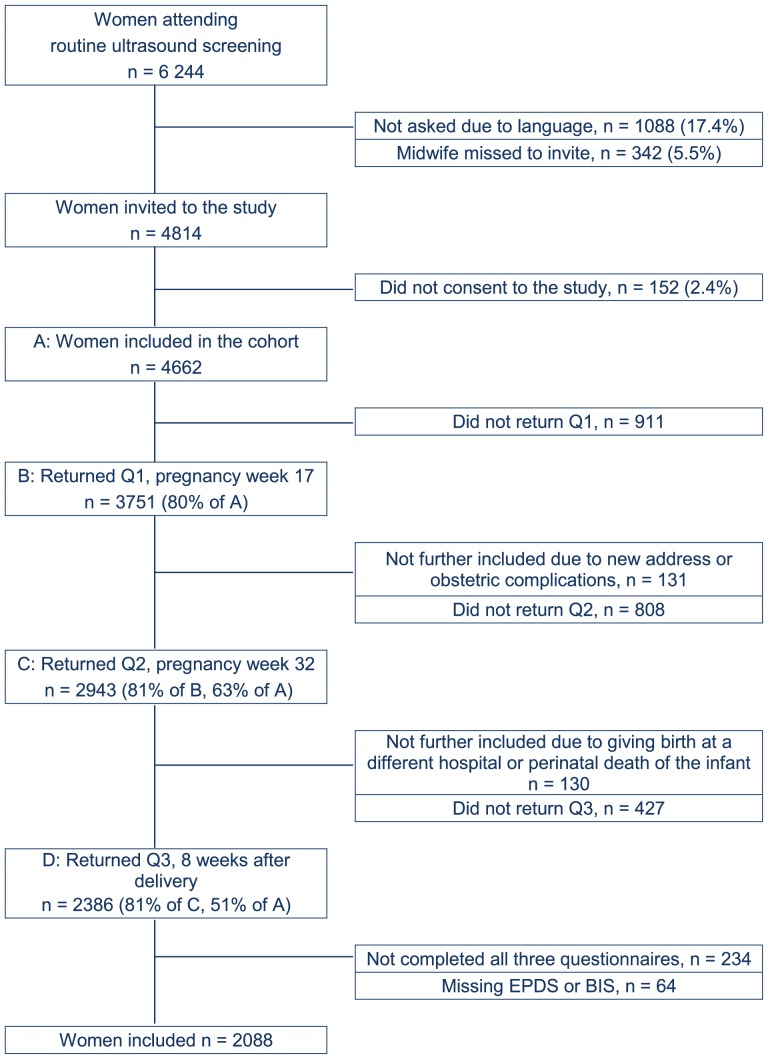
A longitudinal, population-based study was conducted among perinatal women giving birth at Akershus University Hospital, Norway. Women received questionnaires in weeks 17 and 32 of pregnancy and eight weeks postpartum. This paper presents data from 2,088 of 4,662 women with complete data for insomnia and depression in week 32 of pregnancy and eight weeks postpartum. Sleep times, wake-up times and average sleep durations were self-reported. The Bergen Insomnia Scale (BIS) was used to measure insomnia. The Edinburgh Postnatal Depression Scale (EPDS) was used to measure depressive symptoms.
After delivery, sleep duration was reduced by 49 minutes (to 6.5 hours), and mean sleep efficiency was reduced from 84% to 75%. However, self-reported insomnia scores (BIS) improved from 17.2 to 15.4, and the reported prevalence of insomnia decreased from 61.6% to 53.8%. High EPDS scores and anxiety in pregnancy, fear of delivery, previous depression, primiparity, and higher educational level were risk factors for both postpartum insomnia and depression. Insomnia did not predict postpartum depression in women with no prior history of depression, whereas women who recovered from depression had residual insomnia.
Depression and insomnia were not verified by clinical interviews. Women with depressive symptoms were less likely to remain in the study.
Although women slept fewer hours at night after delivery compared to during late pregnancy, and reported more nights with nighttime awakenings, their self-reported insomnia scores improved, and the prevalence of insomnia according to the DSM-IV criteria decreased. Insomnia in pregnancy may be a marker for postpartum recurrence of depression among women with previous depression.
失眠与抑郁症密切相关。本研究旨在描述分娩前后睡眠的变化,并评估孕期失眠是否为产后抑郁症的预测因素。
在挪威阿克什胡斯大学医院分娩的围产期妇女中开展了一项基于人群的纵向研究。妇女在孕期第17周和第32周以及产后8周收到问卷。本文呈现了4662名妇女中2088名的数据,这些妇女在孕期第32周和产后8周有关于失眠和抑郁症的完整数据。睡眠时间、起床时间和平均睡眠时长均为自我报告。使用卑尔根失眠量表(BIS)测量失眠。使用爱丁堡产后抑郁量表(EPDS)测量抑郁症状。
分娩后,睡眠时长减少了49分钟(降至6.5小时),平均睡眠效率从84%降至75%。然而,自我报告的失眠评分(BIS)从17.2改善至15.4,报告的失眠患病率从61.6%降至53.8%。EPDS高分、孕期焦虑、害怕分娩、既往抑郁症史、初产以及较高教育水平是产后失眠和抑郁症的危险因素。对于无抑郁症既往史的女性,失眠并不能预测产后抑郁症,而从抑郁症中康复的女性存在残留失眠。
抑郁症和失眠未通过临床访谈进行核实。有抑郁症状的女性留在研究中的可能性较小。
尽管与妊娠晚期相比,女性产后夜间睡眠时间减少,且报告夜间觉醒的夜晚更多,但她们自我报告的失眠评分有所改善,根据《精神疾病诊断与统计手册》第四版标准的失眠患病率下降。孕期失眠可能是既往有抑郁症的女性产后抑郁症复发的一个标志。