Zhang Pingping, Shao Ming'an
State Key Laboratory of Soil Erosion and Dryland Farming on the Loess Plateau, Northwest A & F University, Yangling, China.
State Key Laboratory of Soil Erosion and Dryland Farming on the Loess Plateau, Northwest A & F University, Yangling, China; Key Laboratory of Ecosystem Network Observation and Modeling, Institute of Geographical Science and Natural Resources, Chinese Academy of Sciences, Beijing, China.
PLoS One. 2014 Apr 14;9(4):e93584. doi: 10.1371/journal.pone.0093584. eCollection 2014.
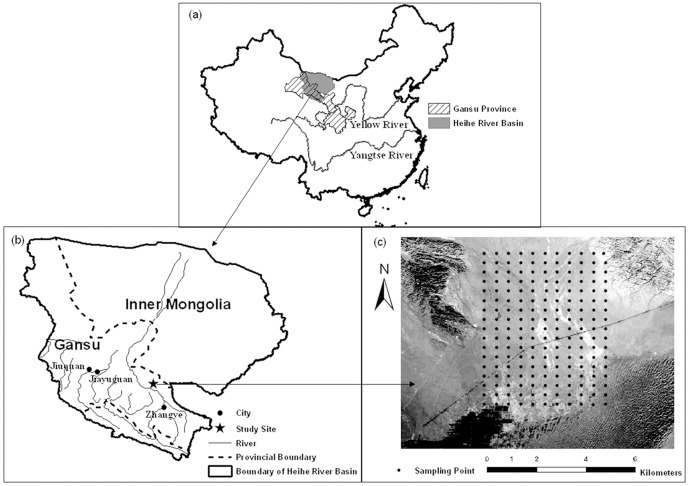
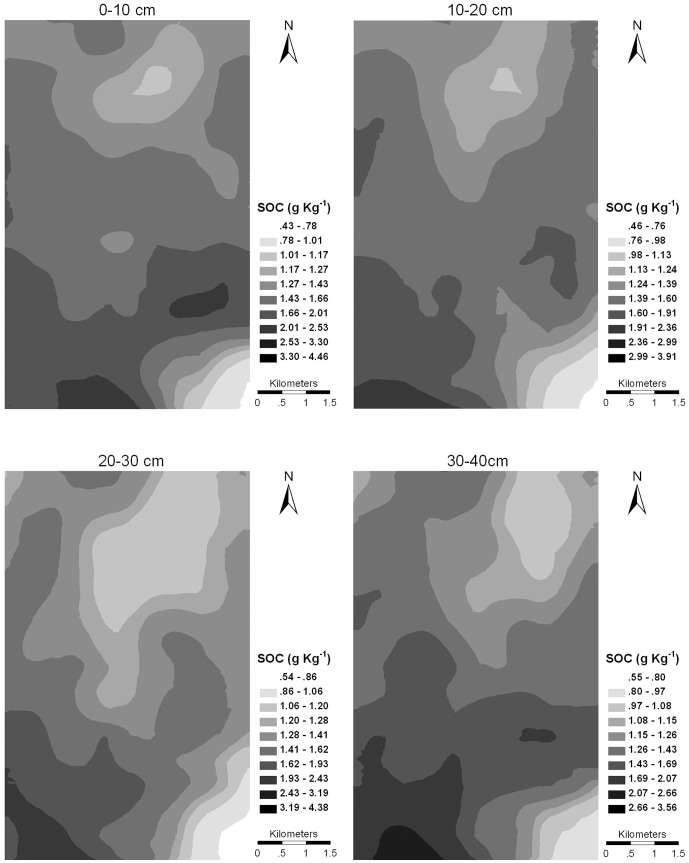
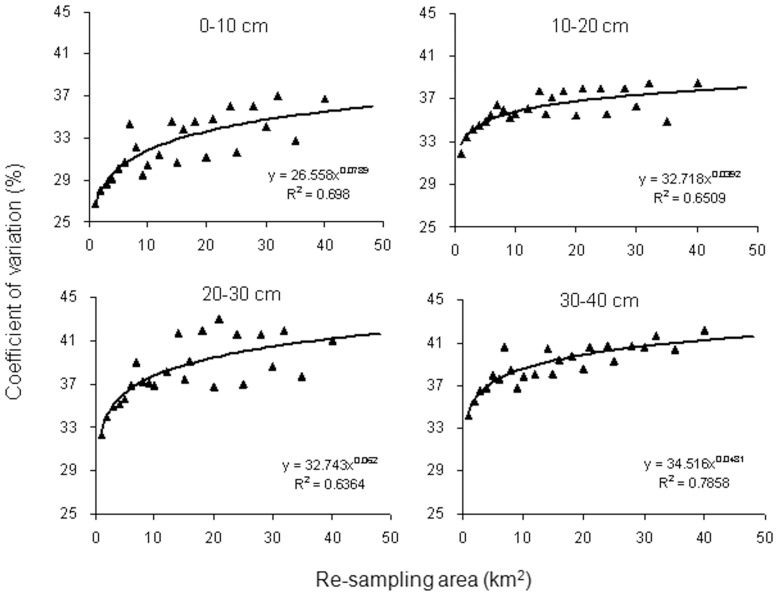
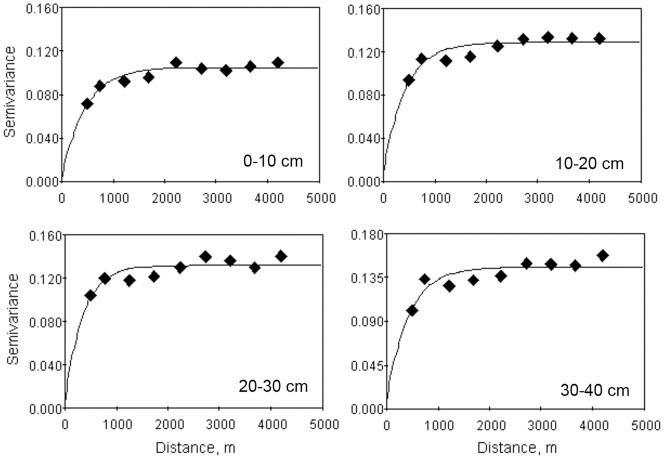
Soil organic carbon (SOC) plays an important role in improving soil properties and the C global cycle. Limited attention, though, has been given to assessing the spatial patterns and stocks of SOC in desert ecosystems. In this study, we quantitatively evaluated the spatial variability of SOC and its influencing factors and estimated SOC storage in a region (40 km2) of the Gobi desert. SOC exhibited a log-normal depth distribution with means of 1.6, 1.5, 1.4, and 1.4 g kg(-1) for the 0-10, 10-20, 20-30, and 30-40 cm layers, respectively, and was moderately variable according to the coefficients of variation (37-42%). Variability of SOC increased as the sampling area expanded and could be well parameterized as a power function of the sampling area. Significant correlations were detected between SOC and soil physical properties, i.e. stone, sand, silt, and clay contents and soil bulk density. The relatively coarse fractions, i.e. sand, silt, and stone contents, had the largest effects on SOC variability. Experimental semivariograms of SOC were best fitted by exponential models. Nugget-to-sill ratios indicated a strong spatial dependence for SOC concentrations at all depths in the study area. The surface layer (0-10 cm) had the largest spatial dependency compared with the other layers. The mapping revealed a decreasing trend of SOC concentrations from south to north across this region of the Gobi desert, with higher levels close to an oasis and lower levels surrounded by mountains and near the desert. SOC density to depths of 20 and 40 cm for this 40 km2 area was estimated at 0.42 and 0.68 kg C m(-2), respectively. This study provides an important contribution to understanding the role of the Gobi desert in the global carbon cycle.
土壤有机碳(SOC)在改善土壤性质和全球碳循环中起着重要作用。然而,对于评估沙漠生态系统中SOC的空间格局和储量,人们关注较少。在本研究中,我们定量评估了SOC的空间变异性及其影响因素,并估算了戈壁沙漠一个区域(40平方公里)的SOC储量。SOC呈现对数正态深度分布,0-10厘米、10-20厘米、20-30厘米和30-40厘米土层的平均值分别为1.6、1.5、1.4和1.4克/千克,根据变异系数(37-42%),其变异性中等。随着采样面积的扩大,SOC的变异性增加,并且可以很好地用采样面积的幂函数进行参数化。SOC与土壤物理性质(即石块、沙子、粉砂和黏土含量以及土壤容重)之间存在显著相关性。相对较粗的组分,即沙子、粉砂和石块含量,对SOC变异性的影响最大。SOC的实验半方差图最适合用指数模型拟合。块金值与基台值之比表明,研究区域内所有深度的SOC浓度都具有很强的空间依赖性。与其他层相比,表层(0-10厘米)的空间依赖性最大。该地图显示,在戈壁沙漠的这个区域,SOC浓度从南向北呈下降趋势,靠近绿洲的水平较高,而被山脉环绕且靠近沙漠的地区水平较低。对于这个40平方公里的区域,估计20厘米和40厘米深度的SOC密度分别为0.42和0.68千克碳/平方米。本研究为理解戈壁沙漠在全球碳循环中的作用做出了重要贡献。