Westrate Laura M, Drocco Jeffrey A, Martin Katie R, Hlavacek William S, MacKeigan Jeffrey P
Laboratory of Systems Biology, Van Andel Research Institute, Grand Rapids, Michigan, United States of America; Van Andel Institute Graduate School, Grand Rapids, Michigan, United States of America.
Center for Nonlinear Studies, Theoretical Division, Los Alamos National Laboratory, Los Alamos, New Mexico, United States of America; Biosciences and Biotechnology Division, Lawrence Livermore National Laboratory, Livermore, California, United States of America.
PLoS One. 2014 Apr 14;9(4):e95265. doi: 10.1371/journal.pone.0095265. eCollection 2014.
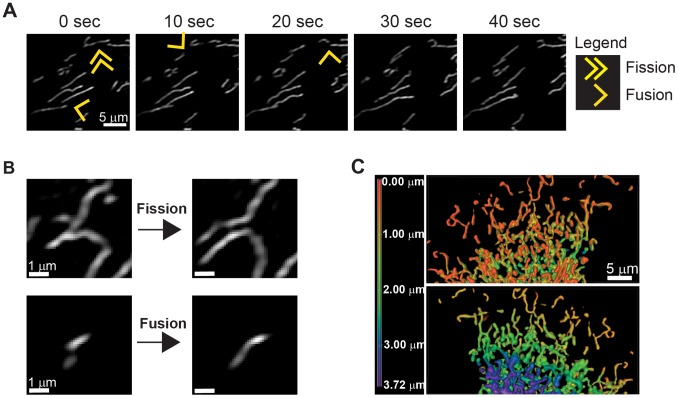
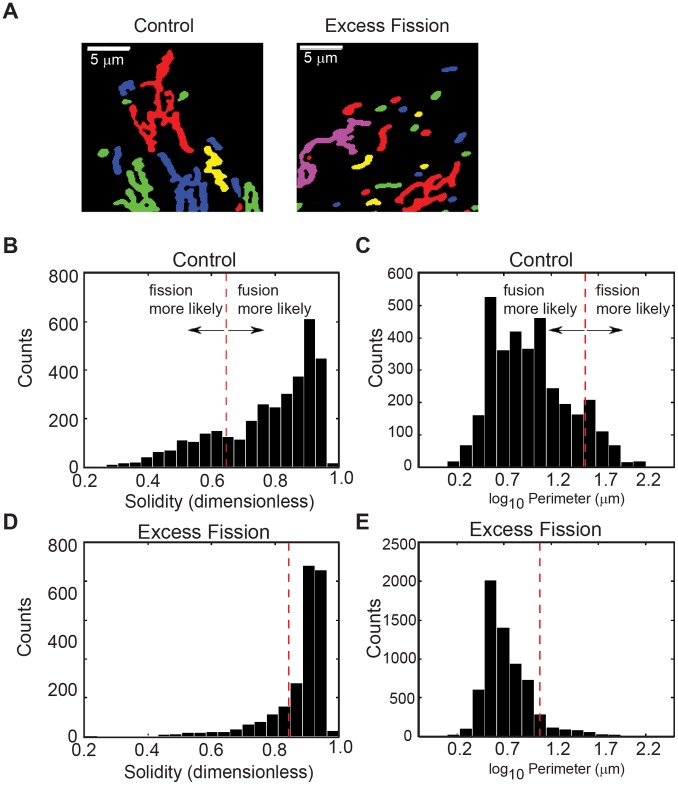
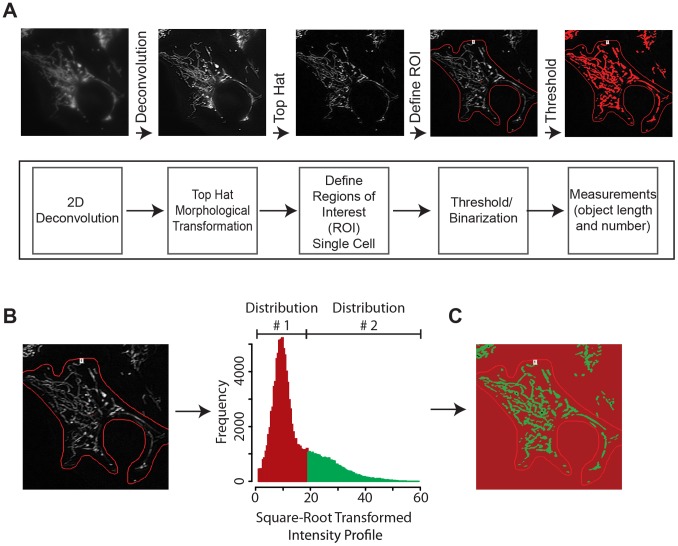
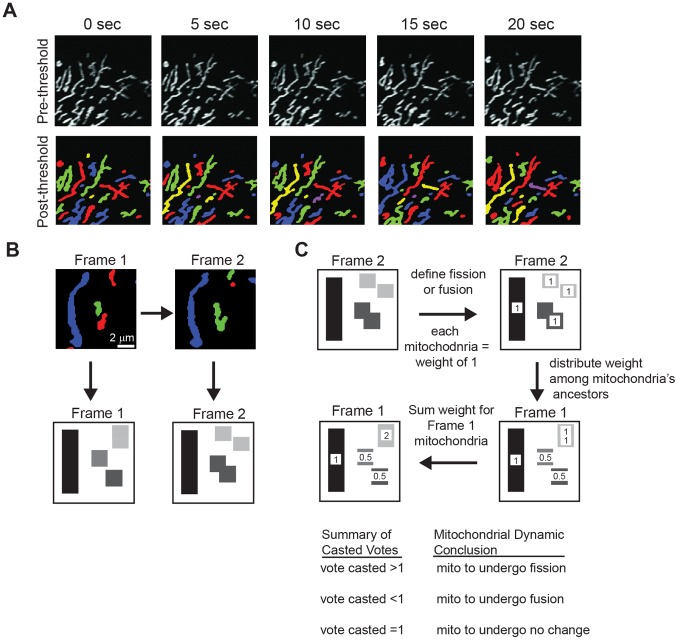
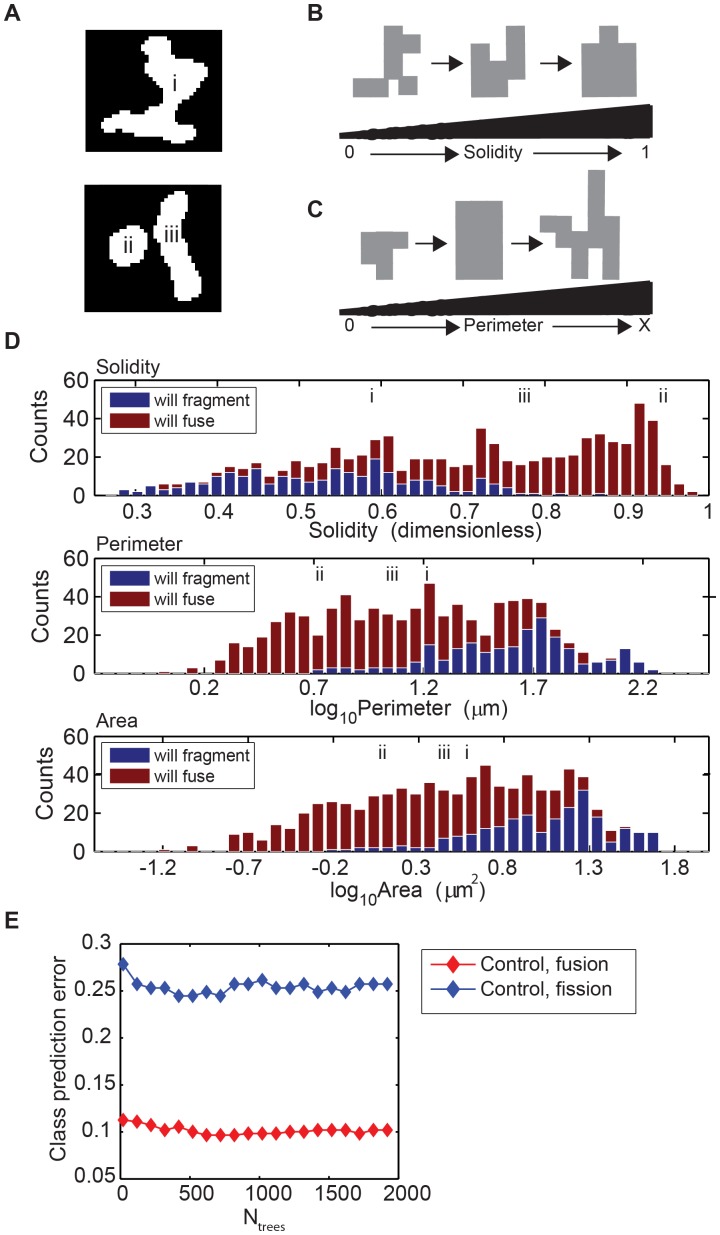
Mitochondria are dynamic organelles that undergo constant remodeling through the regulation of two opposing processes, mitochondrial fission and fusion. Although several key regulators and physiological stimuli have been identified to control mitochondrial fission and fusion, the role of mitochondrial morphology in the two processes remains to be determined. To address this knowledge gap, we investigated whether morphological features extracted from time-lapse live-cell images of mitochondria could be used to predict mitochondrial fate. That is, we asked if we could predict whether a mitochondrion is likely to participate in a fission or fusion event based on its current shape and local environment. Using live-cell microscopy, image analysis software, and supervised machine learning, we characterized mitochondrial dynamics with single-organelle resolution to identify features of mitochondria that are predictive of fission and fusion events. A random forest (RF) model was trained to correctly classify mitochondria poised for either fission or fusion based on a series of morphological and positional features for each organelle. Of the features we evaluated, mitochondrial perimeter positively correlated with mitochondria about to undergo a fission event. Similarly mitochondrial solidity (compact shape) positively correlated with mitochondria about to undergo a fusion event. Our results indicate that fission and fusion are positively correlated with mitochondrial morphological features; and therefore, mitochondrial fission and fusion may be influenced by the mechanical properties of mitochondrial membranes.
线粒体是动态细胞器,通过线粒体分裂和融合这两个相反过程的调控不断进行重塑。尽管已鉴定出几种关键调节因子和生理刺激来控制线粒体分裂和融合,但线粒体形态在这两个过程中的作用仍有待确定。为填补这一知识空白,我们研究了从线粒体延时活细胞图像中提取的形态特征是否可用于预测线粒体命运。也就是说,我们询问是否能根据线粒体当前的形状和局部环境预测其是否可能参与分裂或融合事件。利用活细胞显微镜、图像分析软件和监督机器学习,我们以单细胞器分辨率表征线粒体动力学,以识别可预测分裂和融合事件的线粒体特征。基于每个细胞器的一系列形态和位置特征,训练了一个随机森林(RF)模型来正确分类准备进行分裂或融合的线粒体。在我们评估的特征中,线粒体周长与即将发生分裂事件的线粒体呈正相关。同样,线粒体紧实度(紧凑形状)与即将发生融合事件的线粒体呈正相关。我们的结果表明,分裂和融合与线粒体形态特征呈正相关;因此,线粒体分裂和融合可能受线粒体膜机械特性的影响。