Park Sunghoon, Kim Joo-Hee, Hwang Yong Il, Jung Ki-Suck, Jang Young Sook, Jang Seung Hun
Division of Pulmonary, Allergy and Critical Care Medicine, Department of Internal Medicine, Hallym University Sacred Heart Hospital, Hallym University College of Medicine, Anyang, Korea.
Tuberc Respir Dis (Seoul). 2014 Mar;76(3):114-9. doi: 10.4046/trd.2014.76.3.114. Epub 2014 Mar 29.
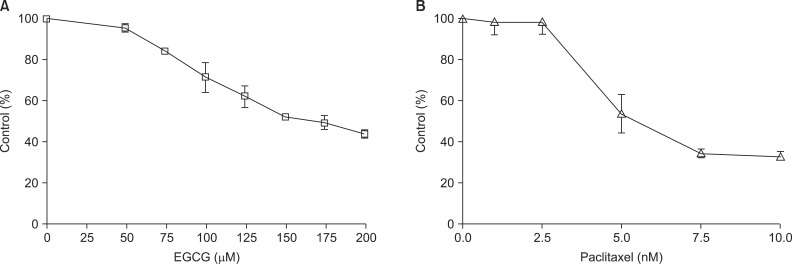
Epigallocatechin-3-gallate (EGCG), a major biologically active component of green tea, has anti-cancer activity in human and animal models. We investigated the schedule-dependent effect of EGCG and paclitaxel on growth of NCI-H460 non-small cell lung cancer cells.
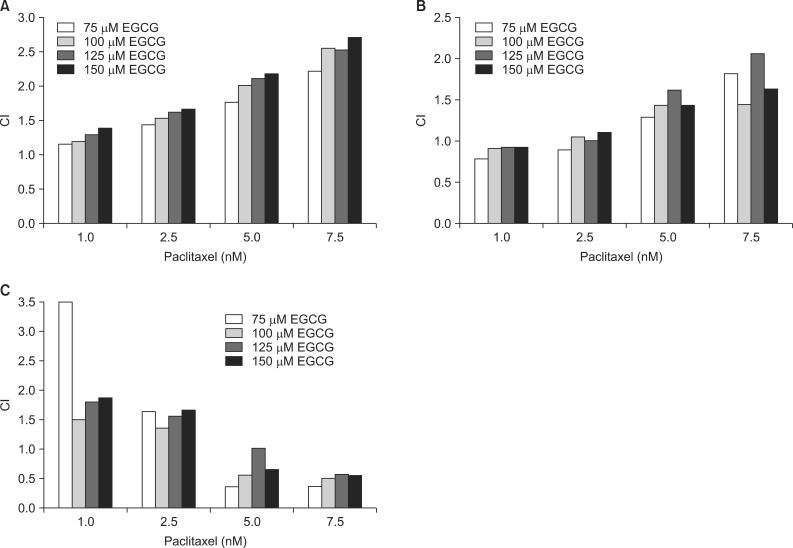
To investigate the combined effect of EGCG (E) and paclitaxel (P), combination indices (CIs) were calculated, and cell cycle analysis was performed. For the effect on cell apoptosis, western blot analysis was also performed.
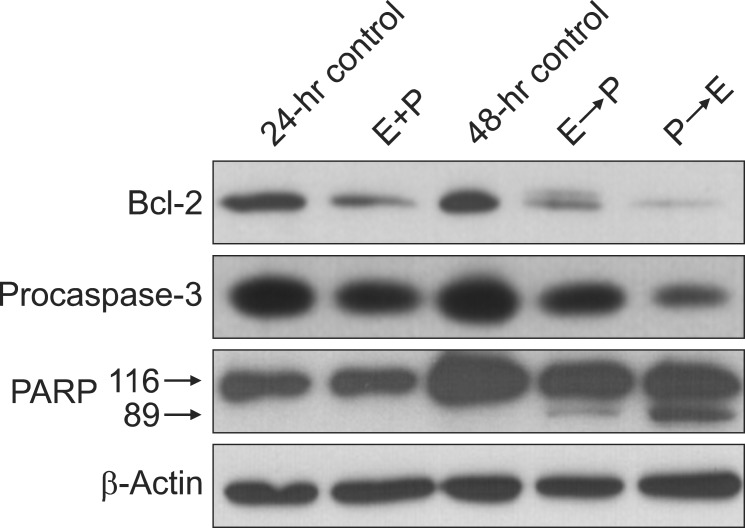
CI analysis demonstrated that both concurrent and sequential E → P treatments had antagonistic effects (CIs >1.0), but sequential P → E had synergistic effects (CIs <1.0), on the growth inhibition of NCI-H460 cells. In the cell cycle analysis, although paclitaxel induced G2/M cell cycle arrest and increased the sub-G1 fraction, concurrent EGCG and paclitaxel treatments did not have any additive or synergistic effects compared with the paclitaxel treatment alone. However, western blot analysis demonstrated that sequential P → E treatment decreased the expression of Bcl-2 and procaspase-3 and increased poly(ADP-ribose) polymerase (PARP) cleavage; while minimal effects were seen with concurrent or sequential E → P treatments.
Concurrent or sequential E → P treatment had opposite effects to P → E treatment, where P → E treatment showed a synergistic effect on growth inhibition of NCI-H460 cells by inducing apoptosis. Thus, the efficacy of EGCG and paclitaxel combination treatment seems to be schedule-dependent.
表没食子儿茶素-3-没食子酸酯(EGCG)是绿茶的主要生物活性成分,在人和动物模型中具有抗癌活性。我们研究了EGCG和紫杉醇对NCI-H460非小细胞肺癌细胞生长的时间依赖性影响。
为研究EGCG(E)和紫杉醇(P)的联合作用,计算联合指数(CI),并进行细胞周期分析。为研究对细胞凋亡的影响,还进行了蛋白质印迹分析。
CI分析表明,同时使用和序贯E→P处理对NCI-H460细胞的生长抑制均具有拮抗作用(CI>1.0),但序贯P→E具有协同作用(CI<1.0)。在细胞周期分析中,尽管紫杉醇诱导G2/M期细胞周期阻滞并增加亚G1期比例,但与单独使用紫杉醇相比,同时使用EGCG和紫杉醇处理没有任何相加或协同作用。然而,蛋白质印迹分析表明,序贯P→E处理降低了Bcl-2和procaspase-3的表达,并增加了聚(ADP-核糖)聚合酶(PARP)的裂解;而同时使用或序贯E→P处理的影响最小。
同时使用或序贯E→P处理与P→E处理具有相反的效果,其中P→E处理通过诱导凋亡对NCI-H460细胞的生长抑制显示出协同作用。因此,EGCG和紫杉醇联合治疗的疗效似乎取决于给药顺序。