Bai Hanako, Sakurai Toshihiro, Bai Rulan, Yamakoshi Sachiko, Aoki Etsunari, Kuse Mariko, Okuda Kiyoshi, Imakawa Kazuhiko
Laboratory of Theriogenology and Animal Breeding, Graduate School of Agricultural and Life Science, the University of Tokyo, Tokyo.
Anim Sci J. 2014 Aug;85(8):799-804. doi: 10.1111/asj.12202. Epub 2014 Apr 15.
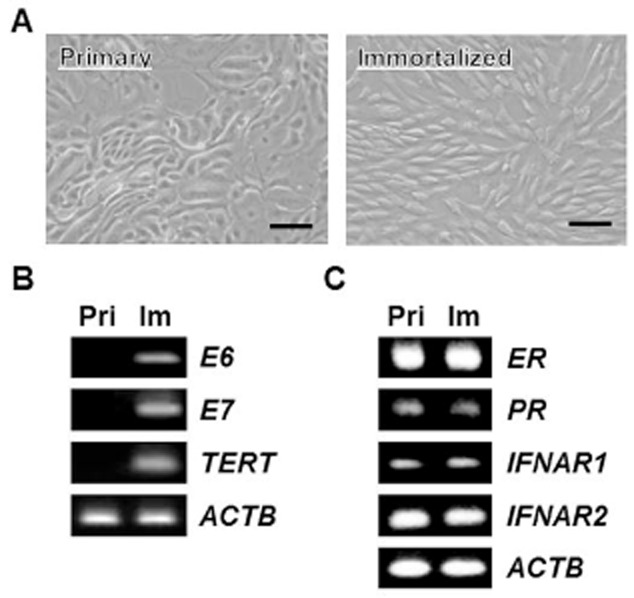
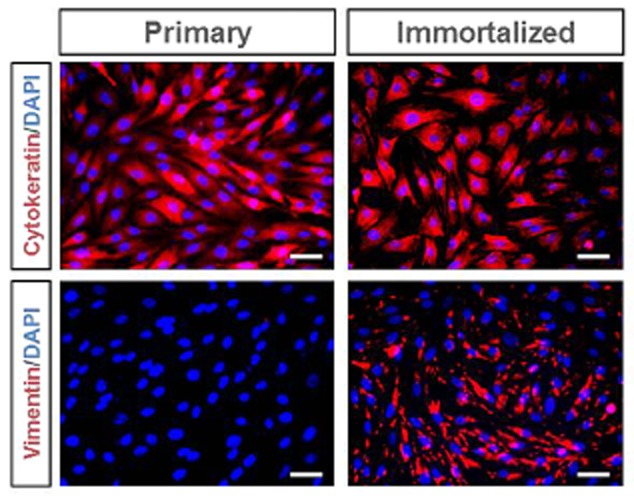
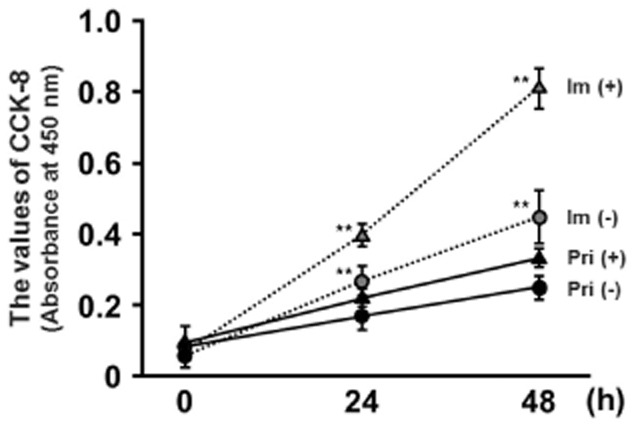
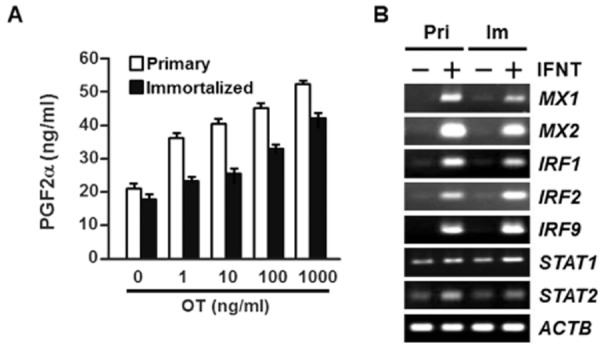
Bovine primary uterine endometrial epithelial cells (EECs) are not ideal for long-term studies, because primary EECs lose hormone responsiveness quickly, and/or they tend to have a short life span. The aims of this study were to establish immortalized bovine EECs and to characterize these cells following long-term cultures. Immortalized bovine EECs were established by transfecting retroviral vectors encoding human papillomavirus (HPV) E6 and E7, and human telomerase reverse transcriptase (hTERT) genes. Established bovine immortalized EECs (imEECs) showed the same morphology as primary EECs, and could be grown without any apparent changes for over 60 passages. In addition, imEECs have maintained the features as EECs, exhibiting oxytocin (OT) and interferon tau (IFNT) responsiveness. Therefore, these imEECs, even after numbers of passages, could be used as an in vitro model to investigate cellular and molecular mechanisms, by which the uterine epithelium responds to IFNT stimulation, the event required for the maternal recognition of pregnancy in the bovine species.
牛原代子宫子宫内膜上皮细胞(EECs)并不适合用于长期研究,因为原代EECs会迅速丧失激素反应性,和/或它们往往寿命较短。本研究的目的是建立永生化牛EECs,并对这些细胞进行长期培养后的特性鉴定。通过转染编码人乳头瘤病毒(HPV)E6和E7以及人端粒酶逆转录酶(hTERT)基因的逆转录病毒载体来建立永生化牛EECs。建立的牛永生化EECs(imEECs)与原代EECs具有相同的形态,并且可以在超过60代的培养过程中无明显变化地生长。此外,imEECs保持了EECs的特征,表现出对催产素(OT)和干扰素τ(IFNT)的反应性。因此,这些imEECs即使经过多次传代,也可作为体外模型来研究子宫上皮对IFNT刺激作出反应的细胞和分子机制,这是牛种母体识别妊娠所必需的事件。