Fontanesi Luca, Vargiolu Manuela, Scotti Emilio, Latorre Rocco, Faussone Pellegrini Maria Simonetta, Mazzoni Maurizio, Asti Martina, Chiocchetti Roberto, Romeo Giovanni, Clavenzani Paolo, De Giorgio Roberto
Department of Agricultural and Food Sciences, Division of Animal Sciences, Laboratory of Livestock Genomics, University of Bologna, Bologna, Italy; Centre for Genome Biology, University of Bologna, Bologna, Italy.
Health Sciences and Technologies-Interdepartmental Center for Industrial Research, University of Bologna, Bologna, Italy.
PLoS One. 2014 Apr 15;9(4):e93750. doi: 10.1371/journal.pone.0093750. eCollection 2014.
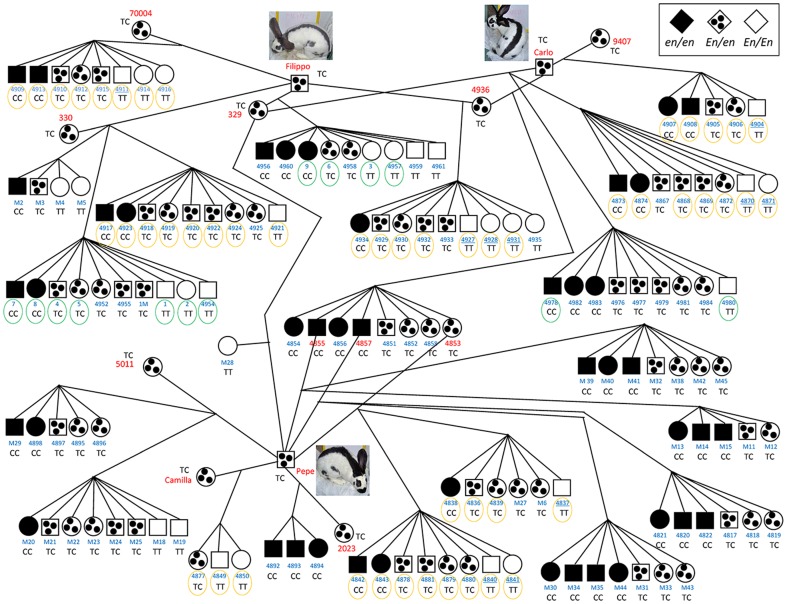
The English spotting coat color locus in rabbits, also known as Dominant white spotting locus, is determined by an incompletely dominant allele (En). Rabbits homozygous for the recessive wild-type allele (en/en) are self-colored, heterozygous En/en rabbits are normally spotted, and homozygous En/En animals are almost completely white. Compared to vital en/en and En/en rabbits, En/En animals are subvital because of a dilated ("mega") cecum and ascending colon. In this study, we investigated the role of the KIT gene as a candidate for the English spotting locus in Checkered Giant rabbits and characterized the abnormalities affecting enteric neurons and c-kit positive interstitial cells of Cajal (ICC) in the megacolon of En/En rabbits. Twenty-one litters were obtained by crossing three Checkered Giant bucks (En/en) with nine Checkered Giant (En/en) and two en/en does, producing a total of 138 F1 and backcrossed rabbits. Resequencing all coding exons and portions of non-coding regions of the KIT gene in 28 rabbits of different breeds identified 98 polymorphisms. A single nucleotide polymorphism genotyped in all F1 families showed complete cosegregation with the English spotting coat color phenotype (θ=0.00 LOD =75.56). KIT gene expression in cecum and colon specimens of En/En (pathological) rabbits was 5-10% of that of en/en (control) rabbits. En/En rabbits showed reduced and altered c-kit immunolabelled ICC compared to en/en controls. Morphometric data on whole mounts of the ascending colon showed a significant decrease of HuC/D (P<0.05) and substance P (P<0.01) immunoreactive neurons in En/En vs. en/en. Electron microscopy analysis showed neuronal and ICC abnormalities in En/En tissues. The En/En rabbit model shows neuro-ICC changes reminiscent of the human non-aganglionic megacolon. This rabbit model may provide a better understanding of the molecular abnormalities underlying conditions associated with non-aganglionic megacolon.
兔子的英文斑点毛色基因座,也被称为显性白色斑点基因座,由一个不完全显性等位基因(En)决定。隐性野生型等位基因纯合的兔子(en/en)毛色均一,杂合的En/en兔子通常有斑点,而纯合的En/En动物几乎完全为白色。与有活力的en/en和En/en兔子相比,En/En动物因盲肠和升结肠扩张(“巨大”)而活力不足。在本研究中,我们调查了KIT基因作为花斑巨兔英文斑点基因座候选基因的作用,并描述了En/En兔子巨结肠中影响肠神经元和c-kit阳性Cajal间质细胞(ICC)的异常情况。通过将3只花斑巨兔雄兔(En/en)与9只花斑巨兔(En/en)和2只en/en雌兔杂交,获得了21窝后代,共产生138只F1代和回交兔子。对28只不同品种兔子的KIT基因所有编码外显子和部分非编码区域进行重测序,鉴定出98个多态性。在所有F1家系中进行基因分型的一个单核苷酸多态性与英文斑点毛色表型完全共分离(θ=0.00,LOD =75.56)。En/En(病理)兔子盲肠和结肠标本中的KIT基因表达是en/en(对照)兔子的5%-10%。与en/en对照相比,En/En兔子的c-kit免疫标记ICC减少且发生改变。升结肠整装片的形态计量学数据显示,与en/en相比,En/En中HuC/D(P<0.05)和P物质(P<0.01)免疫反应性神经元显著减少。电子显微镜分析显示En/En组织中存在神经元和ICC异常。En/En兔子模型显示出类似于人类无神经节巨结肠的神经-ICC变化。该兔子模型可能有助于更好地理解与无神经节巨结肠相关疾病的分子异常情况。