Noguchi Takao, Stewart Neil, Olivola Christopher Y, Moat Helen Susannah, Preis Tobias
Department of Psychology, University of Warwick, Coventry, United Kingdom.
Tepper School of Business, Carnegie Mellon University, Pittsburgh, Pennsylvania, United States of America.
PLoS One. 2014 Apr 15;9(4):e95209. doi: 10.1371/journal.pone.0095209. eCollection 2014.
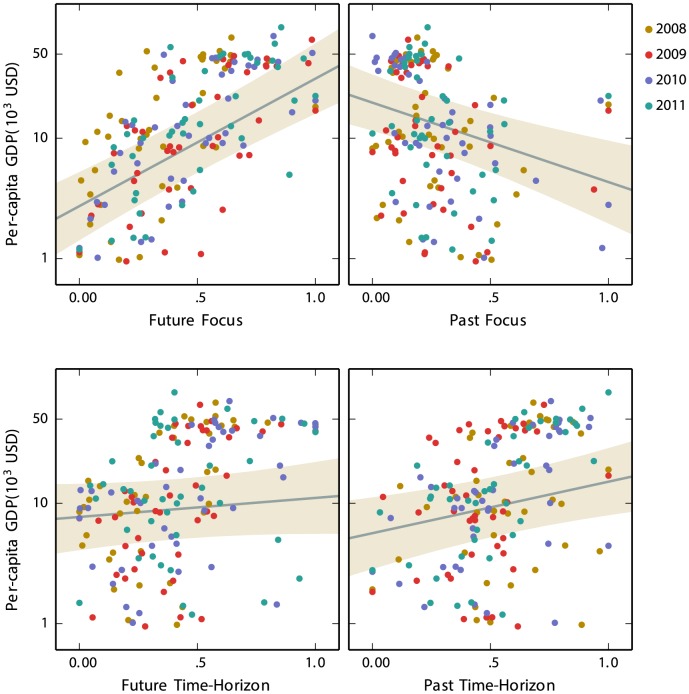
Vast quantities of data on human behavior are being created by our everyday internet usage. Building upon a recent study by Preis, Moat, Stanley, and Bishop (2012), we used search engine query data to construct measures of the time-perspective of nations, and tested these measures against per-capita gross domestic product (GDP). The results indicate that nations with higher per-capita GDP are more focused on the future and less on the past, and that when these nations do focus on the past, it is more likely to be the distant past. These results demonstrate the viability of using nation-level data to build psychological constructs.
我们日常的互联网使用正在产生大量关于人类行为的数据。基于普赖斯、莫特、斯坦利和毕晓普(2012年)最近的一项研究,我们使用搜索引擎查询数据构建了各国时间观的衡量指标,并针对人均国内生产总值(GDP)对这些指标进行了测试。结果表明,人均GDP较高的国家更关注未来,而对过去的关注较少,并且当这些国家确实关注过去时,更有可能是遥远的过去。这些结果证明了使用国家层面的数据来构建心理结构的可行性。