Sloan Luke, Morgan Jeffrey
School of Social Sciences, Cardiff University, Cardiff, Wales.
School of Computer Science and Informatics, Cardiff University, Cardiff, Wales.
PLoS One. 2015 Nov 6;10(11):e0142209. doi: 10.1371/journal.pone.0142209. eCollection 2015.
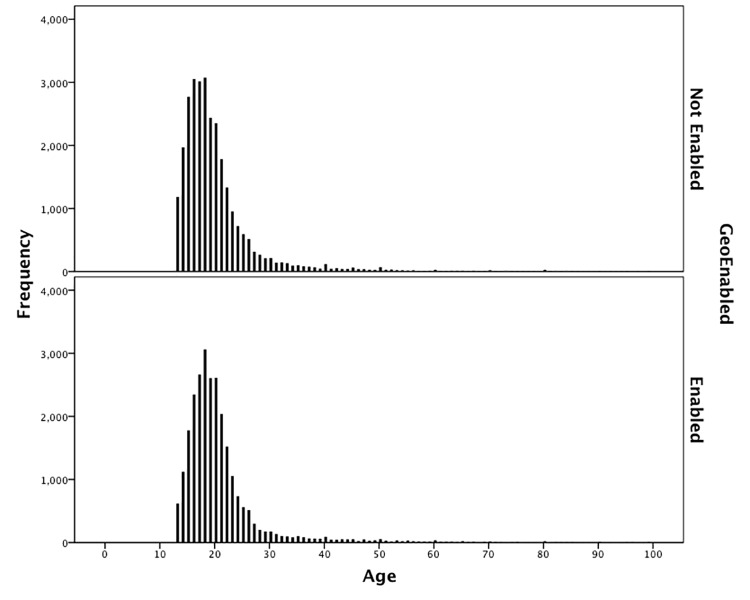
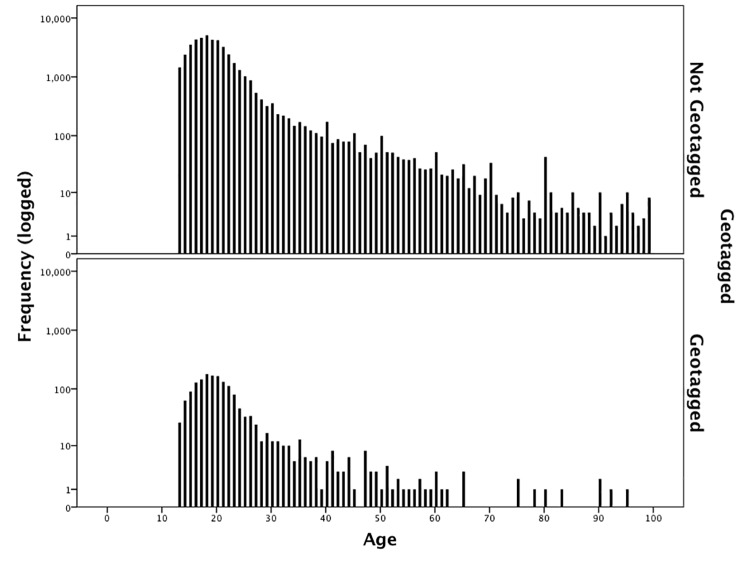
In this paper we take advantage of recent developments in identifying the demographic characteristics of Twitter users to explore the demographic differences between those who do and do not enable location services and those who do and do not geotag their tweets. We discuss the collation and processing of two datasets-one focusing on enabling geoservices and the other on tweet geotagging. We then investigate how opting in to either of these behaviours is associated with gender, age, class, the language in which tweets are written and the language in which users interact with the Twitter user interface. We find statistically significant differences for both behaviours for all demographic characteristics, although the magnitude of association differs substantially by factor. We conclude that there are significant demographic variations between those who opt in to geoservices and those who geotag their tweets. Not withstanding the limitations of the data, we suggest that Twitter users who publish geographical information are not representative of the wider Twitter population.
在本文中,我们利用近期在识别推特用户人口统计学特征方面的进展,来探究启用和未启用定位服务的用户之间,以及对推文添加和未添加地理标记的用户之间的人口统计学差异。我们讨论了两个数据集的整理和处理——一个聚焦于启用地理服务,另一个聚焦于推文地理标记。然后,我们研究选择进行这两种行为中的任何一种与性别、年龄、阶层、推文所使用的语言以及用户与推特用户界面交互所使用的语言之间的关联。我们发现,对于所有人口统计学特征而言,这两种行为均存在统计学上的显著差异,尽管关联程度因因素不同而有很大差异。我们得出结论,选择启用地理服务的用户和对推文添加地理标记的用户之间存在显著的人口统计学差异。尽管数据存在局限性,但我们认为发布地理信息的推特用户并不代表更广泛的推特用户群体。