Gladstone Institute of Neurological Disease, University of California, San Francisco, San Francisco, CA.
Ann Neurol. 2014 Feb;75(2):303-8. doi: 10.1002/ana.24078. Epub 2014 Feb 24.
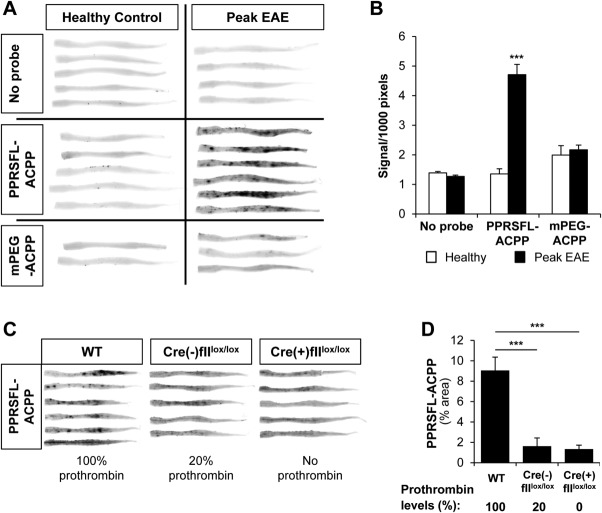
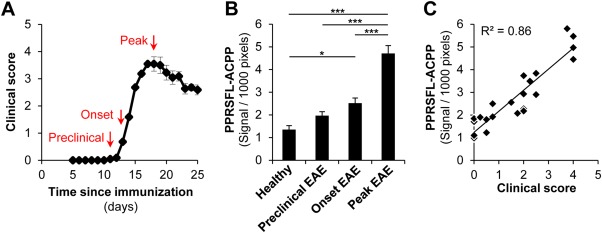
Although multiple sclerosis (MS) has been associated with the coagulation system, the temporal and spatial regulation of coagulation activity in neuroinflammatory lesions is unknown. Using a novel molecular probe, we characterized the activity pattern of thrombin, the central protease of the coagulation cascade, in experimental autoimmune encephalomyelitis. Thrombin activity preceded onset of neurological signs, increased at disease peak, and correlated with fibrin deposition, microglial activation, demyelination, axonal damage, and clinical severity. Mice with a genetic deficit in prothrombin confirmed the specificity of the thrombin probe. Thrombin activity might be exploited for developing sensitive probes for preclinical detection and monitoring of neuroinflammation and MS progression.
尽管多发性硬化症 (MS) 与凝血系统有关,但神经炎症病变中凝血活性的时空调节尚不清楚。本研究使用新型分子探针,研究了凝血级联反应的中心蛋白酶——凝血酶在实验性自身免疫性脑脊髓炎中的活性模式。凝血酶活性先于神经症状出现,在疾病高峰期增加,与纤维蛋白沉积、小胶质细胞激活、脱髓鞘、轴突损伤和临床严重程度相关。缺乏凝血酶原的基因缺陷小鼠证实了凝血酶探针的特异性。凝血酶活性可能被用于开发用于临床前检测和监测神经炎症和 MS 进展的敏感探针。