
二氧化碳和氮气注入置换煤层甲烷过程及效率的实验室研究
Laboratory study of the displacement coalbed CH4 process and efficiency of CO2 and N2 injection.
作者信息
Wang Liguo, Cheng Yuanping, Wang Yongkang
机构信息
National Engineering Research Center for Coal & Gas Control, China University of Mining & Technology, Xuzhou 221116, China ; College of Safety Science and Engineering, Henan Polytechnic University, Jiaozuo 454000, China.
National Engineering Research Center for Coal & Gas Control, China University of Mining & Technology, Xuzhou 221116, China.
出版信息
ScientificWorldJournal. 2014 Mar 6;2014:242947. doi: 10.1155/2014/242947. eCollection 2014.
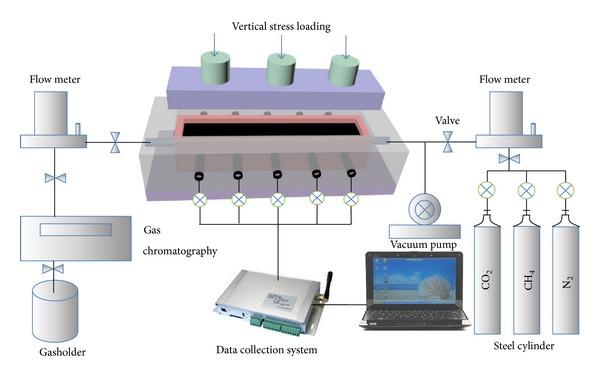
ECBM displacement experiments are a direct way to observe the gas displacement process and efficiency by inspecting the produced gas composition and flow rate. We conducted two sets of ECBM experiments by injecting N2 and CO2 through four large parallel specimens (300 × 50 × 50 mm coal briquette). N2 or CO2 is injected at pressures of 1.5, 1.8, and 2.2 MPa and various crustal stresses. The changes in pressure along the briquette and the concentration of the gas mixture flowing out of the briquette were analyzed. Gas injection significantly enhances CBM recovery. Experimental recoveries of the original extant gas are in excess of 90% for all cases. The results show that the N2 breakthrough occurs earlier than the CO2 breakthrough. The breakthrough time of N2 is approximately 0.5 displaced volumes. Carbon dioxide, however, breaks through at approximately 2 displaced volumes. Coal can adsorb CO2, which results in a slower breakthrough time. In addition, ground stress significantly influences the displacement effect of the gas injection.
煤层气置换实验是通过检测产出气体的成分和流量来直接观察气体置换过程及效率的一种方法。我们通过四个大型平行样本(300×50×50毫米型煤)注入氮气和二氧化碳进行了两组煤层气置换实验。氮气或二氧化碳在1.5、1.8和2.2兆帕的压力以及不同地应力条件下注入。分析了沿型煤的压力变化以及从型煤中流出的混合气体的浓度。注气显著提高了煤层气的采收率。在所有情况下,原始现存气体的实验采收率均超过90%。结果表明,氮气突破比二氧化碳突破更早发生。氮气的突破时间约为0.5倍置换体积。然而,二氧化碳在约2倍置换体积时突破。煤能够吸附二氧化碳,这导致突破时间更慢。此外,地应力显著影响注气的置换效果。



 Zotero 插件