Loomis Erick W, Sanz Lionel A, Chédin Frédéric, Hagerman Paul J
Department of Biochemistry and Molecular Medicine, University of California, Davis, School of Medicine, Davis, California, United States of America.
Department of Molecular and Cellular Biology, University of California, Davis, Davis, California, United States of America; The Genome Center, University of California, Davis, Davis, California, United States of America.
PLoS Genet. 2014 Apr 17;10(4):e1004294. doi: 10.1371/journal.pgen.1004294. eCollection 2014 Apr.
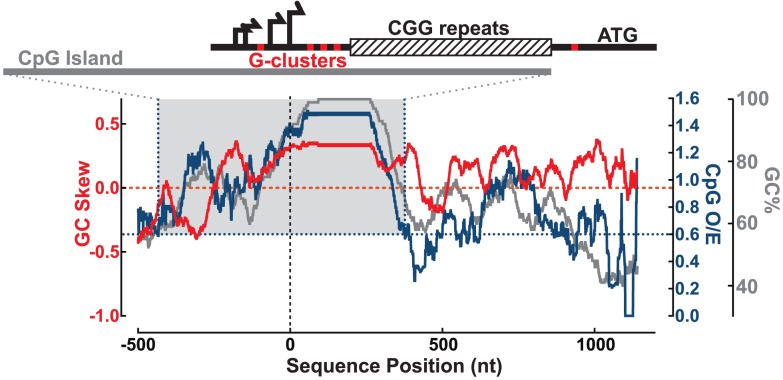
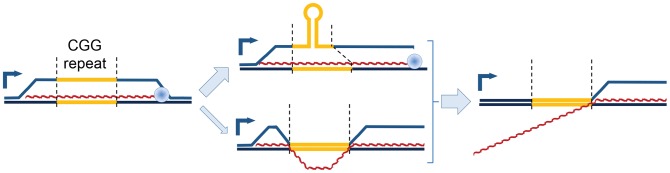
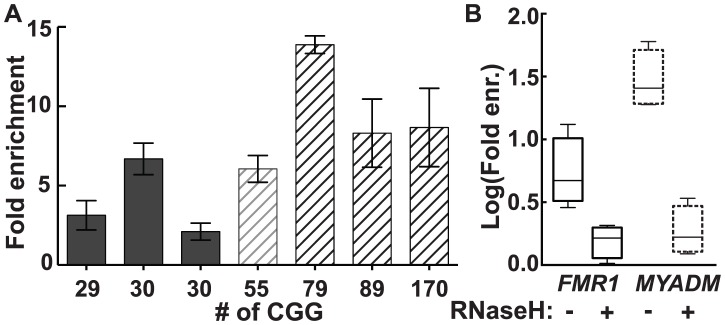
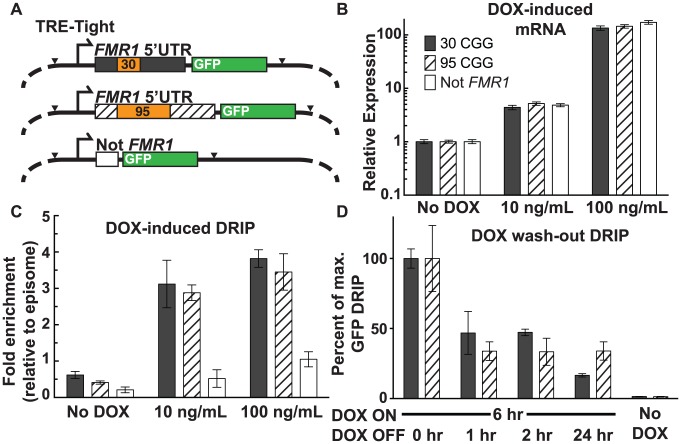
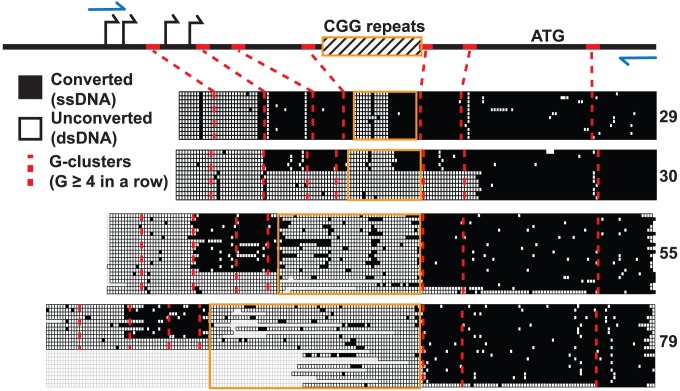
Expansion of a trinucleotide (CGG) repeat element within the 5' untranslated region (5'UTR) of the human FMR1 gene is responsible for a number of heritable disorders operating through distinct pathogenic mechanisms: gene silencing for fragile X syndrome (>200 CGG) and RNA toxic gain-of-function for FXTAS (∼ 55-200 CGG). Existing models have focused almost exclusively on post-transcriptional mechanisms, but co-transcriptional processes could also contribute to the molecular dysfunction of FMR1. We have observed that transcription through the GC-rich FMR1 5'UTR region favors R-loop formation, with the nascent (G-rich) RNA forming a stable RNA:DNA hybrid with the template DNA strand, thereby displacing the non-template DNA strand. Using DNA:RNA (hybrid) immunoprecipitation (DRIP) of genomic DNA from cultured human dermal fibroblasts with both normal (∼ 30 CGG repeats) and premutation (55<CGG<200 repeats) alleles, we provide evidence for FMR1 R-loop formation in human genomic DNA. Using a doxycycline (DOX)-inducible episomal system in which both the CGG-repeat and transcription frequency can be varied, we further show that R-loop formation increases with higher expression levels. Finally, non-denaturing bisulfite mapping of the displaced single-stranded DNA confirmed R-loop formation at the endogenous FMR1 locus and further indicated that R-loops formed over CGG repeats may be prone to structural complexities, including hairpin formation, not commonly associated with other R-loops. These observations introduce a new molecular feature of the FMR1 gene that is directly affected by CGG-repeat expansion and is likely to be involved in the associated cellular dysfunction.
人类FMR1基因5'非翻译区(5'UTR)内三核苷酸(CGG)重复元件的扩增通过不同的致病机制导致多种遗传性疾病:脆性X综合征(>200个CGG)的基因沉默以及FXTAS(约55 - 200个CGG)的RNA毒性功能获得。现有模型几乎完全集中在转录后机制上,但共转录过程也可能导致FMR1的分子功能障碍。我们观察到,通过富含GC的FMR1 5'UTR区域进行转录有利于R环形成,新生的(富含G的)RNA与模板DNA链形成稳定的RNA:DNA杂交体,从而取代非模板DNA链。使用来自具有正常(约30个CGG重复)和前突变(55 < CGG < 200个重复)等位基因的培养人皮肤成纤维细胞的基因组DNA进行DNA:RNA(杂交)免疫沉淀(DRIP),我们提供了人类基因组DNA中FMR1 R环形成的证据。使用一种强力霉素(DOX)诱导的附加型系统,其中CGG重复和转录频率均可变化,我们进一步表明R环形成随着表达水平的升高而增加。最后,对被取代的单链DNA进行非变性亚硫酸氢盐作图证实了内源性FMR1基因座处的R环形成,并进一步表明在CGG重复上形成的R环可能易于形成包括发夹形成在内的结构复杂性,这与其他R环通常无关。这些观察结果引入了FMR1基因的一种新的分子特征,该特征直接受CGG重复扩增影响,并且可能参与相关的细胞功能障碍。