Azandémè-Hounmalon Ginette Y, Fellous Simon, Kreiter Serge, Fiaboe Komi K M, Subramanian Sevgan, Kungu Miriam, Martin Thibaud
Cirad, UPR Hortsys, Montpellier, France; icipe- Plant Health Department, Nairobi, Kenya.
INRA, UMR CBGP, Montpellier, France.
PLoS One. 2014 Apr 17;9(4):e95071. doi: 10.1371/journal.pone.0095071. eCollection 2014.
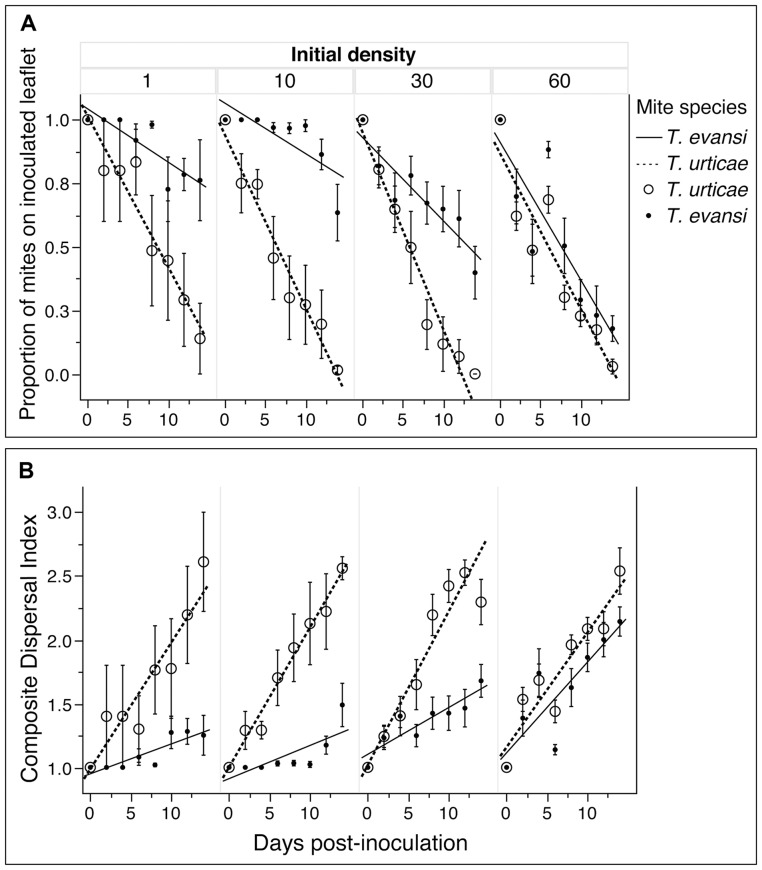
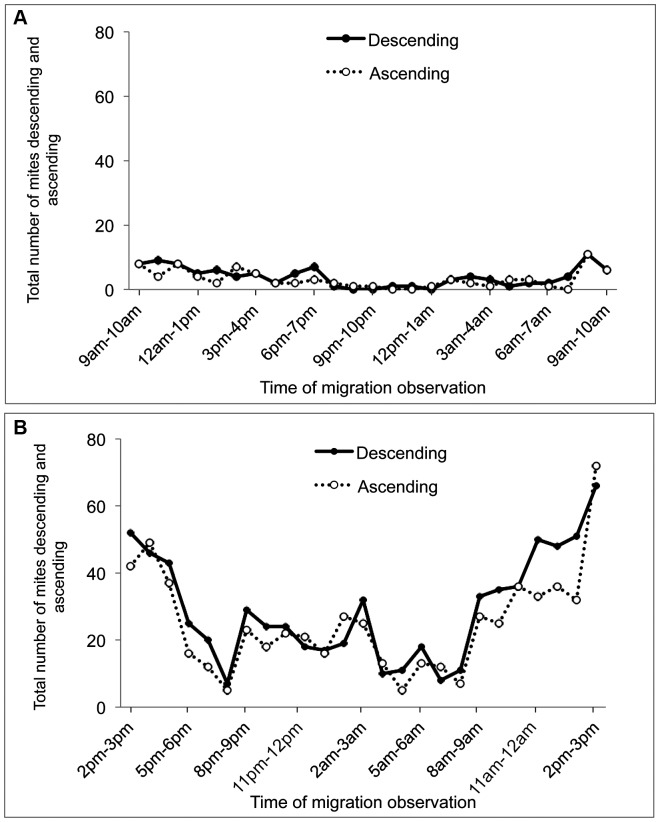
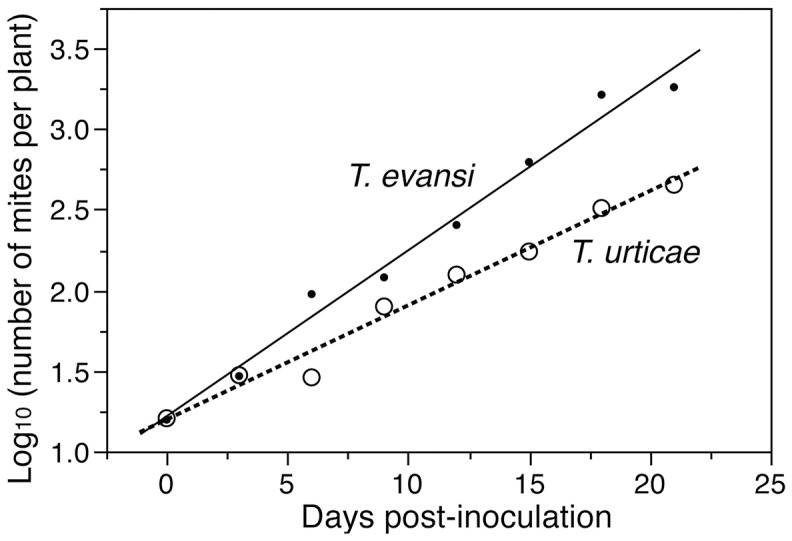
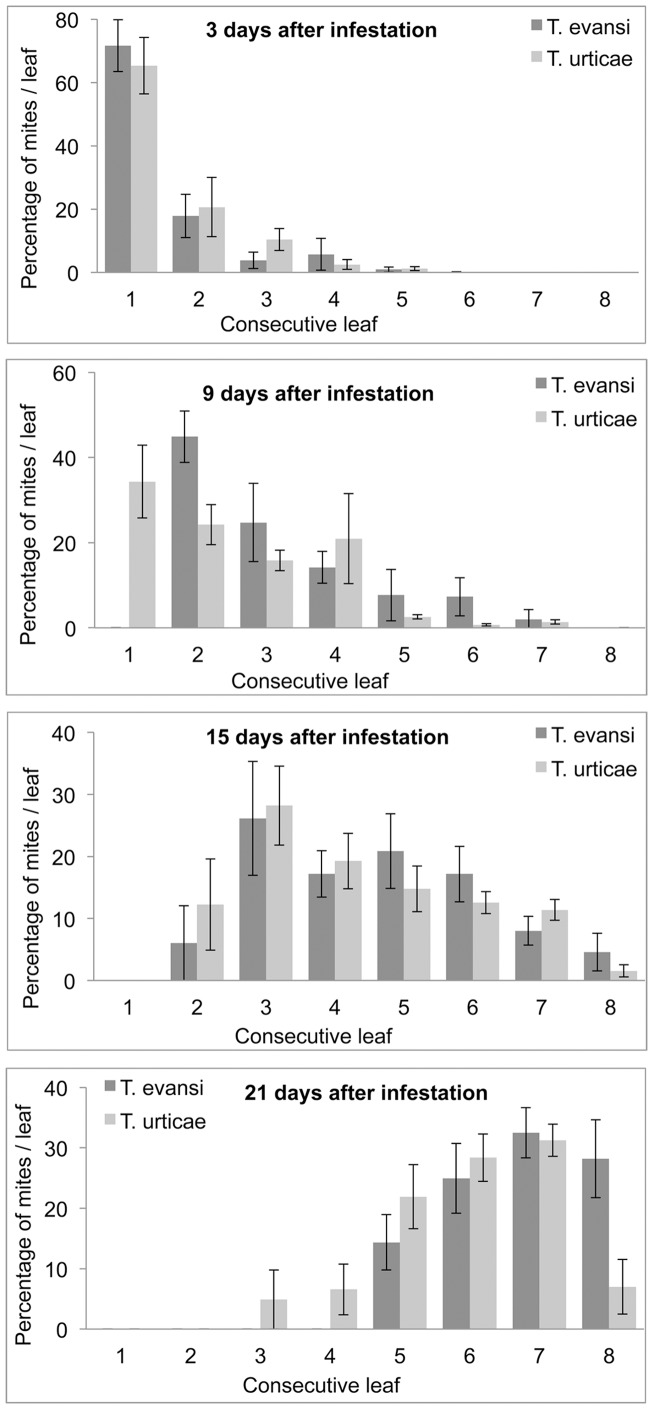
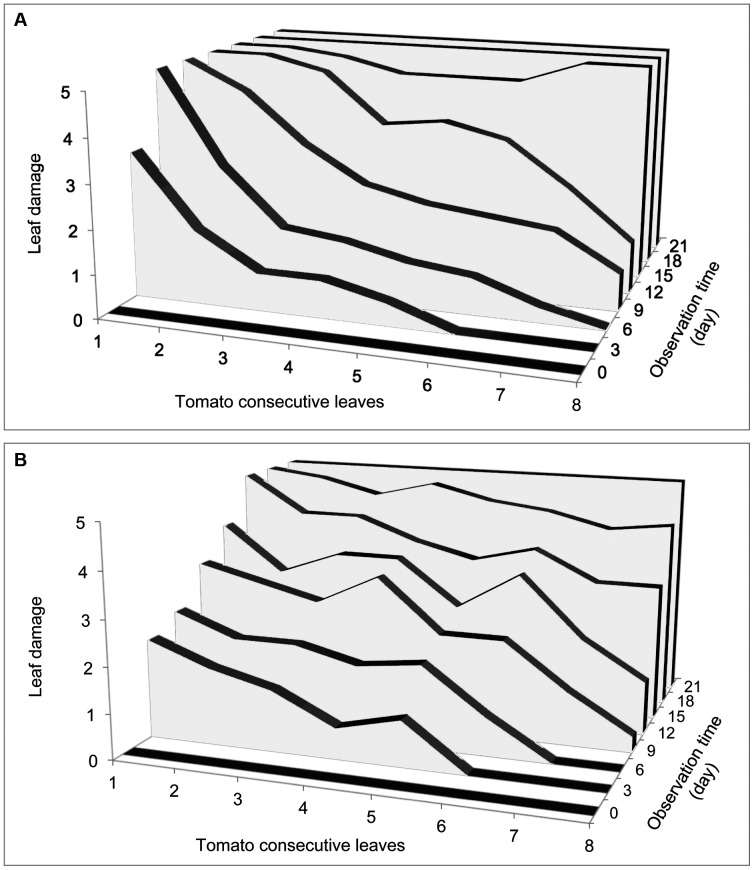
Studying distribution is necessary to understand and manage the dynamics of species with spatially structured populations. Here we studied the distribution in Tetranychus evansi and T. urticae, two mite pests of tomato, in the scope of evaluating factors that can influence the effectiveness of Integrated Pest Management strategies. We found greater positive density-dependent distribution with T. evansi than T. urticae when assayed on single, detached tomato leaves. Indeed, T. evansi distribution among leaflets increased with initial population density while it was high even at low T. urticae densities. Intensity and rate of damage to whole plants was higher with T. evansi than T. urticae. We further studied the circadian migration of T. evansi within plant. When T. evansi density was high the distribution behavior peaked between 8 am and 3 pm and between 8 pm and 3 am local time of Kenya. Over 24 h the total number of mites ascending and descending was always similar and close to the total population size. The gregarious behavior of T. evansi combined with its rapid population growth rate, may explain why few tomato plants can be severely damaged by T. evansi and how suddenly all the crop can be highly infested. However the localisation and elimination of the first infested plants damaged by T. evansi could reduce the risk of outbreaks in the entire crop. These findings suggest also that an acaricide treated net placed on the first infested plants could be very effective to control T. evansi. Moreover circadian migration would therefore accentuate the efficiency of an acaricide treated net covering the infested plants.
研究分布对于理解和管理具有空间结构种群的物种动态是必要的。在此,我们在评估可能影响综合虫害管理策略有效性的因素范围内,研究了番茄的两种螨类害虫——西花蓟马和二斑叶螨的分布情况。当在单个离体番茄叶片上进行测定时,我们发现西花蓟马比二斑叶螨具有更强的正密度依赖性分布。实际上,西花蓟马在小叶间的分布随初始种群密度增加,而二斑叶螨即使在低密度时分布也较高。西花蓟马对整株植物的危害强度和速率高于二斑叶螨。我们进一步研究了西花蓟马在植株内的昼夜迁移情况。当西花蓟马密度较高时,其分布行为在肯尼亚当地时间上午8点至下午3点以及晚上8点至凌晨3点达到峰值。在24小时内,螨类上下迁移的总数始终相似且接近种群总数。西花蓟马的聚集行为与其快速的种群增长率相结合,可能解释了为什么很少有番茄植株会被西花蓟马严重损害,以及为什么所有作物会突然受到高度侵染。然而,定位并清除最早被西花蓟马侵染的受损植株可以降低整个作物爆发虫害的风险。这些发现还表明,在最早被侵染的植株上放置经杀螨剂处理的网对控制西花蓟马可能非常有效。此外,昼夜迁移因此会增强覆盖受侵染植株的经杀螨剂处理的网的效果。