Barton Madeleine, Sunnucks Paul, Norgate Melanie, Murray Neil, Kearney Michael
Department of Zoology, The University of Melbourne, Parkville, Victoria, Australia.
School of Biological Sciences, Monash University, Clayton, Victoria, Australia.
PLoS One. 2014 Apr 17;9(4):e95258. doi: 10.1371/journal.pone.0095258. eCollection 2014.
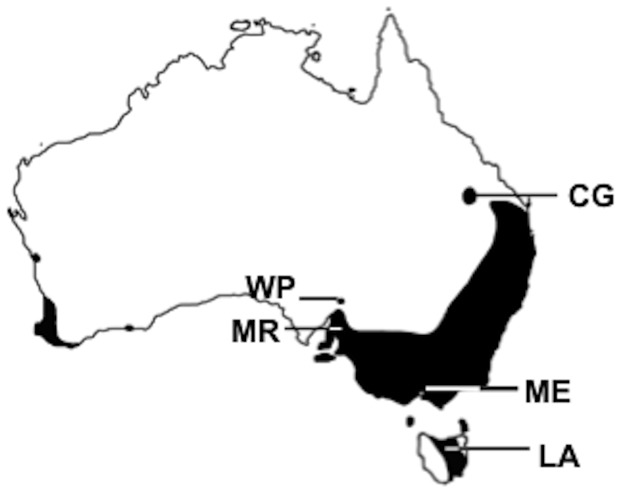
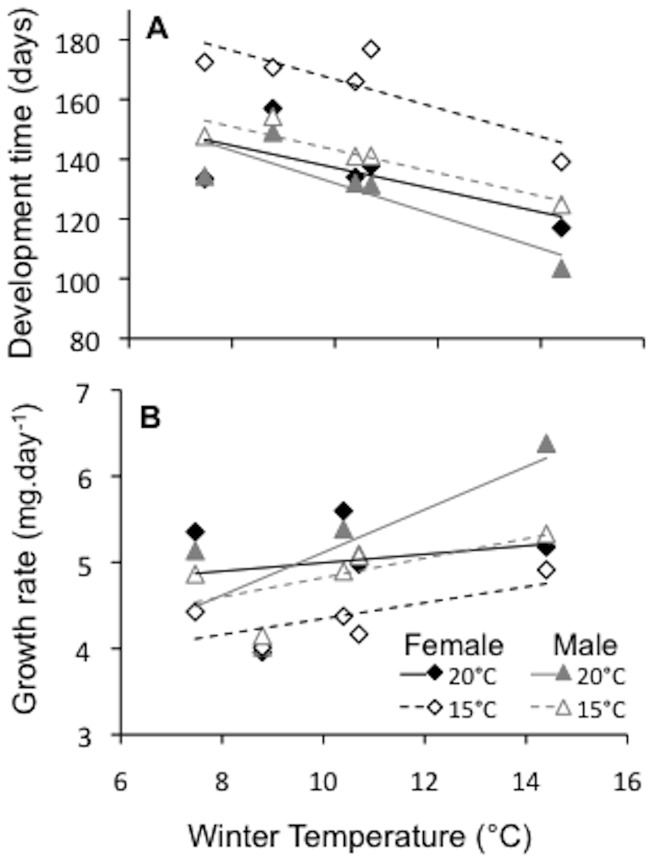
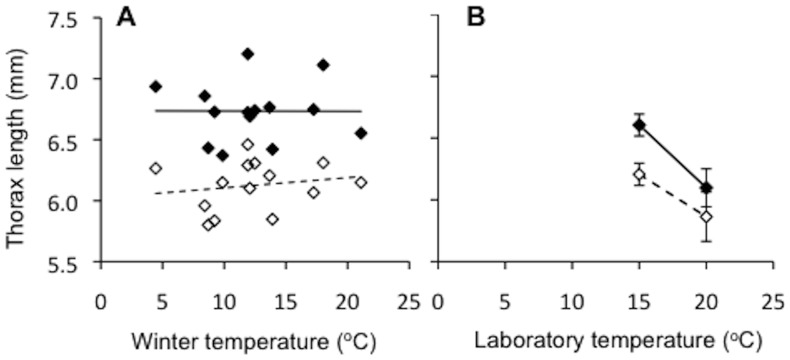
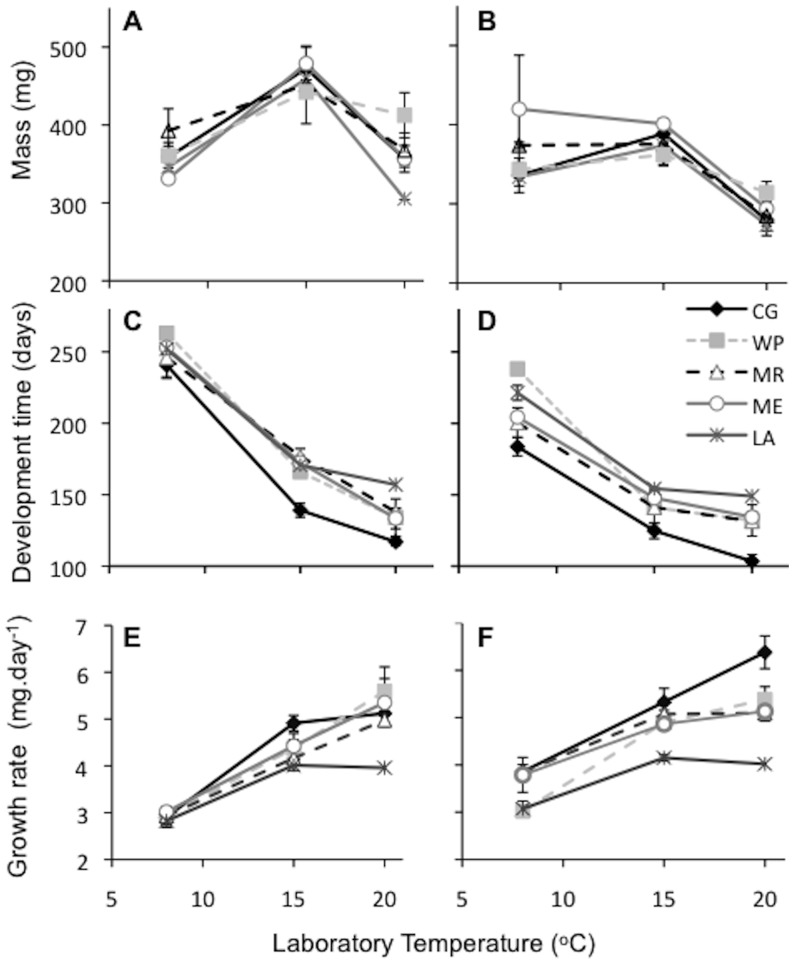
Widespread species often show geographic variation in thermally-sensitive traits, providing insight into how species respond to shifts in temperature through time. Such patterns may arise from phenotypic plasticity, genetic adaptation, or their interaction. In some cases, the effects of genotype and temperature may act together to reduce, or to exacerbate, phenotypic variation in fitness-related traits across varying thermal environments. We find evidence for such interactions in life-history traits of Heteronympha merope, a butterfly distributed across a broad latitudinal gradient in south-eastern Australia. We show that body size in this butterfly is negatively related to developmental temperature in the laboratory, in accordance with the temperature-size rule, but not in the field, despite very strong temperature gradients. A common garden experiment on larval thermal responses, spanning the environmental extremes of H. merope's distribution, revealed that butterflies from low latitude (warmer climate) populations have relatively fast intrinsic growth and development rates compared to those from cooler climates. These synergistic effects of genotype and temperature across the landscape (co-gradient variation) are likely to accentuate phenotypic variation in these traits, and this interaction must be accounted for when predicting how H. merope will respond to temperature change through time. These results highlight the importance of understanding how variation in life-history traits may arise in response to environmental change. Without this knowledge, we may fail to detect whether organisms are tracking environmental change, and if they are, whether it is by plasticity, adaptation or both.
分布广泛的物种通常在对温度敏感的性状上表现出地理变异,这有助于深入了解物种如何随时间对温度变化做出反应。这种模式可能源于表型可塑性、遗传适应或它们之间的相互作用。在某些情况下,基因型和温度的影响可能共同作用,减少或加剧不同热环境中与适应性相关性状的表型变异。我们在澳大利亚东南部广泛纬度梯度上分布的一种蝴蝶——梅洛普异名蛱蝶(Heteronympha merope)的生活史性状中发现了这种相互作用的证据。我们发现,根据温度-体型规则,在实验室中这种蝴蝶的体型与发育温度呈负相关,但在野外并非如此,尽管野外存在很强的温度梯度。一项针对幼虫热反应的共同花园实验,涵盖了梅洛普异名蛱蝶分布的环境极端情况,结果显示,与来自较凉爽气候的蝴蝶相比,来自低纬度(气候较温暖)种群的蝴蝶具有相对较快的内在生长和发育速度。基因型和温度在整个地理区域的这种协同效应(共梯度变异)可能会加剧这些性状的表型变异,在预测梅洛普异名蛱蝶如何随时间对温度变化做出反应时,必须考虑这种相互作用。这些结果凸显了理解生活史性状变异如何因环境变化而产生的重要性。没有这些知识,我们可能无法检测到生物体是否在追踪环境变化,如果它们在追踪,是通过可塑性、适应性还是两者兼而有之。