Tomlinson D J, Erskine R M, Morse C I, Winwood K, Onambélé-Pearson G L
Institute for Performance Research, Department of Exercise and Sport Science, Manchester Metropolitan University, Crewe Green Road, Crewe, CW1 5DU, UK.
Age (Dordr). 2014 Jun;36(3):9652. doi: 10.1007/s11357-014-9652-1. Epub 2014 Apr 19.
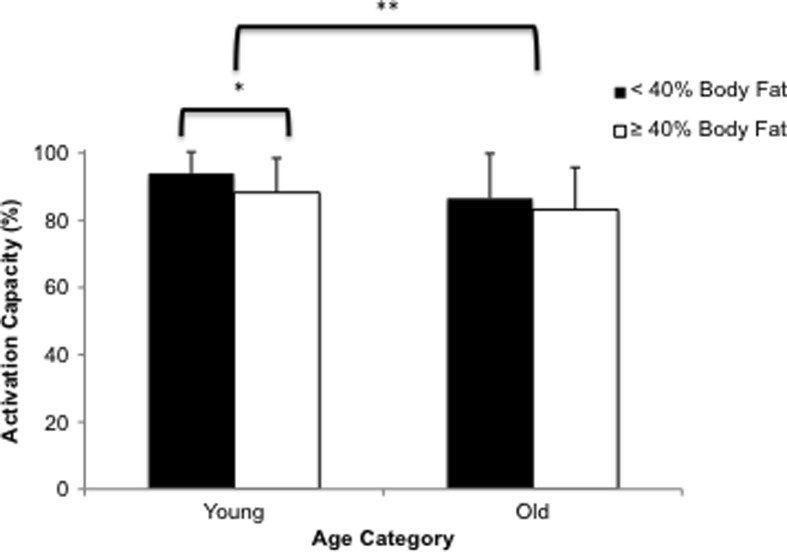
This study aimed to establish the interplay between body mass, adiposity, ageing and determinants of skeletal muscle strength. One hundred and two untrained healthy women categorised by age into young (Y) (mean ± SD, 26.7 ± 9.4 years) vs. old (O) (65.1 ± 7.2 years) were assessed for body fat, lean mass, plantar flexion and dorsiflexion maximum voluntary isometric contraction (MVC) torque, muscle activation capacity and antagonist muscle co-contraction. MVC torque normalised to body mass in the obese group was 35 and 29 % lower (p < 0.05) in Y and 34 and 31 % lower (p < 0.05) in O, compared with underweight and normal weight individuals, respectively. Y with ≥40 % body fat had significantly lower activation than Y with <40 % body fat (88.3 vs. 94.4 %, p < 0.05), but O did not exhibit this effect. Co-contraction was affected by ageing (16.1 % in O vs. 13.8 % in Y, p < 0.05) but not body composition. There were significant associations between markers of body composition, age, strength and activation capacity, with the strongest correlation between muscle strength and total body mass (r (2) = 0.508 in Y, p < 0.001, vs. r (2) = 0.204 in O, p < 0.01). Furthermore, the age-related loss in plantar flexion (PF) MVC torque was exacerbated in obese compared to underweight, normal weight and overweight individuals (-0.96 vs. -0.54, -0.57 and -0.57 % per year, p < 0.05). The negative impact of adiposity on muscle performance is associated with not only muscular but also neural factors. Overall, the effects of ageing and obesity on this system are somewhat cumulative.
本研究旨在确定体重、肥胖、衰老与骨骼肌力量决定因素之间的相互作用。102名未经训练的健康女性按年龄分为年轻组(Y组)(平均±标准差,26.7±9.4岁)和老年组(O组)(65.1±7.2岁),对她们的体脂、瘦体重、跖屈和背屈最大自主等长收缩(MVC)扭矩、肌肉激活能力和拮抗肌共同收缩情况进行评估。与体重过轻和正常体重个体相比,肥胖组中按体重标准化的MVC扭矩在Y组中分别低35%和29%(p<0.05),在O组中分别低34%和31%(p<0.05)。体脂≥40%的Y组激活水平显著低于体脂<40%的Y组(88.3%对94.4%,p<0.05),但O组未表现出这种效应。共同收缩受衰老影响(O组为16.1%,Y组为13.8%,p<0.05),但不受身体成分影响。身体成分、年龄、力量和激活能力指标之间存在显著关联,肌肉力量与总体重之间的相关性最强(Y组r(2)=0.508,p<0.001,O组r(2)=0.204,p<0.01)。此外,与体重过轻、正常体重和超重个体相比,肥胖个体中与年龄相关的跖屈(PF)MVC扭矩损失加剧(每年-0.96%对-0.54%、-0.57%和-0.57%,p<0.05)。肥胖对肌肉性能的负面影响不仅与肌肉因素有关,还与神经因素有关。总体而言,衰老和肥胖对该系统的影响在一定程度上是累积性的。