Nguyen Evelyne B, Zilla Peter, Bezuidenhout Deon
Cardiovascular Research Unit, University of Cape Town, Cape Town - South Africa.
J Appl Biomater Funct Mater. 2014 Dec 30;12(3):172-82. doi: 10.5301/jabfm.5000192.
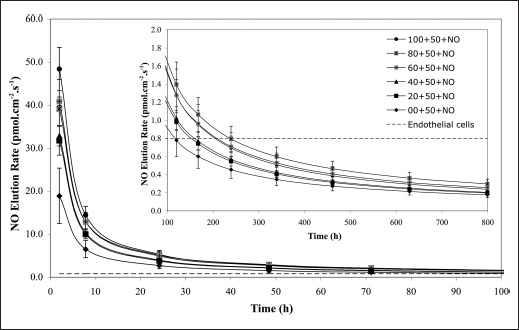
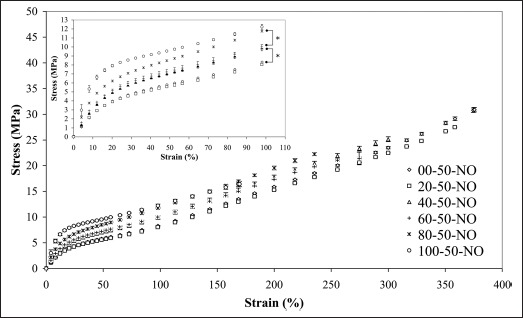
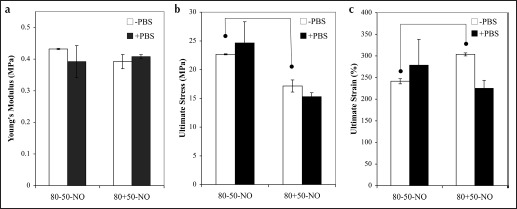
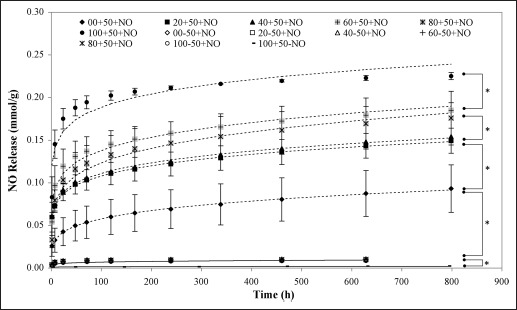
Localized nitric oxide (NO) release from polymeric materials holds much promise for the prevention of coagulation often associated with implantable and extracorporeal blood-contacting devices. Films of polyurethane (PU) containing incorporated polyethyleneimine were thus exposed to NO gas to form diazeniumdiolates (NONOates) in situ. Donor incorporation and NO gas exposure did not affect the mechanical properties of the films. The NO release capacity increased with increasing polydimethylsiloxane (PDMS) content in the soft segment of the PU: total capacity could be more than doubled (P<0.05) from 0.093 ± 0.028 to 0.225 ± 0.004 mmol/g when the PDMS content was increased from 0 to 100%. Release kinetics were best approximated using a modified Korsemeyer-Peppas power law (R2=0.95-0.99). Despite the resultant rapid initial decrease in NO release rates, values above that observed for quiescent endothelial cells (0.83 pmol·cm(-2)·s(-1)) were maintained for extended periods of 5-10 days, while rates above that of a stimulated endothelium (2.7-6.8 pmol·cm(-2)·s(-1)) were achieved for the first 24 hours. This method of NONOate formation may be advantageous, as potential premature NO release by exposure of diazeniumdiolated donors during incorporation, processing and storage, can be avoided by in situ diazoniumdiolation closer to the time of implantation.
从聚合材料中局部释放一氧化氮(NO)对于预防通常与植入式和体外血液接触装置相关的凝血具有很大的前景。因此,将含有聚乙烯亚胺的聚氨酯(PU)薄膜暴露于NO气体中以原位形成二氮烯二醇盐(NONOates)。供体掺入和NO气体暴露不会影响薄膜的机械性能。随着PU软段中聚二甲基硅氧烷(PDMS)含量的增加,NO释放能力增强:当PDMS含量从0增加到100%时,总释放量可从0.093±0.028 mmol/g增加一倍多(P<0.05),达到0.225±0.004 mmol/g。释放动力学最适合用修正的Korsemeyer-Peppas幂律来近似(R2=0.95-0.99)。尽管最初NO释放速率会迅速下降,但在5-10天的较长时间内,释放值保持在高于静态内皮细胞的观测值(0.83 pmol·cm(-2)·s(-1)),而在最初24小时内,释放速率高于受刺激内皮细胞的速率(2.7-6.8 pmol·cm(-2)·s(-1))。这种形成NONOates的方法可能具有优势,因为在掺入、加工和储存过程中,通过二氮烯二醇化供体暴露可能导致的潜在过早NO释放,可以通过在更接近植入时间时进行原位二氮烯二醇化来避免。