Cassidy Sorcha A, Cheent Kuldeep S, Khakoo Salim I
Division of Medicine, Imperial College London , London , UK.
Clinical and Experimental Sciences, Faculty of Medicine, Southampton General Hospital, University of Southampton , Southampton , UK.
Front Immunol. 2014 Mar 31;5:133. doi: 10.3389/fimmu.2014.00133. eCollection 2014.
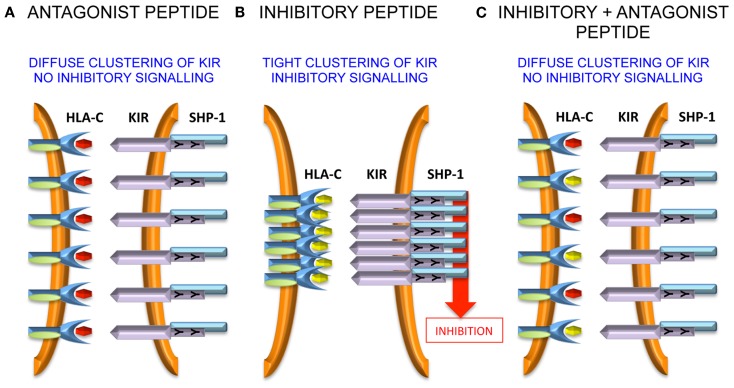
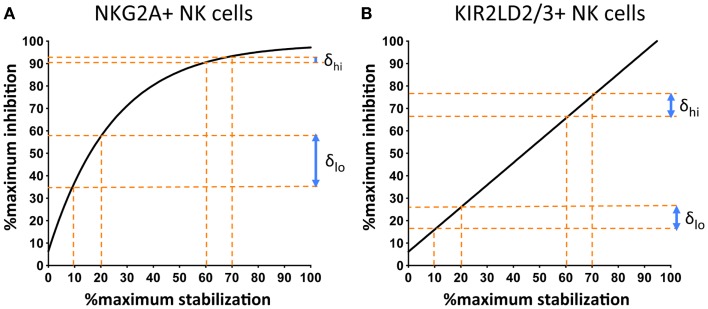
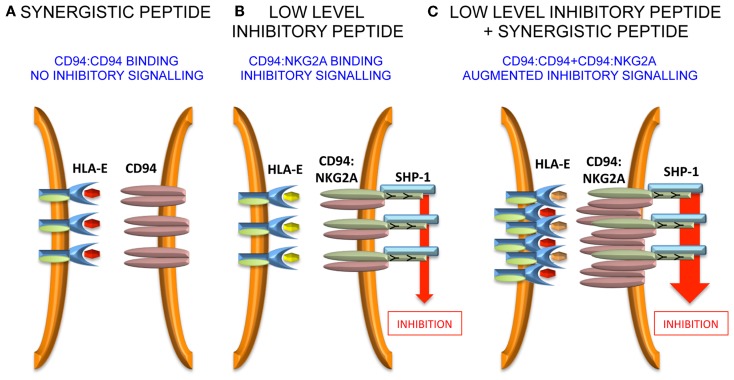
The inhibitory receptors for MHC class I have a central role in controlling natural killer (NK) cell activity. Soon after their discovery, it was found that these receptors have a degree of peptide selectivity. Such peptide selectivity has been demonstrated for all inhibitory killer cell immunoglobulin-like receptor (KIR) tested to date, certain activating KIR, and also members of the C-type lectin-like family of receptors. This selectivity is much broader than the peptide specificity of T cell receptors, with NK cell receptors recognizing peptide motifs, rather than individual peptides. Inhibitory receptors on NK cells can survey the peptide:MHC complexes expressed on the surface of target cells, therefore subsequent transduction of an inhibitory signal depends on the overall peptide content of these MHC class I complexes. Functionally, KIR-expressing NK cells have been shown to be unexpectedly sensitive to changes in the peptide content of MHC class I, as peptide:MHC class I complexes that weakly engage KIR can antagonize the inhibitory signals generated by engagement of stronger KIR-binding peptide:MHC class I complexes. This property provides KIR-expressing NK cells with the potential to recognize changes in the peptide:MHC class I repertoire, which may occur during viral infections and tumorigenesis. By contrast, in the presence of HLA class I leader peptides, virus-derived peptides can induce a synergistic inhibition of CD94:NKG2A-expressing NK cells through recruitment of CD94 in the absence of NKG2A. On the other hand, CD94:NKG2A-positive NK cells can be exquisitely sensitive to changes in the levels of MHC class I. Peptide antagonism and sensitivity to changes in MHC class I levels are properties that distinguish KIR and CD94:NKG2A. The subtle difference in the properties of NK cells expressing these receptors provides a rationale for having complementary inhibitory receptor systems for MHC class I.
MHC I类分子的抑制性受体在控制自然杀伤(NK)细胞活性中起核心作用。在它们被发现后不久,人们就发现这些受体具有一定程度的肽选择性。迄今为止,所有测试过的抑制性杀伤细胞免疫球蛋白样受体(KIR)、某些活化性KIR以及C型凝集素样受体家族成员都已证明存在这种肽选择性。这种选择性比T细胞受体的肽特异性要宽泛得多,NK细胞受体识别的是肽基序,而非单个肽段。NK细胞上的抑制性受体能够监测靶细胞表面表达的肽:MHC复合物,因此随后抑制性信号的转导取决于这些MHC I类复合物的整体肽含量。在功能上,已表明表达KIR的NK细胞对MHC I类肽含量的变化异常敏感,因为与KIR弱结合的肽:MHC I类复合物能够拮抗由与KIR结合更强的肽:MHC I类复合物所产生的抑制性信号。这一特性使表达KIR的NK细胞有潜力识别肽:MHC I类库中的变化,这种变化可能发生在病毒感染和肿瘤发生过程中。相比之下,在存在HLA I类前导肽的情况下,病毒衍生肽可通过在缺乏NKG2A时募集CD94来诱导对表达CD94:NKG2A的NK细胞的协同抑制。另一方面,CD94:NKG2A阳性NK细胞可能对MHC I类水平的变化极为敏感。肽拮抗作用以及对MHC I类水平变化的敏感性是区分KIR和CD94:NKG2A的特性。表达这些受体的NK细胞特性上的细微差异为拥有针对MHC I类的互补抑制性受体系统提供了理论依据。