Saljoughian Noushin, Taheri Tahareh, Rafati Sima
Molecular Immunology and Vaccine Research Laboratory, Pasteur Institute of Iran , Tehran , Iran.
Front Immunol. 2014 Mar 31;5:134. doi: 10.3389/fimmu.2014.00134. eCollection 2014.
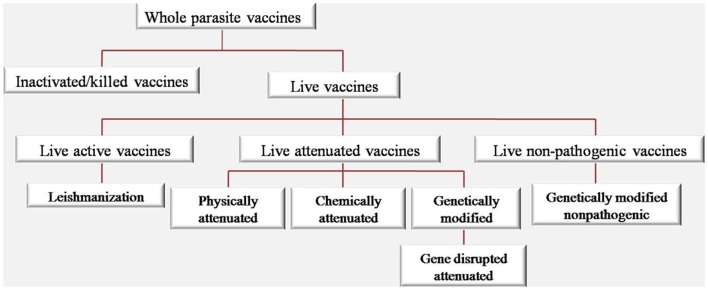
Vaccination with durable immunity is the main goal and fundamental to control leishmaniasis. To stimulate the immune response, small numbers of parasites are necessary to be presented in the mammalian host. Similar to natural course of infection, strategy using live vaccine is more attractive when compared to other approaches. Live vaccines present the whole spectrum of antigens to the host immune system in the absence of any adjuvant. Leishmanization was the first effort for live vaccination and currently used in a few countries against cutaneous leishmaniasis, in spite of their obstacle and safety. Then, live attenuated vaccines developed with similar promotion of creating long-term immunity in the host with lower side effect. Different examples of attenuated strains are generated through long-term in vitro culturing, culturing under drug pressure, temperature sensitivity, and chemical mutagenesis, but none is safe enough and their revision to virulent form is possible. Attenuation through genetic manipulation and disruption of virulence factors or essential enzymes for intracellular survival are among other approaches that are intensively under study. Other designs to develop live vaccines for visceral form of leishmaniasis are utilization of live avirulent microorganisms such as Lactococcus lactis, Salmonella enterica, and Leishmania tarentolae called as vectored vaccine. Apparently, these vaccines are intrinsically safer and can harbor the candidate antigens in their genome through different genetic manipulation and create more potential to control Leishmania parasite as an intracellular pathogen.
实现持久免疫的疫苗接种是控制利什曼病的主要目标和根本手段。为了刺激免疫反应,需要在哺乳动物宿主体内呈现少量寄生虫。与自然感染过程类似,与其他方法相比,使用活疫苗的策略更具吸引力。活疫苗在没有任何佐剂的情况下将全谱抗原呈现给宿主免疫系统。自限性利什曼原虫接种是活疫苗接种的首次尝试,目前在少数国家用于预防皮肤利什曼病,尽管存在障碍和安全性问题。然后,开发了减毒活疫苗,其在促进宿主产生长期免疫力方面类似,但副作用较小。通过长期体外培养、在药物压力下培养、温度敏感性和化学诱变产生了不同的减毒株实例,但没有一种足够安全,它们有可能恢复为毒力形式。通过基因操作和破坏毒力因子或细胞内存活所必需的酶来实现减毒是正在深入研究的其他方法之一。开发用于内脏型利什曼病的活疫苗的其他设计包括利用无毒活微生物,如乳酸乳球菌、肠炎沙门氏菌和塔兰托拉利什曼原虫,称为载体疫苗。显然,这些疫苗本质上更安全,并且可以通过不同的基因操作在其基因组中携带候选抗原,从而更有潜力控制作为细胞内病原体的利什曼原虫。