Department of Radiation Oncology, Hallym University Dongtan Sacred Heart Hospital, Hwaseong, Korea.
Department of Radiation Oncology, Hallym University Sacred Heart Hospital, Anyang, Korea.
J Breast Cancer. 2014 Mar;17(1):69-75. doi: 10.4048/jbc.2014.17.1.69. Epub 2014 Mar 28.
This study was performed to assess frequency, timings of occurrence, and predictors of radiologic lung damage (RLD) after forward-planned intensity-modulated radiotherapy (FIMRT) for whole breast irradiation.
We retrospectively reviewed medical records of 157 breast cancer patients and each of their serial chest computed tomography (CT) taken 4, 10, 16, and 22 months after completion of breast radiotherapy (RT). FIMRT was administered to whole breast only (n=152), or whole breast and supraclavicular regions (n=5). Dosimetric parameters, such as mean lung dose and lung volume receiving more than 10 to 50 Gy (V10-V50), and clinical parameters were analyzed in relation to radiologic lung damage.
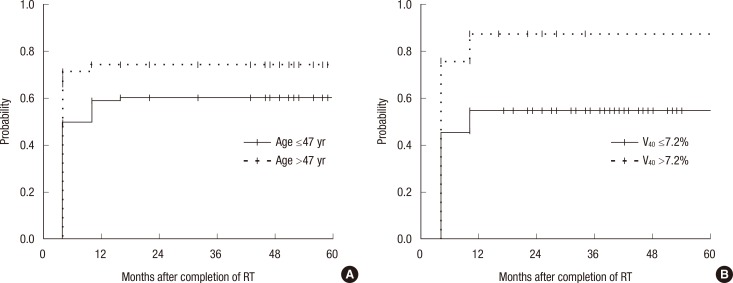
In total, 104 patients (66.2%) developed RLD after whole breast FIMRT. Among the cases of RLD, 84.7% were detected at 4 months, and 15.3% at 10 months after completion of RT. More patients of 47 or younger were found to have RLD at 10 months after RT than patients older than the age (11.7% vs. 2.9%, p=0.01). In univariate and multivariate analyses, age >47 and V40 >7.2% were significant predictors for higher risk of RLD.
RLD were not infrequently detected in follow-up CT after whole breast FIMRT. More detected cases of RLD among younger patients are believed to have developed at later points after RT than those of older patients. Age and V40 were significant predictors for RLD after whole breast intensity-modulated radiotherapy.
本研究旨在评估全乳腺照射后正向计划调强放疗(FIMRT)后放射性肺损伤(RLD)的发生频率、时间和预测因素。
我们回顾性分析了 157 例乳腺癌患者的病历和完成乳腺癌放疗(RT)后 4、10、16 和 22 个月的连续胸部 CT。FIMRT 仅用于全乳腺(n=152)或全乳腺和锁骨上区域(n=5)。分析了剂量学参数,如平均肺剂量和接受 10 至 50 Gy 以上的肺体积(V10-V50),以及与放射性肺损伤相关的临床参数。
共有 104 例(66.2%)患者在全乳腺 FIMRT 后出现 RLD。在 RLD 病例中,84.7%在 RT 完成后 4 个月发现,15.3%在 RT 完成后 10 个月发现。RT 完成后 10 个月时,更多 47 岁或更年轻的患者出现 RLD,而年龄较大的患者则较少(11.7%比 2.9%,p=0.01)。单因素和多因素分析表明,年龄>47 岁和 V40>7.2%是 RLD 风险较高的显著预测因素。
在全乳腺 FIMRT 后随访 CT 中常发现 RLD。年轻患者中更多的 RLD 病例被认为是在 RT 后较晚的时间点出现的,而不是年龄较大的患者。年龄和 V40 是全乳腺调强放疗后 RLD 的显著预测因素。