Denies Maxwell S, Johnson Jordan, Maliphol Amanda B, Bruno Michael, Kim Annabelle, Rizvi Abbas, Rustici Kevyn, Medler Scott
Department of Biology, State University of New York at Fredonia, Fredonia, 14063, New York.
Department of Biological Sciences, University at Buffalo, Buffalo, 14260, New York.
Physiol Rep. 2014 Jan 28;2(1):e00204. doi: 10.1002/phy2.204. eCollection 2014 Jan 1.
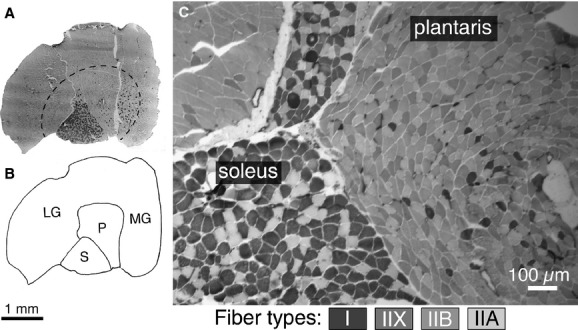
Skeletal muscles are highly plastic tissues capable dramatic remodeling in response to use, disuse, disease, and other factors. Growing evidence suggests that adipose tissues exert significant effects on the basic fiber-type composition of skeletal muscles. In the current study, we investigated the long-term effects of a high-fat diet and subsequent obesity on the muscle fiber types in C57 BLK/6J mice. Litters of mice were randomly assigned to either a high-fat diet or a control group at the time of weaning, and were maintained on this diet for approximately 1 year. Single fibers were harvested from the soleus and plantaris muscles, and fiber types were determined using SDS-PAGE. The high-fat diet mice were significantly heavier than the control mice (39.17 ± 2.7 g vs. 56.87 ± 3.4 g; P < 0.0003), but muscle masses were not different. In male mice, the high-fat diet was associated with a significantly lower proportion of slow, type I fibers in the soleus muscle (40.4 ± 3.5% vs. 29.33 ± 2.6%; P < 0.0165). Moreover, the proportion of type I fibers in the soleus of male mice was inversely proportional to the relative fatness of the male mice (P < 0.003; r (2) = 0.65), but no association was observed in female mice. In male mice, the decline in type I fibers was correlated with an increase in type I/IIA hybrid fibers, suggesting that the type I fibers were transformed primarily into these hybrids. The reported trends indicate that type I fibers are most susceptible to the effects of obesity, and that these fiber-type changes can be sex specific.
骨骼肌是具有高度可塑性的组织,能够根据使用、废用、疾病和其他因素进行显著的重塑。越来越多的证据表明,脂肪组织对骨骼肌的基本纤维类型组成有显著影响。在本研究中,我们调查了高脂饮食及随后的肥胖对C57 BLK/6J小鼠肌肉纤维类型的长期影响。在小鼠断奶时,将一窝小鼠随机分为高脂饮食组或对照组,并维持该饮食约1年。从比目鱼肌和跖肌中采集单根纤维,并用SDS-PAGE确定纤维类型。高脂饮食组小鼠比对照组小鼠明显更重(39.17±2.7克对56.87±3.4克;P<0.0003),但肌肉质量没有差异。在雄性小鼠中,高脂饮食与比目鱼肌中慢肌I型纤维的比例显著降低有关(40.4±3.5%对29.33±2.6%;P<0.0165)。此外,雄性小鼠比目鱼肌中I型纤维的比例与雄性小鼠的相对肥胖程度呈负相关(P<0.003;r(2)=0.65),但在雌性小鼠中未观察到相关性。在雄性小鼠中,I型纤维的减少与I/IIA混合型纤维的增加相关,这表明I型纤维主要转化为这些混合型纤维。报告的趋势表明,I型纤维最易受肥胖影响,且这些纤维类型的变化可能具有性别特异性。