• 文献检索
  • 文档翻译
  • 深度研究
  • 学术资讯
  • Suppr Zotero 插件Zotero 插件
  • 邀请有礼
  • 套餐&价格
  • 历史记录
应用&插件
Suppr Zotero 插件Zotero 插件浏览器插件Mac 客户端Windows 客户端微信小程序
定价
高级版会员购买积分包购买API积分包
服务
文献检索文档翻译深度研究API 文档MCP 服务
关于我们
关于 Suppr公司介绍联系我们用户协议隐私条款
关注我们

Suppr 超能文献

核心技术专利:CN118964589B侵权必究
粤ICP备2023148730 号-1Suppr @ 2026

文献检索

告别复杂PubMed语法,用中文像聊天一样搜索,搜遍4000万医学文献。AI智能推荐,让科研检索更轻松。

立即免费搜索

文件翻译

保留排版,准确专业,支持PDF/Word/PPT等文件格式,支持 12+语言互译。

免费翻译文档

深度研究

AI帮你快速写综述,25分钟生成高质量综述,智能提取关键信息,辅助科研写作。

立即免费体验

2013 - 2014年冬季墨西哥甲型H1N1流感大流行相关的严重发病率和死亡率:年龄分布的逐渐变化及严重程度

Substantial Morbidity and Mortality Associated with Pandemic A/H1N1 Influenza in Mexico, Winter 2013-2014: Gradual Age Shift and Severity.

作者信息

Dávila Javier, Chowell Gerardo, Borja-Aburto Víctor H, Viboud Cécile, Grajales Muñiz Concepciòn, Miller Mark

机构信息

Dirección de Prestaciones Médicas, Instituto Mexicano del Seguro Social, Mexico City, México.

Division of Epidemiology and Population Studies, Fogarty International Center, National Institutes of Health, Bethesda, Maryland, USA; Mathematical, Computational & Modeling Sciences Center, School of Human Evolution and Social Change, Arizona State University, Tempe, Arizona, USA.

出版信息

PLoS Curr. 2014 Mar 26;6:ecurrents.outbreaks.a855a92f19db1d90ca955f5e908d6631. doi: 10.1371/currents.outbreaks.a855a92f19db1d90ca955f5e908d6631.

DOI:10.1371/currents.outbreaks.a855a92f19db1d90ca955f5e908d6631
PMID:24744975
原文链接:https://pmc.ncbi.nlm.nih.gov/articles/PMC3967911/
Abstract

BACKGROUND

A recrudescent wave of pandemic influenza A/H1N1 is underway in Mexico in winter 2013-14, following a mild 2012-13 A/H3N2 influenza season. Mexico previously experienced several waves of pandemic A/H1N1 activity in spring, summer and fall 2009 and winter 2011-2012, with a gradual shift of influenza-related hospitalizations and deaths towards older ages. Here we describe changes in the epidemiology of the 2013-14 A/H1N1 influenza outbreak, relative to previous seasons dominated by the A/H1N1 pandemic virus. The analysis is intended to guide public health intervention strategies in near real time.

METHODS

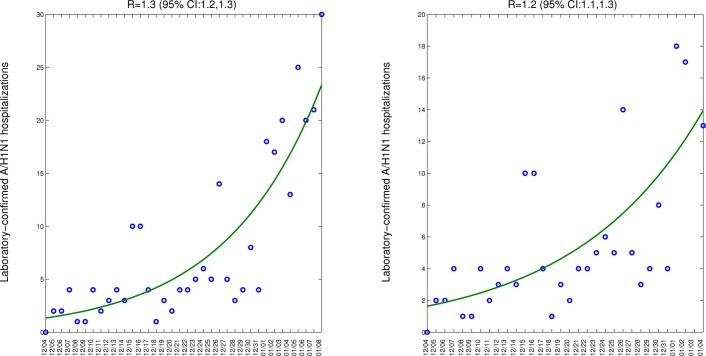
We analyzed demographic and geographic data on hospitalizations with severe acute respiratory infection (SARI), laboratory-confirmed A/H1N1 influenza hospitalizations, and inpatient deaths, from a large prospective surveillance system maintained by the Mexican Social Security medical system during 01-October 2013 to 31-Jan 2014. We characterized the age and regional patterns of influenza activity relative to the preceding 2011-2012 A/H1N1 influenza epidemic. We also estimated the reproduction number (R) based on the growth rate of daily case incidence by date of symptoms onset.

RESULTS

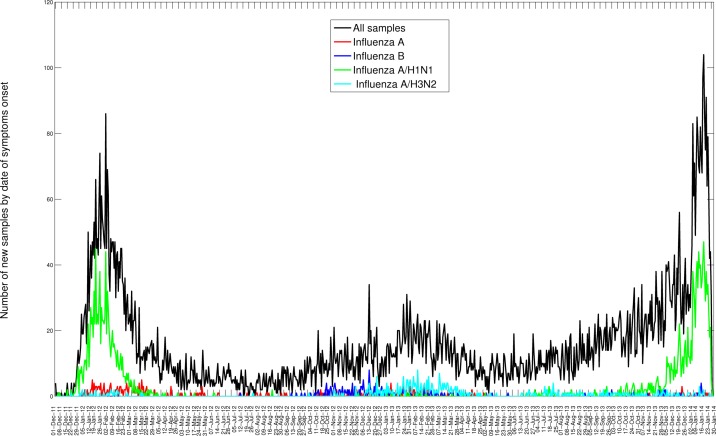
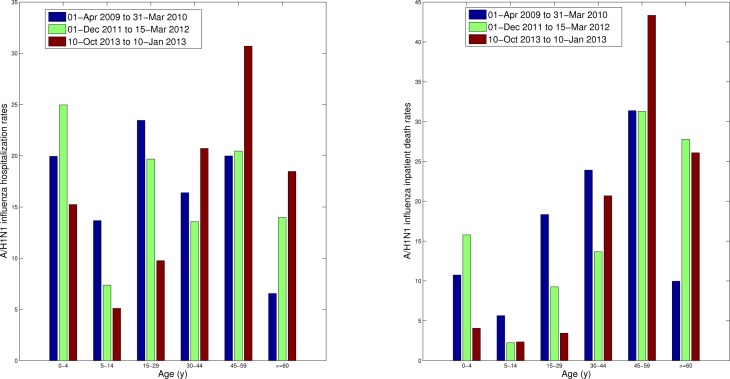
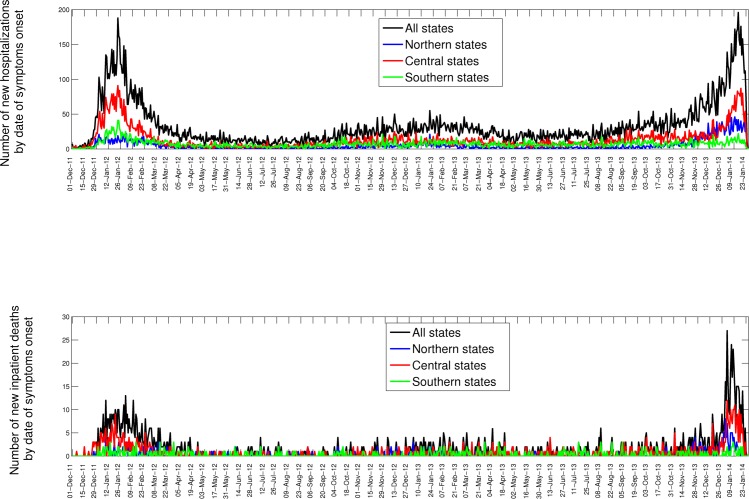
A total of 7,886 SARI hospitalizations and 529 inpatient-deaths (3.2%) were reported between 01-October 2013 and 31-January 2014 (resulting in 3.2 laboratory-confirmed A/H1N1 hospitalizations per 100,00 and 0.52 laboratory-confirmed A/H1N1-positive deaths per 100,000). The progression of daily SARI hospitalizations in 2013-14 exceeded that observed during the 2011-2012 A/H1N1 epidemic. The mean age of laboratory-confirmed A/H1N1 patients in 2013-14 was 41.1 y (SD=20.3) for hospitalizations and 49.2 y (SD=16.7) for deaths. Rates of laboratory-confirmed A/H1N1 hospitalizations and deaths were significantly higher among individuals aged 30-59 y and lower among younger age groups for the ongoing 2013-2014 epidemic, compared to the 2011-12 A/H1N1 epidemic (Chi-square test, P<0.001). The reproduction number of the winter 2013-14 wave in central Mexico was estimated at 1.3-1.4 which is slightly higher than that reported for the 2011-2012 A/H1N1 epidemic.

CONCLUSIONS

We have documented a substantial and ongoing increase in the number of A/H1N1-related hospitalizations and deaths during the period October 2013-January 2014 and a proportionate shift of severe disease to middle aged adults, relative to the preceding A/H1N1 2011-2012 epidemic in Mexico. In the absence of clear antigenic drift in globally circulating A/H1N1 viruses in the post-pandemic period, the gradual change in the age distribution of A/H1N1 infections observed in Mexico suggests a slow build-up of immunity among younger populations, reminiscent of the age profile of past pandemics.

摘要

背景

在经历了2012 - 2013年温和的A/H3N2流感季节后,2013 - 2014年冬季墨西哥正在经历甲型H1N1流感大流行的复发浪潮。墨西哥此前在2009年春、夏、秋季以及2011 - 2012年冬季经历了几波甲型H1N1流感大流行,流感相关的住院和死亡病例逐渐向老年人转移。在此,我们描述2013 - 2014年甲型H1N1流感疫情的流行病学变化,与之前以甲型H1N1大流行病毒为主导的季节相比。该分析旨在近乎实时地指导公共卫生干预策略。

方法

我们分析了墨西哥社会保障医疗系统维护的大型前瞻性监测系统在2013年10月1日至2014年1月31日期间关于严重急性呼吸道感染(SARI)住院、实验室确诊的甲型H1N1流感住院以及住院死亡的人口统计学和地理数据。我们描述了相对于之前2011 - 2012年甲型H1N1流感疫情的流感活动的年龄和区域模式。我们还根据症状出现日期的每日病例发病率增长率估计了繁殖数(R)。

结果

在2013年10月1日至2014年1月31日期间共报告了7886例SARI住院病例和529例住院死亡病例(3.2%)(相当于每10万人中有3.2例实验室确诊的甲型H1N1流感住院病例和每10万人中有0.52例实验室确诊的甲型H1N1阳性死亡病例)。2013 - 2014年每日SARI住院病例的进展超过了2011 - 2012年甲型H1N1流感疫情期间观察到的情况。2013 - 2014年实验室确诊的甲型H1N1患者住院的平均年龄为41.1岁(标准差 = 20.3),死亡患者的平均年龄为49.2岁(标准差 = 16.7)。与2011 - 2012年甲型H1N1流感疫情相比,在当前2013 - 2014年疫情中,30 - 59岁人群中实验室确诊的甲型H1N1流感住院和死亡发生率显著更高,而在较年轻年龄组中则较低(卡方检验,P < 0.001)。2013 - 2014年冬季墨西哥中部疫情的繁殖数估计为1.3 - 1.4,略高于2011 - 2012年甲型H1N1流感疫情报告的数值。

结论

我们记录了2013年10月至2014年1月期间甲型H1N1相关住院和死亡病例数量持续大幅增加,并且与墨西哥之前2011 - 2012年甲型H1N1流感疫情相比,严重疾病比例向中年成年人转移。在大流行后全球传播的甲型H1N1病毒没有明显抗原漂移的情况下,墨西哥观察到的甲型H1N1感染年龄分布的逐渐变化表明年轻人群中免疫力在缓慢增强,这让人想起过去大流行的年龄特征。
https://cdn.ncbi.nlm.nih.gov/pmc/blobs/097f/3967911/79852e557bd7/Figure_growthrate3.jpg
https://cdn.ncbi.nlm.nih.gov/pmc/blobs/097f/3967911/fe09d1fecd98/Figure_curvesLab2014.jpg
https://cdn.ncbi.nlm.nih.gov/pmc/blobs/097f/3967911/9c01ecbc4db7/Figure_curvesLabSubtype2014.jpg
https://cdn.ncbi.nlm.nih.gov/pmc/blobs/097f/3967911/9f0536620973/Figure_RatesAge2014.jpg
https://cdn.ncbi.nlm.nih.gov/pmc/blobs/097f/3967911/79852e557bd7/Figure_growthrate3.jpg
https://cdn.ncbi.nlm.nih.gov/pmc/blobs/097f/3967911/fe09d1fecd98/Figure_curvesLab2014.jpg
https://cdn.ncbi.nlm.nih.gov/pmc/blobs/097f/3967911/9c01ecbc4db7/Figure_curvesLabSubtype2014.jpg
https://cdn.ncbi.nlm.nih.gov/pmc/blobs/097f/3967911/9f0536620973/Figure_RatesAge2014.jpg
https://cdn.ncbi.nlm.nih.gov/pmc/blobs/097f/3967911/79852e557bd7/Figure_growthrate3.jpg

相似文献

1
Substantial Morbidity and Mortality Associated with Pandemic A/H1N1 Influenza in Mexico, Winter 2013-2014: Gradual Age Shift and Severity.2013 - 2014年冬季墨西哥甲型H1N1流感大流行相关的严重发病率和死亡率:年龄分布的逐渐变化及严重程度
PLoS Curr. 2014 Mar 26;6:ecurrents.outbreaks.a855a92f19db1d90ca955f5e908d6631. doi: 10.1371/currents.outbreaks.a855a92f19db1d90ca955f5e908d6631.
2
Recrudescent wave of pandemic A/H1N1 influenza in Mexico, winter 2011-2012: Age shift and severity.2011 - 2012年冬季墨西哥甲型H1N1流感大流行的复发浪潮:年龄变化与严重程度
PLoS Curr. 2012 Feb 24;4:RRN1306. doi: 10.1371/currents.RRN1306.
3
Intense seasonal A/H1N1 influenza in Mexico, winter 2013-2014.墨西哥 2013-2014 年冬季高强度季节性 A/H1N1 流感。
Arch Med Res. 2015 Jan;46(1):63-70. doi: 10.1016/j.arcmed.2014.11.005. Epub 2014 Nov 13.
4
Epidemiological characterization of a fourth wave of pandemic A/H1N1 influenza in Mexico, winter 2011-2012: age shift and severity.墨西哥 2011-2012 年冬季第四波甲型 H1N1 流感大流行的流行病学特征:年龄偏移和严重程度。
Arch Med Res. 2012 Oct;43(7):563-70. doi: 10.1016/j.arcmed.2012.09.005. Epub 2012 Oct 16.
5
Impact of antiviral treatment and hospital admission delay on risk of death associated with 2009 A/H1N1 pandemic influenza in Mexico.抗病毒治疗和住院延迟对墨西哥与 2009 年 A/H1N1 大流行流感相关死亡风险的影响。
BMC Infect Dis. 2012 Apr 20;12:97. doi: 10.1186/1471-2334-12-97.
6
Characterizing the epidemiology of the 2009 influenza A/H1N1 pandemic in Mexico.描述墨西哥 2009 年甲型 H1N1 流感大流行的流行病学特征。
PLoS Med. 2011 May;8(5):e1000436. doi: 10.1371/journal.pmed.1000436. Epub 2011 May 24.
7
Mortality burden of the A/H1N1 pandemic in Mexico: a comparison of deaths and years of life lost to seasonal influenza.墨西哥甲型 H1N1 大流行的死亡负担:与季节性流感相比的死亡人数和生命损失年数。
Clin Infect Dis. 2011 Nov;53(10):985-93. doi: 10.1093/cid/cir644. Epub 2011 Oct 5.
8
Gradual changes in the age distribution of excess deaths in the years following the 1918 influenza pandemic in Copenhagen: using epidemiological evidence to detect antigenic drift.1918 年流感大流行后数年哥本哈根超额死亡人数年龄分布的逐渐变化:使用流行病学证据检测抗原漂移。
Vaccine. 2011 Jul 22;29 Suppl 2(Suppl 2):B42-8. doi: 10.1016/j.vaccine.2011.02.065.
9
Surveillance for influenza--United States, 1997-98, 1998-99, and 1999-00 seasons.美国1997 - 1998、1998 - 1999及1999 - 2000年流感监测情况
MMWR Surveill Summ. 2002 Oct 25;51(7):1-10.
10
Severe respiratory disease concurrent with the circulation of H1N1 influenza.与甲型H1N1流感病毒传播同时出现的严重呼吸道疾病。
N Engl J Med. 2009 Aug 13;361(7):674-9. doi: 10.1056/NEJMoa0904023. Epub 2009 Jun 29.

引用本文的文献

1
Characterization of a Novel 2018 Influenza Virus Outbreak on the Yucatan Peninsula, Mexico, in the Summer.2018年夏季墨西哥尤卡坦半岛新型流感病毒爆发的特征描述。
Microorganisms. 2025 May 7;13(5):1086. doi: 10.3390/microorganisms13051086.
2
Influenza immune escape under heterogeneous host immune histories.宿主免疫史异质性下的流感免疫逃逸。
Trends Microbiol. 2021 Dec;29(12):1072-1082. doi: 10.1016/j.tim.2021.05.009. Epub 2021 Jul 1.
3
In-Hospital 30-Day Survival Among Young Adults With Coronavirus Disease 2019: A Cohort Study.

本文引用的文献

1
Interim estimates of 2013/14 vaccine effectiveness against influenza A(H1N1)pdm09 from Canada s sentinel surveillance network, January 2014.2013/14 年度加拿大哨点监测网络针对甲型 H1N1pdm09 流感疫苗效力的临时估计结果,2014 年 1 月。
Euro Surveill. 2014 Feb 6;19(5):20690. doi: 10.2807/1560-7917.es2014.19.5.20690.
2
Global mortality estimates for the 2009 Influenza Pandemic from the GLaMOR project: a modeling study.全球 2009 年流感大流行的死亡率估计值来自 GLaMOR 项目:一项建模研究。
PLoS Med. 2013 Nov;10(11):e1001558. doi: 10.1371/journal.pmed.1001558. Epub 2013 Nov 26.
3
Increased transmissibility explains the third wave of infection by the 2009 H1N1 pandemic virus in England.
2019年冠状病毒病年轻成人患者的院内30天生存率:一项队列研究
Open Forum Infect Dis. 2021 May 7;8(6):ofab233. doi: 10.1093/ofid/ofab233. eCollection 2021 Jun.
4
Evaluation of Pregnancy, Younger Age, and Old Age as Independent Risk Factors for Poor Hospitalization Outcomes in Influenza A (H1N1)pdm09 Virus a Decade After the Pandemic.甲型H1N1流感大流行十年后,评估妊娠、年轻和老年作为甲型H1N1流感大流行后住院结局不佳的独立危险因素。
Cureus. 2020 Nov 28;12(11):e11762. doi: 10.7759/cureus.11762.
5
Earliest infections predict the age distribution of seasonal influenza A cases.早期感染可预测季节性甲型流感病例的年龄分布。
Elife. 2020 Jul 7;9:e50060. doi: 10.7554/eLife.50060.
6
The Role of Sociodemographic and Psychological Variables on Risk Perception of the Flu.社会人口学和心理变量对流感风险认知的作用。
Sage Open. 2017 Jul 14;7(3):2158244017718890. doi: 10.1177/2158244017718890. eCollection 2017 Jul.
7
Geriatric infections: Decreased immunity or evolved opportunists?老年感染:免疫下降还是进化的机会主义者?
J Biosci. 2020;45(1). doi: 10.1007/s12038-020-0025-x.
8
The burden of influenza A and B in Mexico from the year 2010 to 2013: An observational, retrospective, database study, on records from the Directorate General of Epidemiology database.2010 年至 2013 年期间墨西哥 A 型和 B 型流感的负担:基于流行病学总局数据库记录的观察性、回顾性数据库研究。
Hum Vaccin Immunother. 2018;14(8):1890-1898. doi: 10.1080/21645515.2018.1456281. Epub 2018 May 10.
9
Infectious Disease Surveillance in the Big Data Era: Towards Faster and Locally Relevant Systems.大数据时代的传染病监测:迈向更快且与本地相关的系统
J Infect Dis. 2016 Dec 1;214(suppl_4):S380-S385. doi: 10.1093/infdis/jiw376.
10
Influenza and other respiratory viruses: standardizing disease severity in surveillance and clinical trials.流感及其他呼吸道病毒:在监测和临床试验中规范疾病严重程度
Expert Rev Anti Infect Ther. 2017 Jun;15(6):545-568. doi: 10.1080/14787210.2017.1295847. Epub 2017 May 12.
2009 年 H1N1 大流行病毒在英国的第三次感染浪潮是由其传染性增强所致。
Proc Natl Acad Sci U S A. 2013 Aug 13;110(33):13422-7. doi: 10.1073/pnas.1303117110. Epub 2013 Jul 23.
4
Epidemiological characterization of a fourth wave of pandemic A/H1N1 influenza in Mexico, winter 2011-2012: age shift and severity.墨西哥 2011-2012 年冬季第四波甲型 H1N1 流感大流行的流行病学特征:年龄偏移和严重程度。
Arch Med Res. 2012 Oct;43(7):563-70. doi: 10.1016/j.arcmed.2012.09.005. Epub 2012 Oct 16.
5
Mortality burden of the A/H1N1 pandemic in Mexico: a comparison of deaths and years of life lost to seasonal influenza.墨西哥甲型 H1N1 大流行的死亡负担:与季节性流感相比的死亡人数和生命损失年数。
Clin Infect Dis. 2011 Nov;53(10):985-93. doi: 10.1093/cid/cir644. Epub 2011 Oct 5.
6
Seroprevalence of antibodies to influenza A/H1N1/2009 among transmission risk groups after the second wave in Mexico, by a virus-free ELISA method.应用无病毒 ELISA 法检测墨西哥第二波疫情后传播风险人群中抗流感 A/H1N1/2009 抗体的血清阳性率。
Int J Infect Dis. 2011 Nov;15(11):e781-6. doi: 10.1016/j.ijid.2011.07.002. Epub 2011 Aug 19.
7
Gradual changes in the age distribution of excess deaths in the years following the 1918 influenza pandemic in Copenhagen: using epidemiological evidence to detect antigenic drift.1918 年流感大流行后数年哥本哈根超额死亡人数年龄分布的逐渐变化:使用流行病学证据检测抗原漂移。
Vaccine. 2011 Jul 22;29 Suppl 2(Suppl 2):B42-8. doi: 10.1016/j.vaccine.2011.02.065.
8
The 1918-1920 influenza pandemic in Peru.秘鲁 1918-1920 年流感大流行。
Vaccine. 2011 Jul 22;29 Suppl 2(Suppl 2):B21-6. doi: 10.1016/j.vaccine.2011.02.048.
9
Characterizing the epidemiology of the 2009 influenza A/H1N1 pandemic in Mexico.描述墨西哥 2009 年甲型 H1N1 流感大流行的流行病学特征。
PLoS Med. 2011 May;8(5):e1000436. doi: 10.1371/journal.pmed.1000436. Epub 2011 May 24.
10
Inside the outbreak of the 2009 influenza A (H1N1)v virus in Mexico.墨西哥 2009 年甲型 H1N1 流感病毒暴发期间。
PLoS One. 2010 Oct 8;5(10):e13256. doi: 10.1371/journal.pone.0013256.