Mathematical, Computational & Modeling Sciences Center, School of Human Evolution and Social Change, Arizona State University, Tempe, Arizona, United States of America.
PLoS Med. 2011 May;8(5):e1000436. doi: 10.1371/journal.pmed.1000436. Epub 2011 May 24.
Mexico's local and national authorities initiated an intense public health response during the early stages of the 2009 A/H1N1 pandemic. In this study we analyzed the epidemiological patterns of the pandemic during April-December 2009 in Mexico and evaluated the impact of nonmedical interventions, school cycles, and demographic factors on influenza transmission.
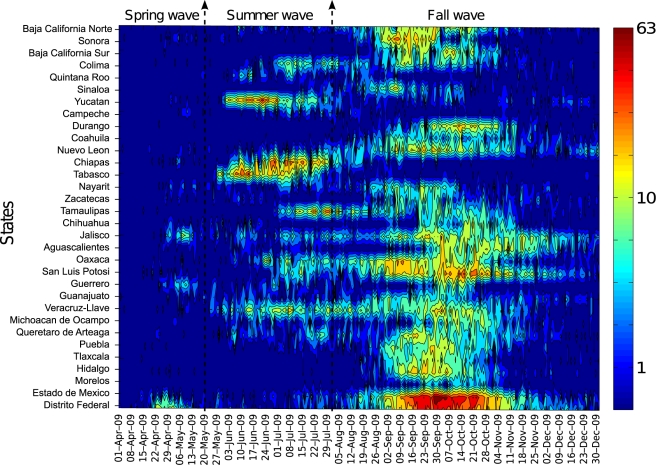
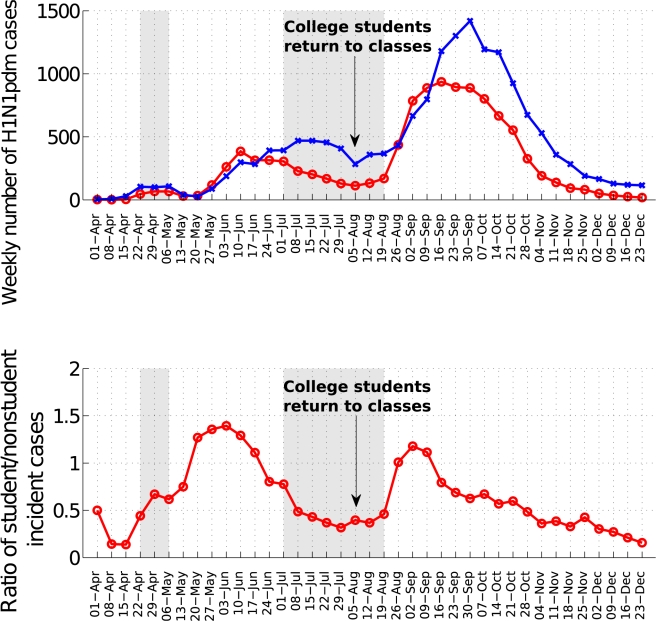
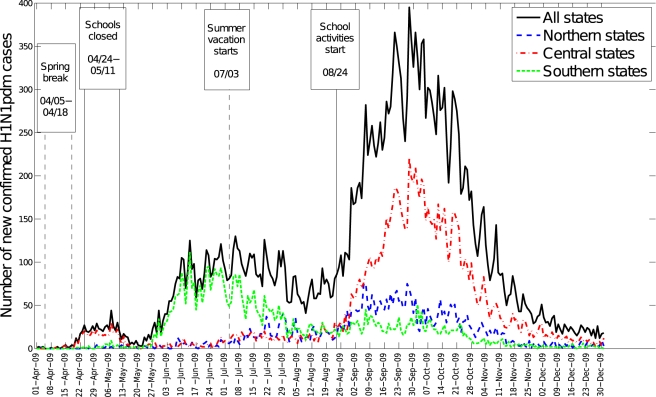
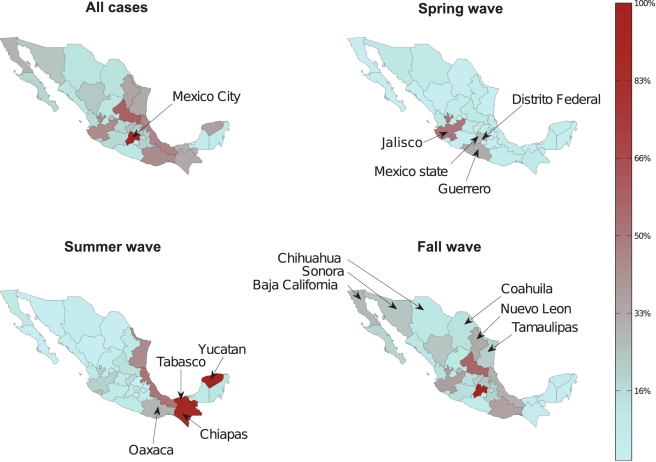
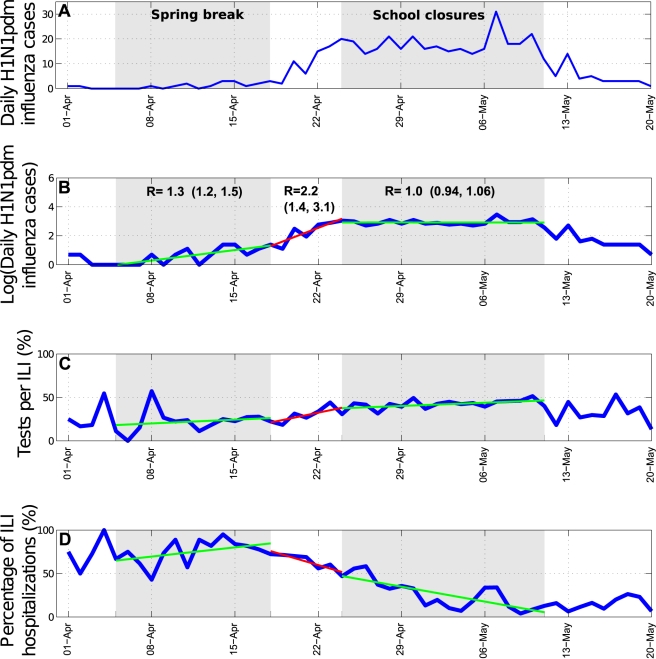
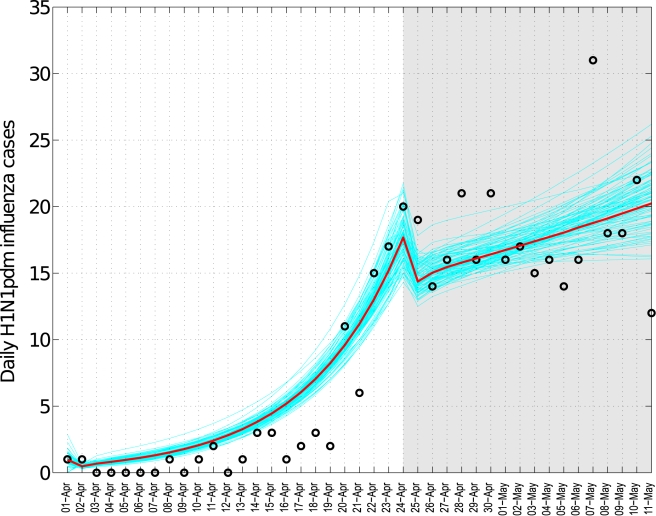
We used influenza surveillance data compiled by the Mexican Institute for Social Security, representing 40% of the population, to study patterns in influenza-like illness (ILIs) hospitalizations, deaths, and case-fatality rate by pandemic wave and geographical region. We also estimated the reproduction number (R) on the basis of the growth rate of daily cases, and used a transmission model to evaluate the effectiveness of mitigation strategies initiated during the spring pandemic wave. A total of 117,626 ILI cases were identified during April-December 2009, of which 30.6% were tested for influenza, and 23.3% were positive for the influenza A/H1N1 pandemic virus. A three-wave pandemic profile was identified, with an initial wave in April-May (Mexico City area), a second wave in June-July (southeastern states), and a geographically widespread third wave in August-December. The median age of laboratory confirmed ILI cases was ∼ 18 years overall and increased to ∼ 31 years during autumn (p<0.0001). The case-fatality ratio among ILI cases was 1.2% overall, and highest (5.5%) among people over 60 years. The regional R estimates were 1.8-2.1, 1.6-1.9, and 1.2-1.3 for the spring, summer, and fall waves, respectively. We estimate that the 18-day period of mandatory school closures and other social distancing measures implemented in the greater Mexico City area was associated with a 29%-37% reduction in influenza transmission in spring 2009. In addition, an increase in R was observed in late May and early June in the southeast states, after mandatory school suspension resumed and before summer vacation started. State-specific fall pandemic waves began 2-5 weeks after school reopened for the fall term, coinciding with an age shift in influenza cases.
We documented three spatially heterogeneous waves of the 2009 A/H1N1 pandemic virus in Mexico, which were characterized by a relatively young age distribution of cases. Our study highlights the importance of school cycles on the transmission dynamics of this pandemic influenza strain and suggests that school closure and other mitigation measures could be useful to mitigate future influenza pandemics. Please see later in the article for the Editors' Summary.
在 2009 年甲型 H1N1 流感大流行的早期,墨西哥地方和国家当局就启动了一场密集的公共卫生应对行动。在这项研究中,我们分析了 2009 年 4 月至 12 月期间大流行期间的流行模式,并评估了非医学干预措施、学校周期和人口因素对流感传播的影响。
我们使用了墨西哥社会保障研究所汇编的流感监测数据,该数据代表了 40%的人口,研究了流感样疾病(ILI)住院、死亡和病死率在流行波和地理区域的模式。我们还根据每日病例增长率估算了繁殖数(R),并使用传播模型评估了春季大流行波期间启动的缓解策略的效果。在 2009 年 4 月至 12 月期间,共发现 117626 例 ILI,其中 30.6%进行了流感检测,23.3%检测出甲型 H1N1 流感大流行病毒阳性。发现存在三波流行模式,第一波发生在 4 月至 5 月(墨西哥城地区),第二波发生在 6 月至 7 月(东南部各州),第三波在 8 月至 12 月在地理上广泛传播。实验室确诊的 ILI 病例的中位年龄总体上约为 18 岁,在秋季增加到约 31 岁(p<0.0001)。ILI 病例的病死率总体上为 1.2%,在 60 岁以上人群中最高(5.5%)。春季、夏季和秋季的区域 R 估计值分别为 1.8-2.1、1.6-1.9 和 1.2-1.3。我们估计,在 2009 年春季,在墨西哥城大都市区实施的为期 18 天的强制性学校关闭和其他社会隔离措施与流感传播减少 29%-37%有关。此外,在东南部各州强制停课恢复后和暑假开始前的 5 月下旬和 6 月初,R 值也有所增加。各州特有的秋季大流行波在秋季学期重新开学后 2-5 周开始,恰逢流感病例年龄分布的转变。
我们记录了墨西哥 2009 年甲型 H1N1 流感病毒的三个空间异质波,其特点是病例的年龄分布相对年轻。我们的研究强调了学校周期对这种大流行流感株传播动态的重要性,并表明学校关闭和其他缓解措施可能有助于减轻未来的流感大流行。请稍后在文章中查看编辑摘要。