Chung Hye Won, Lim Jong-Baeck
Department of Laboratory Medicine, Yonsei University College of Medicine, Seoul, Republic of Korea.
J Transl Med. 2014 Apr 21;12:102. doi: 10.1186/1479-5876-12-102.
CD40-CD40 ligand (CD40L) interaction is considered to contribute to the promotion of prothrombotic responses and production of angiogenesis-associated factor in addition to adaptive immune responses. Recently, the role of soluble CD40L (sCD40L) has gained interest in cancer, although its exact functions remain unknown. This study evaluated the clinical significance of sCD40L in patients with pancreatic ductal adenocarcinoma (PDAC) and validated its utility as a PDAC diagnostic and prognostic biomarker.
Serum sCD40L levels were measured by chemiluminescent immunoassay and compared among normal, chronic pancreatitis (CP, high-risk), and PDAC group in both training (n=25 per group) and independent validation (n=30, 30, and 55, respectively) datasets through one-way ANOVA test with the post-hoc Bonferroni method. To evaluate the diagnostic potential of serum sCD40L for PDAC, receiver operating characteristic (ROC) curves were generated and logistic regression analysis was conducted. To investigate the sCD40L-assoicated cytokines/chemokines in PDAC, cytokines/chemokines levels were analyzed by a MILLIPLEX MAP Human Cytokine/Chemokine Kit. To assess the prognostic potentials of sCD40L, Kaplan-Meier survival curve and Cox proportional-hazards regression analysis were applied.
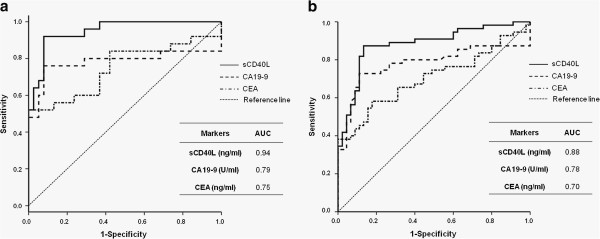
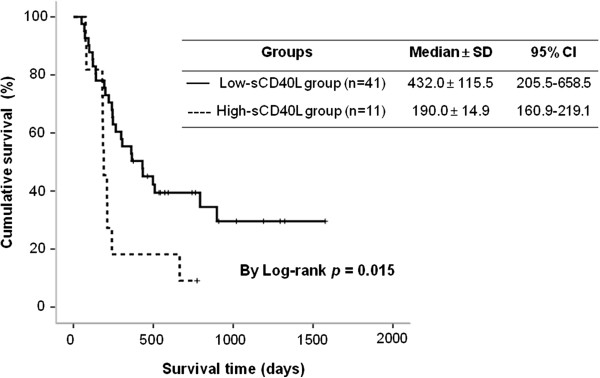
Serum sCD40L levels were significantly higher in PDAC group compared with non-cancer groups in both training (p<0.05) and validation (p<0.05) datasets. Clinically, serum sCD40L closely correlated with unresectability (γs=0.342, p=0.011) and distant metastasis (γs=0.294, p=0.030) of PDAC. ROC curve and logistic regression analysis demonstrated the remarkable predictive potentials of serum sCD40L for PDAC (80.0% sensitivity and 85.5% specificity at cut-off point, 0.45; logistic regression), superior to those of CA19-9 and CEA. According to cytokines/chemokines assay, serum sCD40L levels were closely correlated with serum levels of pro-angiogenic cytokines (EGF, VEGF, IL-8) and immunosuppressive cytokines (IL-6, IL-10, IL-1RA). Kaplan-Meier survival analysis demonstrated patients with high-serum sCD40L (>35,000 ng/ml) had a poorer prognosis than those with low-serum sCD40L (log-rank, p=0.015). Multivariate Cox regression analysis yielded a hazard ratio of 2.509 (95% CI, 1.038-6.067, p=0.041) for mortality in the high-serum sCD40L group.
Serum sCD40L is correlated with immunosuppression and angiogenesis in PDAC carcinogenesis/progression, and is a promising diagnostic and prognostic biomarker for PDAC superior to CA19-9 and CEA.
CD40 - CD40配体(CD40L)相互作用除了有助于适应性免疫反应外,还被认为可促进促血栓形成反应和血管生成相关因子的产生。最近,可溶性CD40L(sCD40L)在癌症中的作用引起了关注,但其确切功能仍不清楚。本研究评估了sCD40L在胰腺导管腺癌(PDAC)患者中的临床意义,并验证了其作为PDAC诊断和预后生物标志物的效用。
通过化学发光免疫分析法测定血清sCD40L水平,并在训练数据集(每组n = 25)和独立验证数据集(分别为n = 30、30和55)中,通过单因素方差分析及事后Bonferroni法,对正常组、慢性胰腺炎(CP,高危组)和PDAC组进行比较。为评估血清sCD40L对PDAC的诊断潜力,绘制了受试者工作特征(ROC)曲线并进行了逻辑回归分析。为研究PDAC中与sCD40L相关的细胞因子/趋化因子,采用MILLIPLEX MAP人细胞因子/趋化因子试剂盒分析细胞因子/趋化因子水平。为评估sCD40L的预后潜力,应用了Kaplan - Meier生存曲线和Cox比例风险回归分析。
在训练数据集(p < 0.05)和验证数据集(p < 0.05)中,PDAC组的血清sCD40L水平均显著高于非癌症组。临床上,血清sCD40L与PDAC的不可切除性(γs = 0.342,p = 0.011)和远处转移(γs = 0.294,p = 0.030)密切相关。ROC曲线和逻辑回归分析表明,血清sCD40L对PDAC具有显著的预测潜力(在截断点0.45时,敏感性为80.0%,特异性为85.5%;逻辑回归),优于CA19 - 9和CEA。根据细胞因子/趋化因子检测,血清sCD40L水平与促血管生成细胞因子(EGF、VEGF、IL - 8)和免疫抑制细胞因子(IL - 6、IL - 10、IL - 1RA)的血清水平密切相关。Kaplan - Meier生存分析表明,血清sCD40L水平高(> 35,000 ng/ml)的患者预后比血清sCD40L水平低的患者差(对数秩检验,p = 0.015)。多变量Cox回归分析得出,血清sCD40L水平高的组死亡率的风险比为2.509(95% CI,1.038 - 6.067,p = 0.041)。
血清sCD40L与PDAC发生/进展中的免疫抑制和血管生成相关,是一种优于CA19 - 9和CEA的、有前景的PDAC诊断和预后生物标志物。