Akinbo David Bolaji, Ajayi Olutayo Ifedayo
Department of Medical Laboratory Science, College of Medicine and Health Sciences, Afe Babalola University, Ado - Ekiti, Ekiti State, Nigeria.
Department of Food, Nutrition, Dietetics and Health, College of Health and Human Sciences, Kansas State University, Manhattan, KS, USA.
Int J Gen Med. 2023 Jan 22;16:259-272. doi: 10.2147/IJGM.S385772. eCollection 2023.
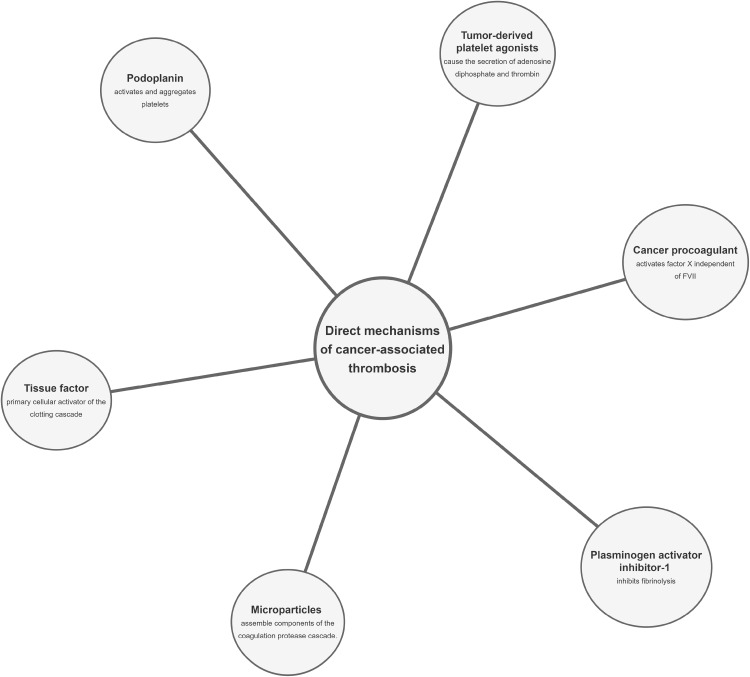
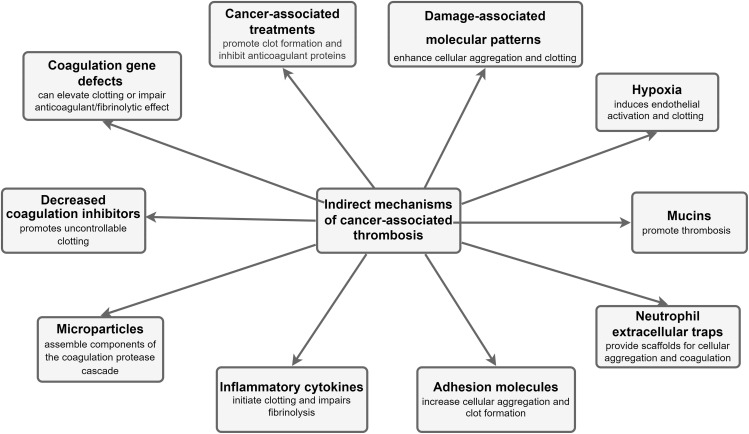
Cancer-associated thrombosis (CAT) is a leading cause of mortality in cancer patients and its incidence varies in different parts of the world. Venous thromboembolism (VTE) is a prominent manifestation of CAT, and significantly impacts morbidity and survival compared to arterial thrombosis in cancer patients. Several risk factors for developing VTE such as chemotherapy and immobilization have also been found co-existing with cancer patients and contributing to the increased risk of VTE in cancer patients than in non-cancer patients. This review highlights recent mechanisms in the pathogenesis of hypercoagulable syndromes associated with cancer, multiple mechanisms implicated in promoting cancer-associated thrombosis and their diagnostic approaches. Cancer cells interact with every part of the hemostatic system; generating their own procoagulant factors, through stimulation of the prothrombotic properties of other blood cell components or the initiation of clotting by cancer therapies which can all directly activate the coagulation cascade and contribute to the VTE experienced in CAT. It is our hope that the multiple interconnections between the hemostatic system and cancer biology and the improved biomarkers reported in this study can be relevant in establishing a predictive model for VTE, optimize early detection of asymptomatic microthrombosis for more personalized prophylactic strategies and incorporate effective therapeutic options and patient management to reduce mortality and morbidity, and improve the quality of life of affected cancer patients.
癌症相关血栓形成(CAT)是癌症患者死亡的主要原因,其发病率在世界不同地区有所差异。静脉血栓栓塞(VTE)是CAT的突出表现,与癌症患者的动脉血栓形成相比,对发病率和生存率有显著影响。还发现一些发生VTE的危险因素,如化疗和制动,与癌症患者并存,导致癌症患者发生VTE的风险高于非癌症患者。本综述重点介绍了与癌症相关的高凝综合征发病机制的最新研究进展、促进癌症相关血栓形成的多种机制及其诊断方法。癌细胞与止血系统的各个部分相互作用;通过刺激其他血细胞成分的促血栓形成特性或癌症治疗引发凝血,产生自身的促凝因子,所有这些都可直接激活凝血级联反应,并导致CAT中出现的VTE。我们希望止血系统与癌症生物学之间的多重联系以及本研究中报道的改进的生物标志物,能够有助于建立VTE的预测模型,优化无症状微血栓形成的早期检测,以制定更个性化的预防策略,并纳入有效的治疗选择和患者管理,从而降低死亡率和发病率,提高受影响癌症患者的生活质量。