Rosenfeld Barry, Pessin Hayley, Marziliano Allison, Jacobson Colleen, Sorger Brooke, Abbey Jennifer, Olden Megan, Brescia Robert, Breitbart William
Department of Psychology, Fordham University, 441 East Fordham Road, Bronx, NY 10458, USA.
Memorial Sloan-Kettering Cancer Center, New York, NY, USA.
Soc Sci Med. 2014 Jun;111:35-40. doi: 10.1016/j.socscimed.2014.03.027. Epub 2014 Mar 28.
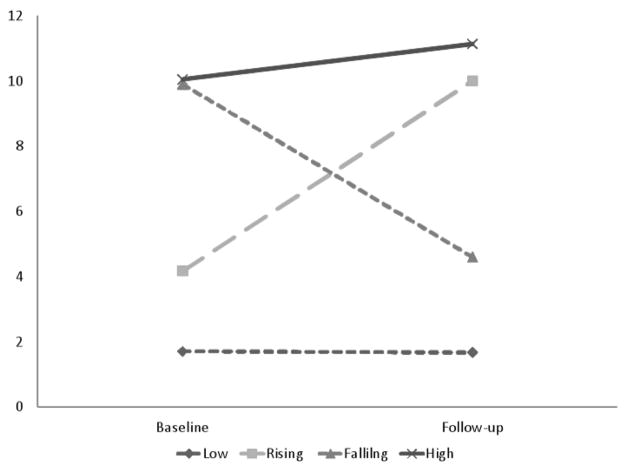
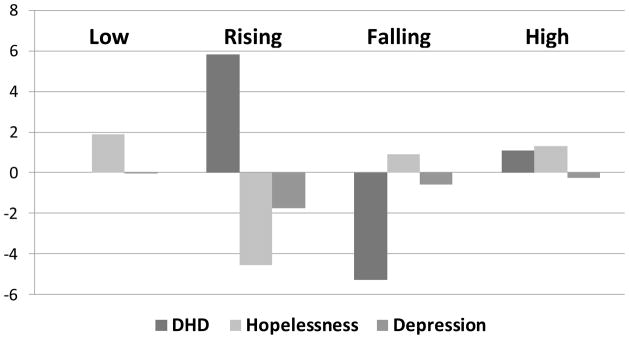
Understanding why some terminally ill patients may seek a hastened death (a construct referred to as "desire for hastened death" or DHD) is critical to understanding how to optimize quality of life during an individual's final weeks, months or even years of life. Although a number of predictor variables have emerged in past DHD research, there is a dearth of longitudinal research on how DHD changes over time and what factors might explain such changes. This study examined DHD over time in a sample of terminally ill cancer patients admitted to a palliative care hospital. A random sample of 128 patients completed the Schedule of Attitudes toward Hastened Death (SAHD) at two time points approximately 2-4 weeks apart participated. Patients were categorized into one of four trajectories based on their SAHD scores at both time points: low (low DHD at T1 and T2), rising (low DHD at T1 and high DHD at T2), falling (high DHD at T1 and low DHD at T2) and high (high DHD at T1 and T2). Among patients who were low at T1, several variables distinguished between those who developed DHD and those who did not: physical symptom distress, depression symptom severity, hopelessness, spiritual well-being, baseline DHD, and a history of mental health treatment. However, these same medical and clinical variables did not distinguish between the falling and high trajectories. Overall, there appears to be a relatively high frequency of change in DHD, even in the last weeks of life. Interventions designed to target patients who are exhibiting subthreshold DHD and feelings of hopelessness may reduce the occurrence of DHD emerging in this population.
理解为何一些绝症患者可能寻求加速死亡(这一概念被称为“加速死亡愿望”或 DHD)对于理解如何在个人生命的最后几周、几个月甚至几年中优化生活质量至关重要。尽管在过去的 DHD 研究中出现了一些预测变量,但关于 DHD 如何随时间变化以及哪些因素可能解释这种变化的纵向研究却很匮乏。本研究在一家姑息治疗医院收治的绝症癌症患者样本中考察了 DHD 随时间的变化情况。128 名患者的随机样本在两个时间点(相隔约 2 - 4 周)完成了《对加速死亡的态度量表》(SAHD)。根据患者在两个时间点的 SAHD 分数,将他们分为四种轨迹之一:低(T1 和 T2 时 DHD 低)、上升(T1 时 DHD 低且 T2 时 DHD 高)、下降(T1 时 DHD 高且 T2 时 DHD 低)和高(T1 和 T2 时 DHD 高)。在 T1 时处于低水平的患者中,有几个变量区分了出现 DHD 的患者和未出现 DHD 的患者:身体症状困扰、抑郁症状严重程度、绝望感、精神幸福感、基线 DHD 以及心理健康治疗史。然而,这些相同的医学和临床变量并未区分下降轨迹和高轨迹患者。总体而言,即使在生命的最后几周,DHD 的变化频率似乎也相对较高。针对表现出阈下 DHD 和绝望感的患者设计的干预措施可能会减少该人群中出现 DHD 的情况。