Lim So Yeon, Choi Won-Il, Jeon Kyeongman, Guallar Eliseo, Koh Younsuck, Lim Chae-Man, Koh Shin Ok, Na Sungwon, Lee Young-Joo, Kim Seok Chan, Kim Ick Hee, Kim Je Hyeong, Kim Jae Yeol, Lim Jaemin, Rhee Chin Kook, Park Sunghoon, Kim Ho Cheol, Lee Jin Hwa, Park Jisook, Suh Gee Young
Division of Pulmonary and Critical Care Medicine, Department of Medicine, Samsung Medical Center, Sungkyunkwan University School of Medicine, Seoul, Korea.
Division of Pulmonary and Critical Care Medicine, Department of Medicine, Keimyung University, Dongsan Hospital, Daegu, Korea.
PLoS One. 2014 Apr 18;9(4):e90039. doi: 10.1371/journal.pone.0090039. eCollection 2014.
The level of body mass index (BMI) that is associated with the lowest mortality in critically ill patients in Asian populations is uncertain. We aimed to examine the association of BMI with hospital mortality in critically ill patients in Korea.
We conducted a prospective multicenter cohort study of 3,655 critically ill patients in 22 intensive care units (ICUs) in Korea. BMI was categorized into five groups: <18.5, 18.5 to 22.9, 23.0 to 24.9 (the reference category), 25.0 to 29.9, and ≥30.0 kg/m2.
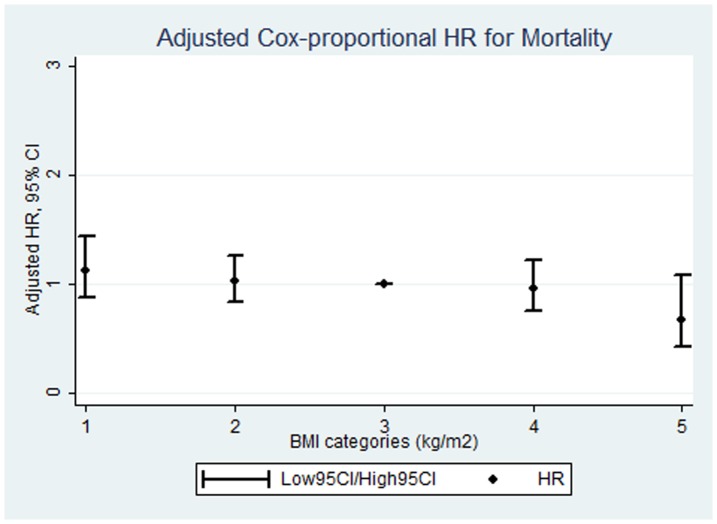
The median BMI was 22.6 (IQR 20.3 to 25.1). The percentages of patients with BMI<18.5, 18.5 to 22.9, 23.0 to 24.9, 25.0 to 29.9, and ≥30.0 were 12, 42.3, 19.9, 22.4, and 3.3%, respectively. The Cox-proportional hazard ratios with exact partial likelihood to handle tied failures for hospital mortality comparing the BMI categories <18.5, 18.5 to 22.9, 25.0 to 29.9, and ≥30.0 with the reference category were 1.13 (0.88 to 1.44), 1.03 (0.84 to 1.26), 0.96 (0.76 to 1.22), and 0.68 (0.43 to 1.08), respectively, with a highly significant test for trend (p = 0.02).
A graded inverse association between BMI and hospital mortality with a strong significant trend was found in critically ill patients in Korea.
在亚洲人群中,与危重症患者最低死亡率相关的体重指数(BMI)水平尚不确定。我们旨在研究韩国危重症患者的BMI与医院死亡率之间的关联。
我们对韩国22个重症监护病房(ICU)的3655例危重症患者进行了一项前瞻性多中心队列研究。BMI分为五组:<18.5、18.5至22.9、23.0至24.9(参考类别)、25.0至29.9和≥30.0kg/m²。
BMI中位数为22.6(四分位间距20.3至25.1)。BMI<18.5、18.5至22.9、23.0至24.9、25.0至29.9和≥30.0的患者百分比分别为12%、42.3%、19.9%、22.4%和3.3%。与参考类别相比,BMI类别<18.5、18.5至22.9、25.0至29.9和≥30.0的医院死亡率的Cox比例风险比及处理失败病例的精确偏似然比分别为1.13(0.88至1.44)、1.03(0.84至1.26)、0.96(0.76至1.22)和0.68(0.43至1.08),趋势检验具有高度显著性(p = 0.02)。
在韩国危重症患者中,发现BMI与医院死亡率之间存在分级负相关且趋势极为显著。