Bhojani Faiyaz A, Tsai Shan P, Wendt Judy K, Koller Kim L
Shell Oil Company, Shell Health, Houston, Texas, USA.
BMJ Open. 2014 Apr 19;4(4):e004788. doi: 10.1136/bmjopen-2014-004788.
To estimate the impact of trends in smoking and obesity prevalence on productivity loss among petrochemical employees from 1980 to 2009.
Smoking and obesity informations were collected during company physical examinations. Productivity loss was calculated as differential workdays lost between smokers and non-smokers, and obese and normal-weight employees.
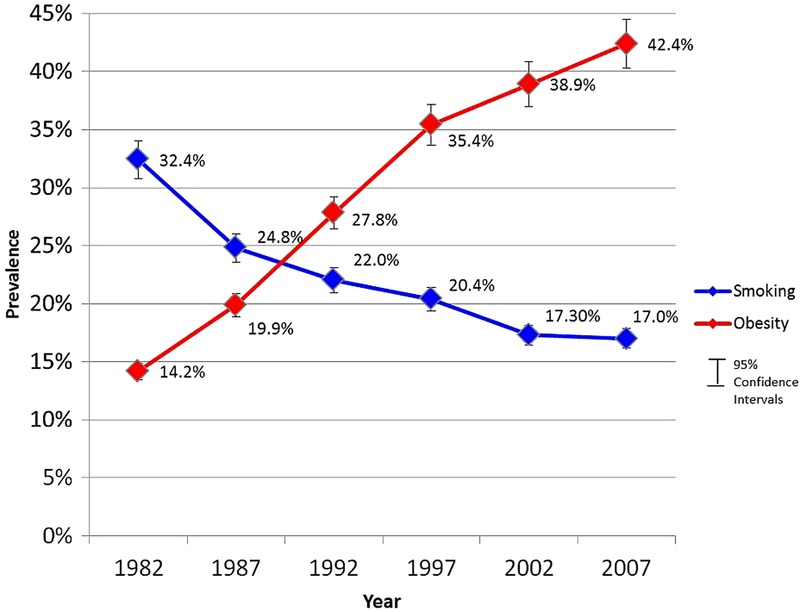
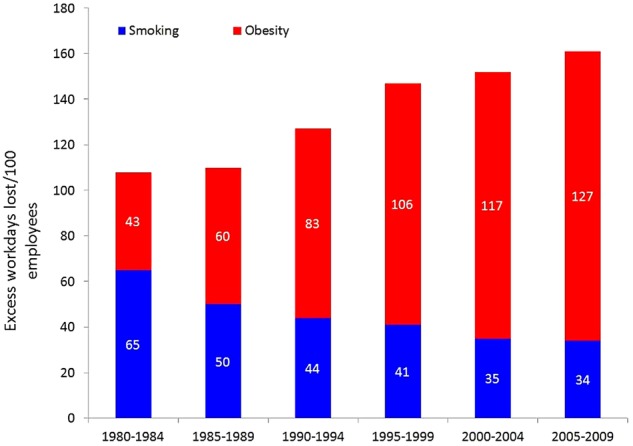
During 1980-2009, smoking prevalence decreased from 32% to 17%, while obesity prevalence increased from 14% to 42%. In 1982, lost productivity from obesity was an estimated 43 days/100 employees, and for smoking, 65 days/100 employees, but by 1987, workdays lost due to obesity exceeded that attributable to smoking. In 2007, workdays lost from obesity were 3.7 times higher than for smoking.
Owing to the increasing trend in obesity, the productivity impact on employers from obesity will continue to rise without effective measures supporting employee efforts to achieve healthy weight through sustainable lifestyle changes.
评估1980年至2009年吸烟率和肥胖患病率的变化趋势对石化企业员工生产力损失的影响。
在公司体检期间收集吸烟和肥胖信息。生产力损失通过计算吸烟者与非吸烟者、肥胖员工与正常体重员工之间的工作日差异来得出。
1980年至2009年期间,吸烟率从32%降至17%,而肥胖患病率从14%升至42%。1982年,肥胖导致的生产力损失估计为43天/100名员工,吸烟导致的为65天/100名员工,但到1987年,肥胖导致的工作日损失超过了吸烟所致。2007年,肥胖导致的工作日损失比吸烟高3.7倍。
由于肥胖呈上升趋势,若没有有效措施支持员工通过可持续的生活方式改变来实现健康体重,肥胖对雇主生产力的影响将持续上升。