Sarda Shrutii, Hannenhalli Sridhar
Center for Bioinformatics and Computational Biology, University of Maryland, College Park, MD 20740, USA.
Genomics Inform. 2014 Mar;12(1):2-11. doi: 10.5808/GI.2014.12.1.2. Epub 2014 Mar 31.
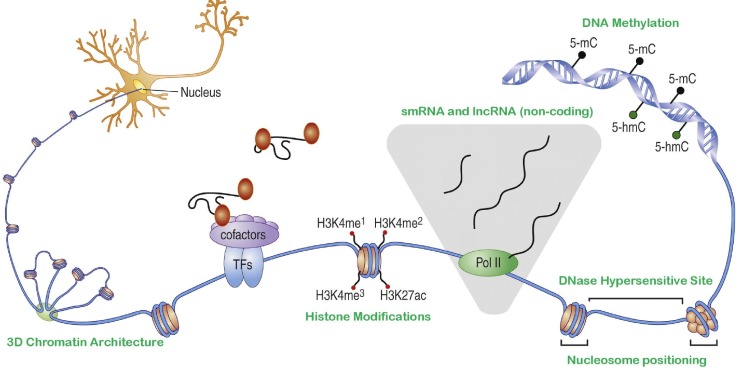
After the initial enthusiasm of the human genome project, it became clear that without additional data pertaining to the epigenome, i.e., how the genome is marked at specific developmental periods, in different tissues, as well as across individuals and species-the promise of the genome sequencing project in understanding biology cannot be fulfilled. This realization prompted several large-scale efforts to map the epigenome, most notably the Encyclopedia of DNA Elements (ENCODE) project. While there is essentially a single genome in an individual, there are hundreds of epigenomes, corresponding to various types of epigenomic marks at different developmental times and in multiple tissue types. Unprecedented advances in next-generation sequencing (NGS) technologies, by virtue of low cost and high speeds that continue to improve at a rate beyond what is anticipated by Moore's law for computer hardware technologies, have revolutionized molecular biology and genetics research, and have in turn prompted innovative ways to reduce the problem of measuring cellular events involving DNA or RNA into a sequencing problem. In this article, we provide a brief overview of the epigenome, the various types of epigenomic data afforded by NGS, and some of the novel discoveries yielded by the epigenomics projects. We also provide ample references for the reader to get in-depth information on these topics.
在人类基因组计划最初的热情过后,人们清楚地认识到,如果没有与表观基因组相关的额外数据,即基因组在特定发育阶段、不同组织以及个体和物种间是如何被标记的,那么基因组测序计划在理解生物学方面的前景就无法实现。这一认识促使了多项绘制表观基因组图谱的大规模努力,其中最著名的是DNA元件百科全书(ENCODE)计划。虽然个体中本质上只有一个基因组,但却有数百种表观基因组,它们对应着不同发育时期和多种组织类型中的各种表观基因组标记。凭借低成本和高速度(其提升速度持续超过计算机硬件技术的摩尔定律预期),新一代测序(NGS)技术取得了前所未有的进展,彻底改变了分子生物学和遗传学研究,进而促使人们采用创新方法将涉及DNA或RNA的细胞事件测量问题简化为测序问题。在本文中,我们简要概述了表观基因组、NGS提供的各类表观基因组数据,以及表观基因组学项目带来的一些新发现。我们还为读者提供了丰富的参考文献,以便他们获取这些主题的深入信息。