Hua Sansan, Ek C Joakim, Mallard Carina, Johansson Maria E
Department of Physiology, Institute of Neuroscience and Physiology, The Sahlgrenska Academy, University of Gothenburg, P.O. Box 432, 405 30 Gothenburg, Sweden.
Biomed Res Int. 2014;2014:718769. doi: 10.1155/2014/718769. Epub 2014 Mar 17.
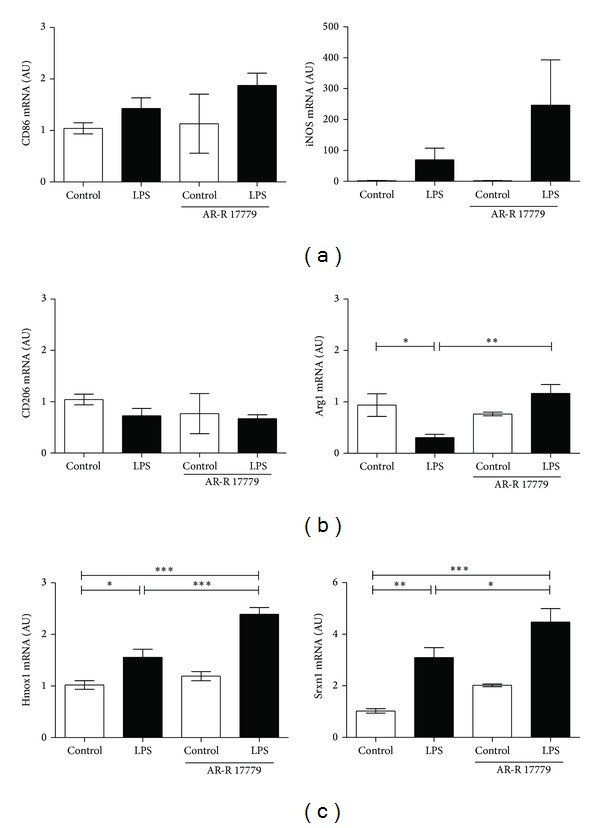
Inflammation plays a central role in neonatal brain injury. During brain inflammation the resident macrophages of the brain, the microglia cells, are rapidly activated. In the periphery, α 7 nicotinic acetylcholine receptors ( α 7R) present on macrophages can regulate inflammation by suppressing cytokine release. In the current study we investigated α 7R expression in neonatal mice after hypoxia-ischemia (HI). We further examined possible anti-inflammatory role of α 7R stimulation in vitro and microglia polarization after α 7R agonist treatment. Real-time PCR analysis showed a 33% reduction in α 7R expression 72 h after HI. Stimulation of primary microglial cells with LPS in combination with increasing doses of the selective α 7R agonist AR-R 17779 significantly attenuated TNF α release and increased α 7R transcript in microglial cells. Gene expression of M1 markers CD86 and iNOS, as well as M2 marker CD206 was not influenced by LPS and/or α 7R agonist treatment. Further, Mox markers heme oxygenase (Hmox1) and sulforedoxin-1 (Srx1) were significantly increased, suggesting a polarization towards the Mox phenotype after α 7R stimulation. Thus, our data suggest a role for the α 7R also in the neonatal brain and support the anti-inflammatory role of α 7R in microglia, suggesting that α 7R stimulation could enhance the polarization towards a reparative Mox phenotype.
炎症在新生儿脑损伤中起核心作用。在脑部炎症期间,脑内的常驻巨噬细胞,即小胶质细胞会迅速被激活。在周围组织中,巨噬细胞上存在的α7烟碱型乙酰胆碱受体(α7R)可通过抑制细胞因子释放来调节炎症。在本研究中,我们调查了缺氧缺血(HI)后新生小鼠体内α7R的表达情况。我们还进一步研究了α7R刺激在体外的可能抗炎作用以及α7R激动剂处理后的小胶质细胞极化情况。实时定量PCR分析显示,HI后72小时α7R表达降低了33%。用脂多糖(LPS)联合递增剂量的选择性α7R激动剂AR-R 17779刺激原代小胶质细胞,可显著减弱肿瘤坏死因子α(TNFα)的释放,并增加小胶质细胞中α7R转录本的表达。M1标志物CD86和诱导型一氧化氮合酶(iNOS)以及M2标志物CD206的基因表达不受LPS和/或α7R激动剂处理的影响。此外,Mox标志物血红素加氧酶(Hmox1)和硫氧还蛋白-1(Srx1)显著增加,表明α7R刺激后向Mox表型极化。因此,我们的数据表明α7R在新生脑中也发挥作用,并支持α7R在小胶质细胞中的抗炎作用,提示α7R刺激可增强向修复性Mox表型的极化。