Neurobiology Research Unit, Copenhagen University Hospital, Rigshospitalet, DK-2100 Copenhagen, Denmark.
Department of Brain Sciences, Imperial College London, London W12 0 LS, UK.
Molecules. 2020 Mar 20;25(6):1425. doi: 10.3390/molecules25061425.
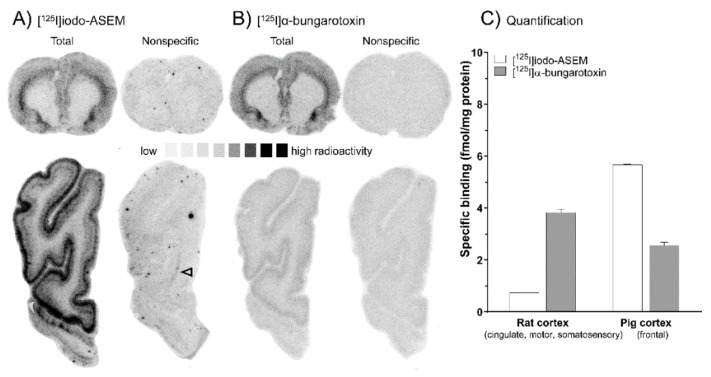
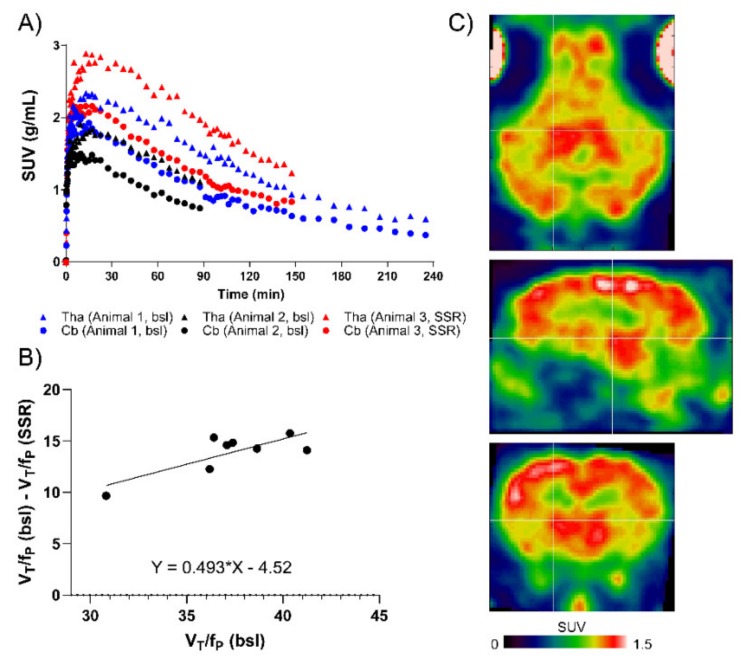
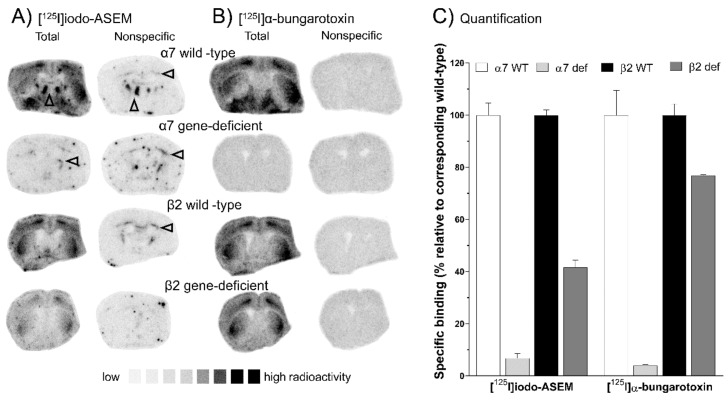
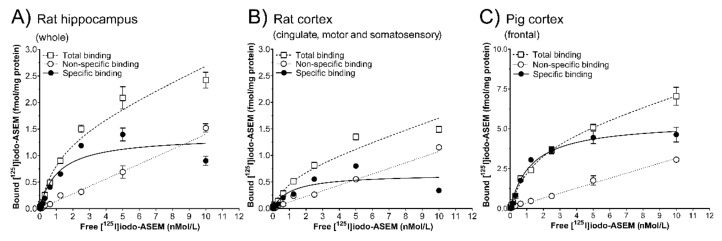
The α7 nicotinic acetylcholine receptor (α7 nAChR) is involved in several cognitive and physiologic processes; its expression levels and patterns change in neurologic and psychiatric diseases, such as schizophrenia and Alzheimer's disease, which makes it a relevant drug target. Development of selective radioligands is important for defining binding properties and occupancy of novel molecules targeting the receptor. We tested the in vitro binding properties of [I]Iodo-ASEM [(3-(1,4-diazabycyclo[3.2.2]nonan-4-yl)-6-(I-iododibenzo[b,d]thiopentene 5,5-dioxide)] in the mouse, rat and pig brain using autoradiography. The in vivo binding properties of [F]ASEM were investigated using positron emission tomography (PET) in the pig brain. [I]Iodo-ASEM showed specific and displaceable high affinity (~1 nM) binding in mouse, rat, and pig brain. Binding pattern overlapped with [I]α-bungarotoxin, specific binding was absent in α7 nAChR gene-deficient mice and binding was blocked by a range of α7 nAChR orthosteric modulators in an affinity-dependent order in the pig brain. Interestingly, relative to the wild-type, binding in β2 nAChR gene-deficient mice was lower for [I]Iodo-ASEM (58% ± 2.7%) than [I]α-bungarotoxin (23% ± 0.2%), potentially indicating different binding properties to heteromeric α7β2 nAChR. [F]ASEM PET in the pig showed high brain uptake and reversible tracer kinetics with a similar spatial distribution as previously reported for α7 nAChR. Blocking with SSR-180,711 resulted in a significant decrease in [F]ASEM binding. Our findings indicate that [I]Iodo-ASEM allows sensitive and selective imaging of α7 nAChR in vitro, with better signal-to-noise ratio than previous tracers. Preliminary data of [F]ASEM in the pig brain demonstrated principal suitable kinetic properties for in vivo quantification of α7 nAChR, comparable to previously published data.
α7 烟碱型乙酰胆碱受体 (α7 nAChR) 参与多种认知和生理过程;其表达水平和模式在神经和精神疾病中发生变化,如精神分裂症和阿尔茨海默病,这使其成为相关的药物靶点。开发选择性放射性配体对于定义新型靶向受体的分子的结合特性和占有率非常重要。我们使用放射自显影法在小鼠、大鼠和猪脑中测试了 [I]碘代-ASEM [(3-(1,4-二氮杂双环[3.2.2]壬烷-4-基)-6-(碘二苯并[b,d]噻吩戊烯 5,5-二氧化物)]的体外结合特性。使用正电子发射断层扫描 (PET) 在猪脑中研究了 [F]ASEM 的体内结合特性。[I]碘代-ASEM 在小鼠、大鼠和猪脑中表现出特异性和可置换的高亲和力(~1 nM)结合。结合模式与 [I]α-银环蛇毒素重叠,在 α7 nAChR 基因缺失小鼠中不存在特异性结合,并且在猪脑中以亲和力依赖性顺序用一系列 α7 nAChR 变构调节剂阻断。有趣的是,与野生型相比,β2 nAChR 基因缺失小鼠中 [I]碘代-ASEM 的结合(58%±2.7%)低于 [I]α-银环蛇毒素(23%±0.2%),这可能表明与异源 α7β2 nAChR 的结合特性不同。在猪脑中的 [F]ASEM PET 显示出高脑摄取和可逆转的示踪剂动力学,与先前报道的 α7 nAChR 的空间分布相似。用 SSR-180,711 阻断导致 [F]ASEM 结合的显著减少。我们的研究结果表明,[I]碘代-ASEM 允许在体外对 α7 nAChR 进行敏感和选择性成像,与以前的示踪剂相比具有更好的信噪比。在猪脑中的 [F]ASEM 的初步数据表明了用于体内定量测定 α7 nAChR 的主要合适的动力学特性,与以前发表的数据相当。