Jiang Shoufang, Su Jing, Yao Sanqiao, Zhang Yanshu, Cao Fuyuan, Wang Fei, Wang Huihui, Li Jun, Xi Shuhua
Department of Occupational and Environmental Health, Liaoning Provincial Key Lab of Arsenic Biological Effect and Poisoning, School of Public Health, China Medical University, Shenyang, Liaoning, P. R. China; Department of Occupational and Environmental Health, Hebei Province Key Laboratory of Occupational Health and Safety for Coal Industry, School of Public Health, Hebei United University, Tangshan, Hebei, P. R. China.
Department of Occupational and Environmental Health, Hebei Province Key Laboratory of Occupational Health and Safety for Coal Industry, School of Public Health, Hebei United University, Tangshan, Hebei, P. R. China.
PLoS One. 2014 Apr 23;9(4):e96041. doi: 10.1371/journal.pone.0096041. eCollection 2014.
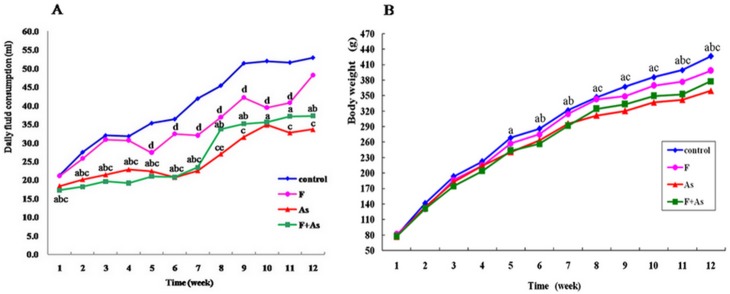
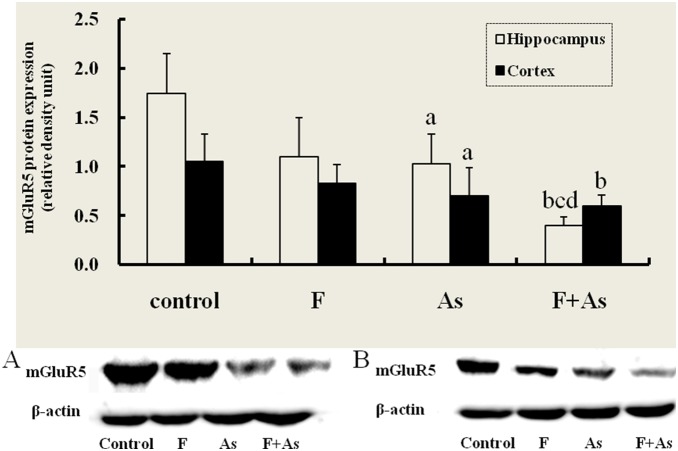
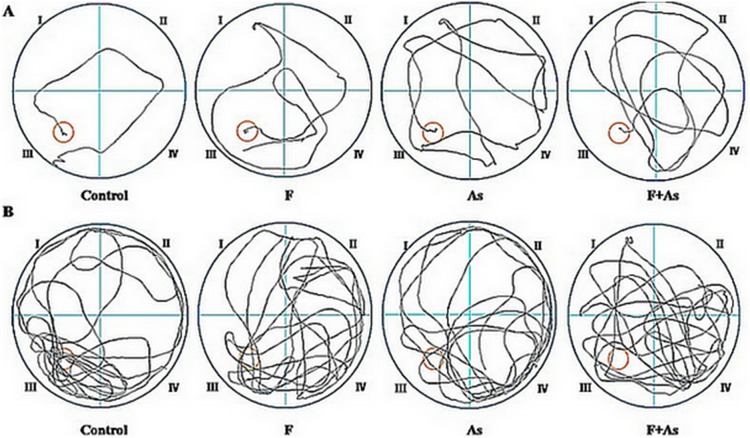
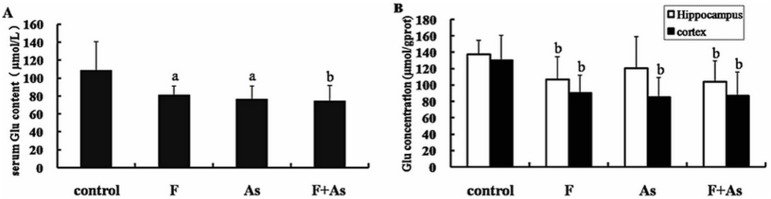
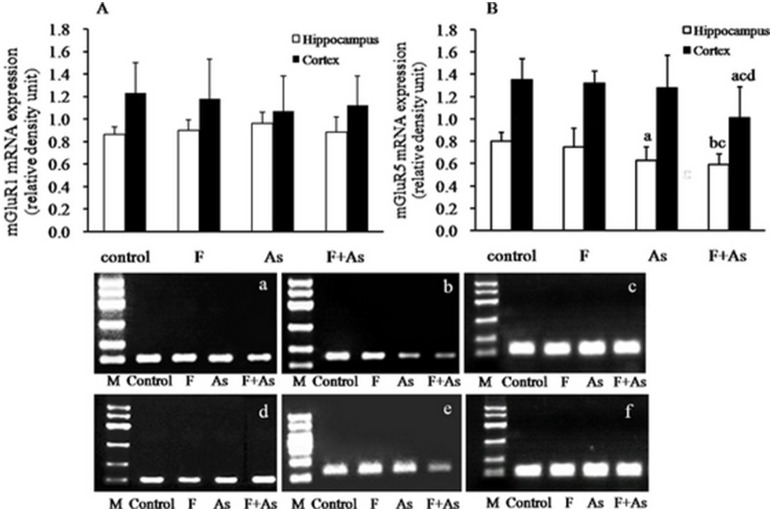
Fluoride and arsenic are two common inorganic contaminants in drinking water that are associated with impairment in child development and retarded intelligence. The present study was conducted to explore the effects on spatial learning, memory, glutamate levels, and group I metabotropic glutamate receptors (mGluRs) expression in the hippocampus and cortex after subchronic exposure to fluoride, arsenic, and a fluoride and arsenic combination in rats. Weaned male Sprague-Dawley rats were assigned to four groups. The control rats drank tap water. Rats in the three exposure groups drank water with sodium fluoride (120 mg/L), sodium arsenite (70 mg/L), and a sodium fluoride (120 mg/L) and sodium arsenite (70 mg/L) combination for 3 months. Spatial learning and memory was measured in Morris water maze. mGluR1 and mGluR5 mRNA and protein expression in the hippocampus and cortex was detected using RT-PCR and Western blot, respectively. Compared with controls, learning and memory ability declined in rats that were exposed to fluoride and arsenic both alone and combined. Combined fluoride and arsenic exposure did not have a more pronounced effect on spatial learning and memory compared with arsenic and fluoride exposure alone. Compared with controls, glutamate levels decreased in the hippocampus and cortex of rats exposed to fluoride and combined fluoride and arsenic, and in cortex of arsenic-exposed rats. mGluR5 mRNA and protein expressions in the hippocampus and mGluR5 protein expression in the cortex decreased in rats exposed to arsenic alone. Interestingly, compared with fluoride and arsenic exposure alone, fluoride and arsenic combination decreased mGluR5 mRNA expression in the cortex and protein expression in the hippocampus, suggesting a synergistic effect of fluoride and arsenic. These data indicate that fluoride and arsenic, either alone or combined, can decrease learning and memory ability in rats. The mechanism may be associated with changes of glutamate level and mGluR5 expression in cortex and hippocampus.
氟化物和砷是饮用水中两种常见的无机污染物,与儿童发育受损和智力发育迟缓有关。本研究旨在探讨大鼠亚慢性暴露于氟化物、砷以及氟化物与砷的组合后,对其空间学习、记忆、海马体和皮质中谷氨酸水平以及I组代谢型谷氨酸受体(mGluRs)表达的影响。将断奶的雄性Sprague-Dawley大鼠分为四组。对照组大鼠饮用自来水。三个暴露组的大鼠分别饮用含氟化钠(120毫克/升)、亚砷酸钠(70毫克/升)以及氟化钠(120毫克/升)与亚砷酸钠(70毫克/升)组合的水,持续3个月。通过莫里斯水迷宫测量空间学习和记忆能力。分别使用逆转录聚合酶链反应(RT-PCR)和蛋白质免疫印迹法检测海马体和皮质中mGluR1和mGluR5的信使核糖核酸(mRNA)及蛋白质表达。与对照组相比,单独暴露于氟化物和砷以及同时暴露于两者的大鼠学习和记忆能力下降。与单独暴露于砷和氟化物相比,同时暴露于氟化物和砷对空间学习和记忆的影响并无更显著差异。与对照组相比,暴露于氟化物、同时暴露于氟化物和砷的大鼠海马体和皮质以及暴露于砷的大鼠皮质中的谷氨酸水平降低。单独暴露于砷的大鼠海马体中mGluR5的mRNA和蛋白质表达以及皮质中mGluR5的蛋白质表达下降。有趣的是,与单独暴露于氟化物和砷相比,同时暴露于氟化物和砷会降低皮质中mGluR5的mRNA表达以及海马体中mGluR5的蛋白质表达,表明氟化物和砷存在协同作用。这些数据表明,氟化物和砷单独或联合作用均可降低大鼠的学习和记忆能力。其机制可能与皮质和海马体中谷氨酸水平及mGluR5表达的变化有关。