Faculty of Health, York University, Ontario, Canada.
Faculty of Health, York University, Ontario, Canada.
Environ Res. 2021 Sep;200:111315. doi: 10.1016/j.envres.2021.111315. Epub 2021 May 27.
Fluoride has been associated with IQ deficits during early brain development, but the period in which children are most sensitive is unknown.
We assessed effects of fluoride on IQ scores across prenatal and postnatal exposure windows.
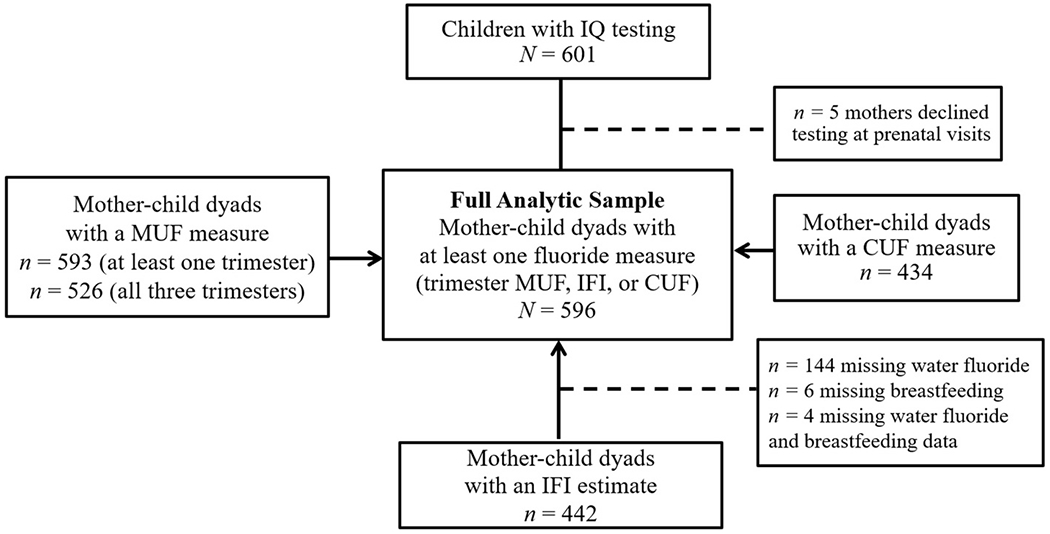
We used repeated exposures from 596 mother-child pairs in the Maternal-Infant Research on Environmental Chemicals pregnancy and birth cohort. Fluoride was measured in urine (mg/L) collected from women during pregnancy and in their children between 1.9 and 4.4 years; urinary fluoride was adjusted for specific gravity. We estimated infant fluoride exposure (mg/day) using water fluoride concentration and duration of formula-feeding over the first year of life. Intelligence was assessed at 3-4 years using the Wechsler Preschool and Primary Scale of Intelligence-III. We used generalized estimating equations to examine the associations between fluoride exposures and IQ, adjusting for covariates. We report results based on standardized exposures given their varying units of measurement.
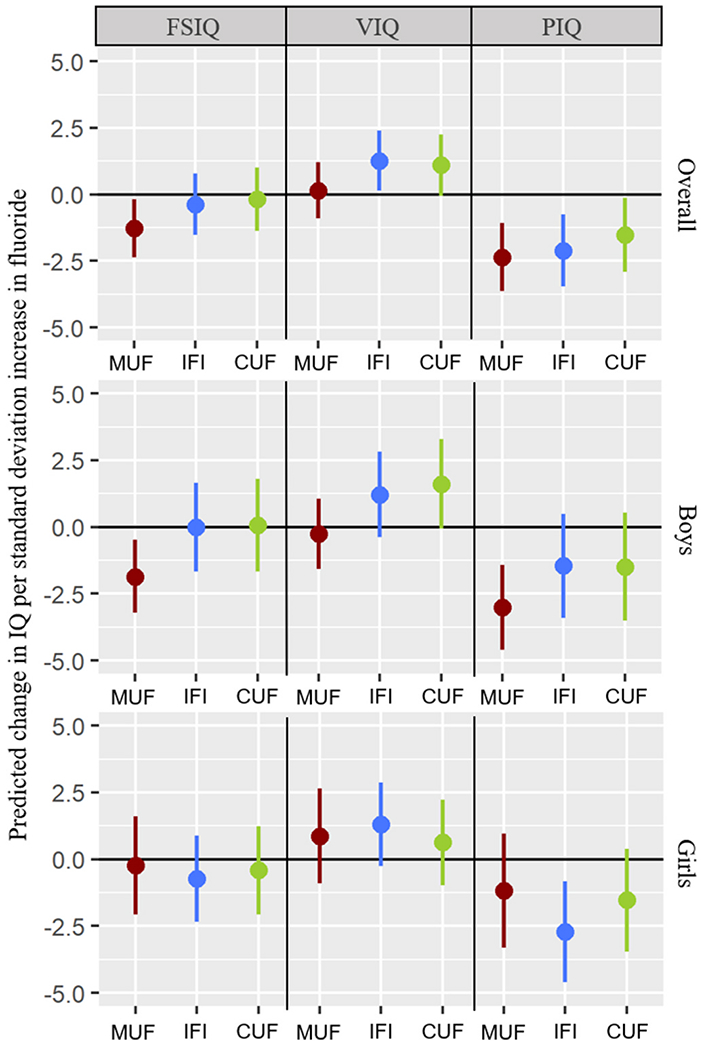
The association between fluoride and performance IQ (PIQ) significantly differed across prenatal, infancy, and childhood exposure windows collapsing across child sex (p = .001). The strongest association between fluoride and PIQ was during the prenatal window, B = -2.36, 95% CI: -3.63, -1.08; the association was also significant during infancy, B = -2.11, 95% CI: -3.45, -0.76, but weaker in childhood, B = -1.51, 95% CI: -2.90, -0.12. Within sex, the association between fluoride and PIQ significantly differed across the three exposure windows (boys: p = .01; girls: p = .01); among boys, the strongest association was during the prenatal window, B = -3.01, 95% CI: -4.60, -1.42, whereas among girls, the strongest association was during infancy, B = -2.71, 95% CI: -4.59, -0.83. Full-scale IQ estimates were weaker than PIQ estimates for every window. Fluoride was not significantly associated with Verbal IQ across any exposure window.
Associations between fluoride exposure and PIQ differed based on timing of exposure. The prenatal window may be critical for boys, whereas infancy may be a critical window for girls.
氟化物与早期大脑发育期间的智商缺陷有关,但儿童最敏感的时期尚不清楚。
我们评估了氟化物在产前和产后暴露窗口期对智商得分的影响。
我们使用了来自母婴环境化学物质研究中的 596 对母婴的重复暴露数据,该研究是在 Maternal-Infant Research on Environmental Chemicals 妊娠和出生队列中进行的。在怀孕期间,我们从女性尿液中(mg/L)测量了氟化物,在儿童 1.9 至 4.4 岁之间也测量了氟化物;尿液中的氟化物按比重进行了调整。我们根据婴儿在第一年中配方奶喂养的时间和水中的氟化物浓度,估算了婴儿的氟化物暴露量(mg/天)。在 3-4 岁时,我们使用韦氏学前和小学智力量表 III 评估了智力。我们使用广义估计方程,在调整协变量的基础上,检验了氟化物暴露与智商之间的关系。我们根据标准化暴露值(由于其测量单位不同)报告结果。
氟化物与表现智商(PIQ)之间的关联在产前、婴儿期和儿童期的暴露窗口期之间存在显著差异,这在跨性别时是一致的(p=0.001)。氟化物与 PIQ 之间最强的关联是在产前窗口期,B 值为-2.36,95%CI:-3.63,-1.08;在婴儿期也存在显著关联,B 值为-2.11,95%CI:-3.45,-0.76,但在儿童期较弱,B 值为-1.51,95%CI:-2.90,-0.12。在性别内,氟化物与 PIQ 之间的关联在三个暴露窗口期之间存在显著差异(男孩:p=0.01;女孩:p=0.01);在男孩中,最强的关联是在产前窗口期,B 值为-3.01,95%CI:-4.60,-1.42,而在女孩中,最强的关联是在婴儿期,B 值为-2.71,95%CI:-4.59,-0.83。在每个窗口期,全量表智商估计值都弱于 PIQ 估计值。氟化物与任何暴露窗口期的言语智商均无显著关联。
氟化物暴露与 PIQ 之间的关联取决于暴露的时间。产前窗口期可能对男孩至关重要,而婴儿期可能对女孩是一个关键窗口。