Ulbrecht Jan S, Hurley Timothy, Mauger David T, Cavanagh Peter R
Department of BioBehavioral Health, Pennsylvania State University, University Park, PADepartment of Medicine, Pennsylvania State University, State College, PAMount Nittany Health System, State College, PADIApedia LLC, State College, PA.
DIApedia LLC, State College, PA.
Diabetes Care. 2014 Jul;37(7):1982-9. doi: 10.2337/dc13-2956. Epub 2014 Apr 23.
To assess the efficacy of in-shoe orthoses that were designed based on shape and barefoot plantar pressure in reducing the incidence of submetatarsal head plantar ulcers in people with diabetes, peripheral neuropathy, and a history of similar prior ulceration.
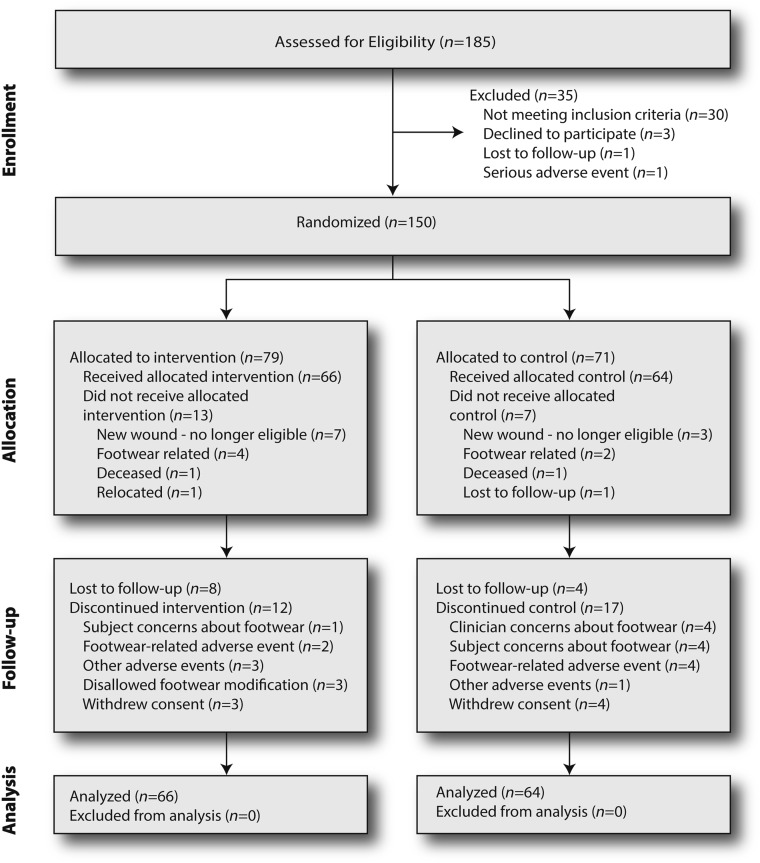
Single-blinded multicenter randomized controlled trial with subjects randomized to wear shape- and pressure-based orthoses (experimental, n = 66) or standard-of-care A5513 orthoses (control, n = 64). Patients were followed for 15 months, until a study end point (forefoot plantar ulcer or nonulcerative plantar forefoot lesion) or to study termination. Proportional hazards regression was used for analysis.
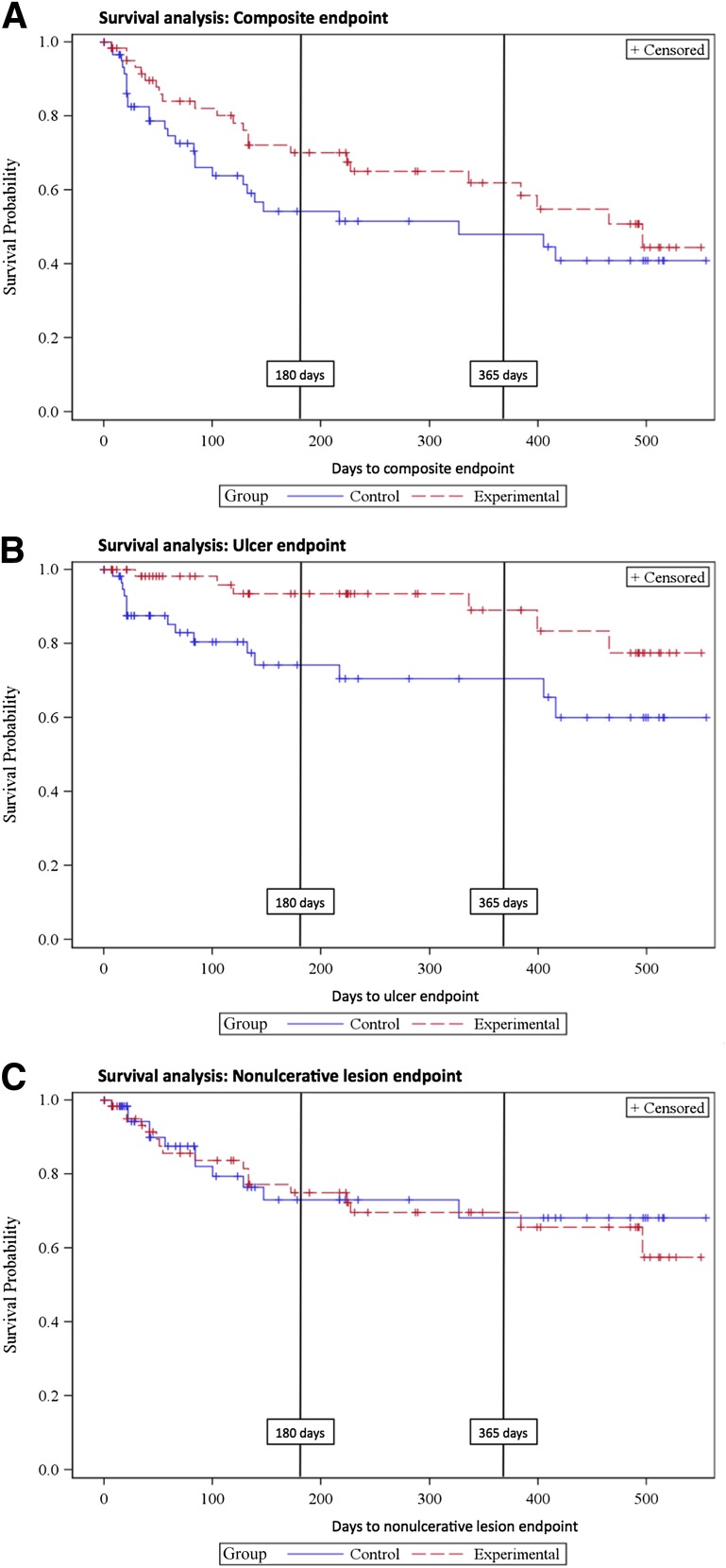
There was a trend in the composite primary end point (both ulcers and nonulcerative lesions) across the full follow-up period (P = 0.13) in favor of the experimental orthoses. This trend was due to a marked difference in ulcer occurrence (P = 0.007) but no difference in the rate of nonulcerative lesions (P = 0.76). At 180 days, the ulcer prevention effect of the experimental orthoses was already significant (P = 0.003) when compared with control, and the benefit of the experimental orthoses with respect to the composite end point was also significant (P = 0.042). The hazard ratio was 3.4 (95% CI 1.3-8.7) for the occurrence of a submetatarsal head plantar ulcer in the control compared with experimental arm over the duration of the study.
We conclude that shape- and barefoot plantar pressure-based orthoses were more effective in reducing submetatarsal head plantar ulcer recurrence than current standard-of-care orthoses, but they did not significantly reduce nonulcerative lesions.
评估基于形状和赤足足底压力设计的鞋垫式矫形器在降低糖尿病、周围神经病变且既往有类似溃疡病史患者跖骨头足底溃疡发生率方面的疗效。
单盲多中心随机对照试验,受试者随机分为穿戴基于形状和压力的矫形器(试验组,n = 66)或标准护理A5513矫形器(对照组,n = 64)。对患者进行15个月的随访,直至达到研究终点(前足足底溃疡或非溃疡性前足足底病变)或研究终止。采用比例风险回归进行分析。
在整个随访期内,复合主要终点(溃疡和非溃疡性病变)存在有利于试验组矫形器的趋势(P = 0.13)。这种趋势是由于溃疡发生率存在显著差异(P = 0.007),而非溃疡性病变发生率无差异(P = 0.76)。在180天时,与对照组相比,试验组矫形器的溃疡预防效果已经显著(P = 0.003),且试验组矫形器在复合终点方面的益处也很显著(P = 0.042)。在研究期间,对照组与试验组相比,跖骨头足底溃疡发生的风险比为3.4(95%CI 1.3 - 8.7)。
我们得出结论,基于形状和赤足足底压力的矫形器在降低跖骨头足底溃疡复发方面比当前标准护理矫形器更有效,但它们并未显著减少非溃疡性病变。